
Campaigns clash over use of AI in Toronto mayoral race
Campaigns clash over use of AI in Toronto mayoral race
Brad Bradford's campaign defends use of AI app to engage with campaign supporters
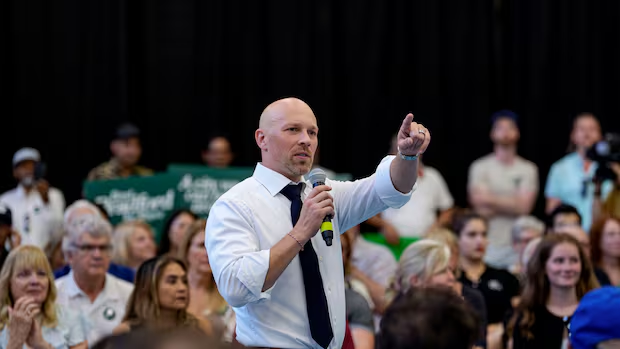
A Toronto mayoral candidate is defending his campaign’s use of artificial intelligence, but experts in the emerging technology say while it could act as an equalizer for under-resourced teams, it's no substitute for the human element of traditional voter persuasion.
Coun. Brad Bradford has come under criticism from other candidates after a National Observer story last week revealed his campaign is using an AI app to supply online talking points to supporters. The story also alleges the app rewards users for posting social media comments and sharing their phone contacts with his campaign.
On Monday, Bradford denied users of the app receive any rewards for posting AI-generated messages on behalf of his campaign.
“There's no rewards, there's no facetime, there's nothing like that,” Bradford said. “We are using a campaign app, just like Olivia Chow's campaign is using a campaign app, and what we're doing is making sure that we're connecting with voters. ”
Olivia Chow vs. Brad Bradford: The fight over Toronto's property taxes
Bradford’s team said in a statement to CBC News that the app's suggested comments and messaging feature helps supporters share their views with their networks. But every comment is “reviewed, edited and always posted by a real person — the supporter, from their own account, under their own name.
"Suggested content is created by volunteers on our team, not AI,” campaign spokesperson Laryssa Waler said in a statement.
“It's no different from a campaign handing out talking points, literature and lawn signs — just faster."
Chow campaign said it does not use AI
The disclosure from the Bradford campaign has prompted debate amongst the city’s top mayoral candidates and disclosures about their own AI use.
Waler said Bradford’s team is not alone in using the technology, pointing to Mayor Olivia Chow’s campaigns use of Nationbuilder — organizing software Bradford's team said has AI elements built into it.
But Chow’s team said it does not use apps that ask people to surrender their personal information, and that it has shut off AI features on any software that utilizes it.
“The Olivia Chow campaign hires designers, videographers and writers as part of our campaign team, and we hope any online feedback we receive are real people providing real comments," Chow's campaign spokesperson Zeus Eden said in a statement.
Chow promises bad landlord task force if re-elected as Toronto mayor
Brad Bradford promises property tax freeze if elected Toronto mayor
Chris Alexander said his campaign uses AI for some research, but verifies sources before making conclusions. His team also uses it for spelling and grammar checks, he said in a statement to CBC News.
“We have spent years trying to work out which parts of what city hall said are true and trust in this city is already thin and no one should get messaging or information that depends on algorithms and machines," Alexander said.
Concerns AI apps can distort online debate
That AI is being utilized by campaigns at the municipal level isn’t a surprise, said Anatoliy Gruzd, professor of information technology management at Toronto Metropolitan University. It’s relatively low cost and can increase a campaign’s reach to its supporters and to voters, he said.
The concern with AI apps that engage supporters is that they’ll be used to distort online debate and supply voters with misinformation, said Gruzd, co-director of the TMU’s Social Media Lab.
For example, he said the apps can be used to organize a social media "mob" post a specific message for a candidate, but represent a minority of online users.
“It creates an illusion of consensus on a particular issue when the consensus may not exist, or maybe the majority actually thinks otherwise,” he said.
McGill University public policy professor Aengus Bridgman said society is moving from a pre-AI world to one in which the technology is normalized.
“The problem is that AI models are often misleading,” said Bridgman who is a director at McGill’s Media Ecosystem Observatory. “They are often producing content that is inaccurate and then it's being given the veneer of credibility that is undeserved.”
Former MP Chris Alexander enters Toronto's mayoral race
Candidates spar over transit, public safety at Toronto’s 1st mayoral debate
Alex Marland, a politics professor at Acadia University, who studies campaigning, said AI use itself is becoming a thorny issue for candidates and their campaigns. If voters don’t trust AI, they’ll ask themselves whether or not they can trust a candidate who uses it, he said.
AI could level playing field for some campaigns: expert
But use of AI by a campaign is not unethical, Marland said. Instead, it comes down to how the technology is applied.
“To somehow suggest that using AI in the Toronto municipal campaign is a bad thing, I would suggest is an absolute overreach, and it's also not fair to campaigns that have fewer resources,” he said. “But to use AI in a manner that is denigrating your opponents, that's where the line really gets crossed.”
Marland likens the shift being experienced with AI to other large technological advances and the impact they’ve had on political campaigns over the decades. When television advertising was first used by political campaigns, there were fears it would wield an inordinate influence on voters, he said.
“It was the hypodermic needle effect, and it was this fear that advertising in broadcasting was almost like taking a syringe and putting messages into their brain,” he said.
New Toronto mayoral poll suggests most want property taxes cut, frozen or below inflation
Toronto's 2026 mayoral election: What citizens and candidates are focused on
Political organizer and consultant Brett Thalmann said AI is used by campaigns for a variety of purposes including content generation, data analysis and voter identification. He founded the Next Campaign Summit, an non-partisan annual conference in Toronto designed to talk about the latest in campaign technologies, including AI tools.
He also understands why voters are skeptical of AI and said campaigns will need to be mindful about disclosing how it’s used by their teams.
“Authenticity in politics is critical, and using AI to generate communications products and content that voters would see directly and interact with, I think, is something that campaigns need to be careful about,” said Thalmann, founder of Nexus Strategies Group.
Marland agrees, and said technology won’t replace the basic ways campaigns need to reach and persuade voters.
“The reality is, you cannot replace the human touch,” he said. “It doesn't matter who you are, how you're using AI. You need to be getting on the doorsteps, knocking on doors, making a connection with voters. That's how you're going to win campaigns.”
Shawn Jeffords is a Provincial Affairs Reporter covering Queen's Park for CBC Toronto. He has previously covered Toronto City Hall for CBC and the Ontario Legislature for The Canadian Press. You can reach him by emailing shawn.jeffords@cbc.ca.
Related Stories
 AI News
OpenAI's new AI tool was too capable. Now its release is delayed
12 minutes ago
 AI News
New AI
13 minutes ago
 AI News
Mining Forum: AI starts paying off, McKinsey says
13 minutes ago
 AI News
e& Egypt CEO says AI must deliver cost
42 minutes ago
 AI News
American Cardinal McElroy explores a Church for the Digital Age
1 hour ago
 AI News
The Limits of the Nuclear Analogy in Frontier Artificial Intelligence Governance
1 hour ago
 AI News
UK Gains Access To Ukrainian Battlefield Artificial Intelligence Training Data - Overt Defense -
1 hour ago
 AI News
OpenAI scraps launch of latest model over security concerns
1 hour ago