
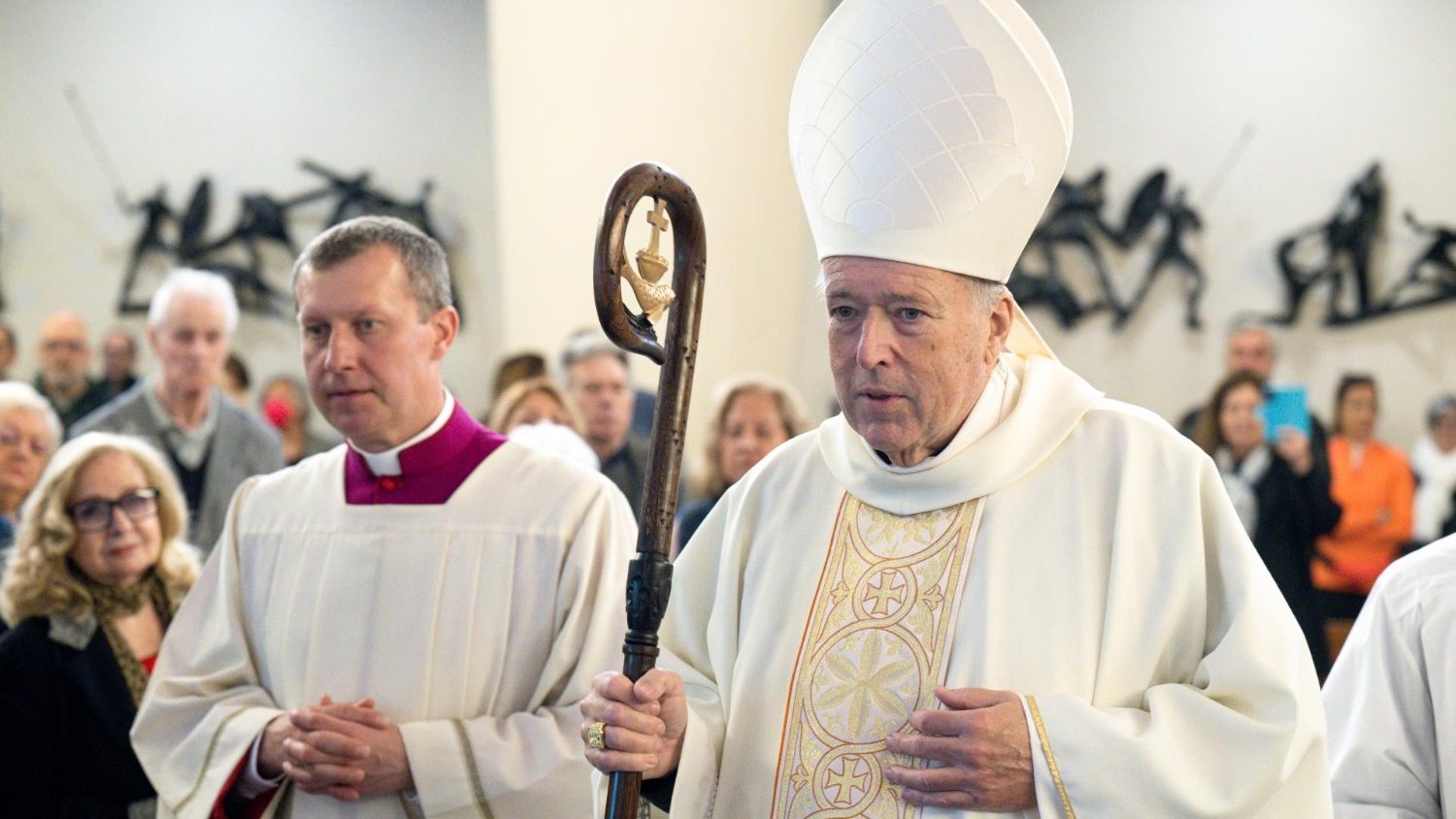
American Cardinal McElroy explores a Church for the Digital Age
American Cardinal McElroy explores a Church for the Digital Age
Over the past weekend, Cardinal Robert McElroy, Archbishop of Washington, D.C., addressed two of the defining challenges of our age: the rapid emergence of artificial intelligence and the treatment of migrants and refugees.
In both addresses, the Cardinal returned to the same fundamental question: What kind of society are we becoming, and how do we ensure that human dignity remains at its center?
Speaking on September 26 at St. Anselm Abbey for the 52nd Thomas Verner Moore Lecture, Cardinal McElroy delivered a lecture on Pope Leo XIV’s encyclical Magnifica Humanitas, exploring the moral implications of artificial intelligence and the digital revolution.
The following evening, at the Cathedral of St. Matthew the Apostle, he preached at the Mass commemorating the 112th World Day of Migrants and Refugees, urging Catholics to confront the suffering of migrants rather than “pass on by” like the priest and Levite in the parable of the Good Samaritan.
Together, the two addresses offered a reflection on Catholic social teaching in a moment of cultural change.
The human person before technology
In his lecture, Cardinal McElroy argued that the Church must engage actively in the global conversation surrounding artificial intelligence.
Drawing extensively from Magnifica Humanitas, he emphasized that technological progress cannot be evaluated solely by efficiency, innovation, or economic gain. Instead, it must be measured by its impact on the human person.
The Cardinal highlighted six foundational principles of Catholic social doctrine – human dignity, the common good, the universal destination of goods, subsidiarity, solidarity, and social justice – as essential guides for evaluating emerging technologies.
He warned against what Pope Leo calls the “technocratic paradigm,” a mindset that places excessive trust in technological power while neglecting moral responsibility.
Such an approach, Cardinal McElroy argued, risks reducing human beings to data points, consumers, or economic units rather than persons created in the image of God.
For the Cardinal, the central challenge is not whether technology will advance – it undoubtedly will – but whether humanity will possess the wisdom to direct that advancement toward authentic human flourishing.
A call for a broader conversation
One of the most striking themes of the lecture was Cardinal McElroy’s insistence that decisions about the future of artificial intelligence cannot be left solely to technology companies, researchers, or governments.
Instead, he called for what he described as a “social contract for the digital world,” bringing together workers, business leaders, universities, religious communities, government officials, and representatives of the poor and marginalized.
The digital revolution, he suggested, raises questions that touch nearly every aspect of human life: employment, privacy, education, warfare, family relationships, and even our understanding of truth itself.
At stake is not simply the development of new tools, but the shape of the civilization those tools will help create.
Seeing the neighbor at the side of the road
If the AI lecture examined the future, Cardinal McElroy’s homily on World Day of Migrants and Refugees focused on an urgent moral challenge in the present.
Reflecting on the parable of the Good Samaritan, he argued that the temptation facing Americans today is the same temptation faced by the priest and Levite in the Gospel: to see suffering, recognize it, and then look away.
The Cardinal rooted his reflection in two traditions. The first was the biblical command, found throughout Scripture, to care for the stranger, the widow, and the orphan. The second was America’s own history as a nation shaped by immigrants seeking freedom, opportunity, and refuge.
Throughout the homily, Cardinal McElroy repeatedly returned to the image of crossing to the other side of the road and passing by.
He challenged Catholics and the broader public to examine whether they have become accustomed to the suffering of migrants, families facing deportation, and communities living in fear.
His central contention was that Christian discipleship requires more than observation or sympathy. Like the Good Samaritan, believers are called to draw near, bind wounds, and assume responsibility for the suffering they encounter.
Whether discussing artificial intelligence or immigration, Cardinal McElroy’s message remained consistent: the future must be shaped by solidarity rather than exclusion, by moral responsibility rather than indifference, and by a recognition that every human person bears an inviolable dignity.
In a culture increasingly defined by technological disruption and political division, Cardinal McElroy’s reflections over the weekend offered a reminder that the Church’s first question is not what is possible, but what serves the human person.
The answer to that question, he suggested, will determine not only the future of technology or immigration policy, but the moral character of the society we are building together.
Related Stories
 AI News
OpenAI's new AI tool was too capable. Now its release is delayed
12 minutes ago
 AI News
New AI
12 minutes ago
 AI News
Mining Forum: AI starts paying off, McKinsey says
13 minutes ago
 AI News
e& Egypt CEO says AI must deliver cost
42 minutes ago
 AI News
The Limits of the Nuclear Analogy in Frontier Artificial Intelligence Governance
1 hour ago
 AI News
UK Gains Access To Ukrainian Battlefield Artificial Intelligence Training Data - Overt Defense -
1 hour ago
 AI News
Campaigns clash over use of AI in Toronto mayoral race
1 hour ago
 AI News
OpenAI scraps launch of latest model over security concerns
1 hour ago