
U.S. bans on Canadian booze hit producers on one of trade war's thorniest fronts
U.S. bans on Canadian booze hit producers on one of trade war's thorniest fronts
As of 12:01 a.m., some Canadian products, including dairy, motorcycles and booze, can no longer cross border
New U.S. import ban takes aim at Canadian alcohol
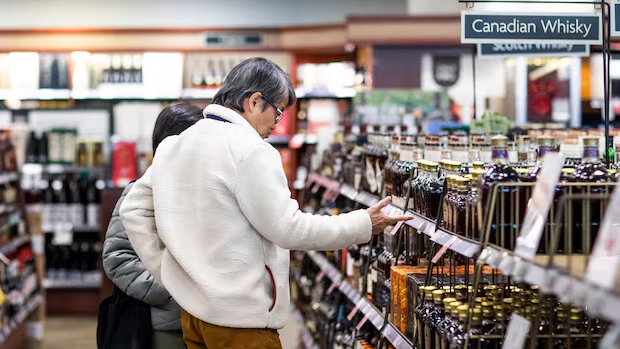
Distiller James Lester has grown used to the on-again, off-again chaos of the trade war, but he's now grappling with a new kind of treatment — being shut out of the U.S. market altogether.
"It's a little sad, to be honest," said Lester, founder and operator of B.C.-based distillery Sons of Vancouver.
As of Tuesday at 12:01 a.m. ET, U.S. bans are in effect on some Canadian alcohol products, dairy byproducts, motorcycles and molasses, shutting certain producers out of the U.S. market entirely.
Sons of Vancouver usually ships a few pallets of wheated rye to the U.S. each year — less than 10 per cent of their business overall. But the change is a disappointment for Lester, as he'd been working hard to forge relationships south of the border and expand the business there.
"We still have a little bit available online in the U.S., but that'll be the last of it for who knows how long."
Trump banning import of Canadian booze, motorcycles, other goods into U.S.
The incoming U.S. import bans on Canadian alcohol, whey, molasses and motorcycles, by the numbers
It leaves Lester with few options for his American consumers, since they wouldn't be able to take it back to the States with them even if they came to Canada to buy a bottle.
The import ban heightens the trade war on one of its thorniest fronts — alcohol, which has become a hot-button issue for politicians on both sides of the border throughout the tariff battle.
Small makers could be hurt most
With import bans stopping the flow of some alcohol products in their tracks, there are lots of individual business owners who stand to be hurt by the ban, according to international trade lawyer with KPMG Law, Robert Glasgow, even if the macro impact isn't massive.
Spirits producers could be hit particularly hard because Canada sends more liquor to the U.S. than it does beer or wine. The U.S. imported $673 million US worth of spirits from Canada in 2025, compared to $62.1 million US worth of wine and just $19.2 million US worth of beer that same year, according to trade data from the U.S. Census Bureau.
Spirits Canada, the national trade association for the spirits industry, says about 93 per cent of spirits sent outside of Canada are destined for the States — making the loss of the "very important" U.S. market concerning, according to the group's president, Cal Bricker.
But the ban won't apply to barrels of certain kinds of liquor over a certain volume, and tariffs were removed from bulk shipments of certain whiskies and liqueurs when the heightened trade measures were announced earlier this month.
That move will spare big, multinational spirits companies that have bottling and mixing facilities on both sides of the border from some of the impact of the ban, according to Glasgow — leaving smaller players feeling the brunt.
"There's going to be a number of breweries, distilleries and vineyards — largely the smaller, more independent shops that are more dependent on U.S. trade and U.S. markets — that this could have some significant impacts for," Glasgow said.
But others in the wine-making business have said the 50 per cent tariff rate effectively excluded Canadian products already, and industry groups are calling for more government support to help Canadian vineyards.
U.S. ban on Canadian alcohol would bite deep, Spirits Canada says
Alcohol has been a focal point in the trade battle since the start, when most Canadian premiers pulled U.S.-made bottles from the shelves of provincially run liquor stores in March 2025 in response to the U.S. imposing tariffs on Canada.
The move drew criticism from political leaders in certain regions of the U.S. where certain types of spirits are made — like Kentucky, where Gov. Andy Beshear appealed to leaders in this country to rethink the move, as it threatened bourbon makers in his state.
How much damage have Canada's booze bans done to the U.S. wine industry?
Ice wine producer in Ontario's Niagara region says U.S. buyers 'flabbergasted' by Trump's booze ban order
The White House also cited Canada's "discrimination" against American alcohol, as well as dairy and autos, when announcing new 50 per cent tariffs in July, which hit Canadian booze among other products, including everything from milk to paper products to synthetic wigs.
Despite booze making up a relatively tiny portion of Canada-U.S. trade, Concordia University economics professor Moshe Lander says it's become a thorny issue in the trade war in part because it's so personal.
"We identify ourselves at least in part by the stuff that we drink," Lander said.
Brands like Foster's in Australia or Guinness in Ireland are more than just drinks, they're part of a country's identity, says Lander. He adds the same is true for Kentucky bourbon and California wine, making them politically effective targets.
Why booze is at the centre of Canada-U.S. trade talks | About That
And despite having a taste for their favourite brand of wine or bourbon, it's relatively easy for consumers to substitute with a local bottle and still have a good night out, KPMG's Glasgow says, making it a smart product for policy makers to target.
"That's a type of retaliation that hits … the country that you're retaliating against harder than it hurts your own markets," Glasgow said.
A year and a half-long hangover
Joan Kautz, head of global sales and marketing for Californian winemaker Ironstone Vineyards, says she understands the strong message sent by taking U.S. alcohol off shelves in Canada.
"I don't like it, but I understand it," Kautz said.
The fight over alcohol has meant wines from the 2,500-hectare vineyard in Lodi, Calif., haven't been available in Canada for a year and a half.
U.S. booze boycott becomes a much-needed boon for B.C. wineries
Kautz says they're still selling some products to Alberta, where private-run liquor stores aren't restricting U.S. booze, but it's a fraction of the business Ironstone used to send north of the border.
Historically, she says 20 per cent of the winery's export business went to Canada, making it their most important market outside of the U.S.
"Obviously, it hits financially," Kautz said. "We've been building the market for 30 years and it all went away overnight."
Her family's business exports to dozens of countries, and has been able to focus on other markets as Canadian demand dried up. But for other wineries, the impacts have been greater — some have reportedly filed for bankruptcy or decided to close and sell their vineyards in recent months.
Across booze categories, exports from the U.S. to Canada for 2025 dropped after bottles were pulled from shelves, with spirits sales falling by 70 per cent and wine exports dropping 87 per cent, according to the Distilled Spirits Council of the U.S.
As a result of the economic impact, the council has called on U.S. President Donald Trump's administration to resolve the feud over over alcohol, so long-time trading partners can raise a glass together again.
Kautz is still hopeful that will happen eventually. She expects Canadian consumers' memories won't be too short, and they'll still have a taste for California wine when they can eventually get their hands on a bottle.
"There'll be a group that's probably slower to the table," Kautz said. "But you have to be hopeful."
Abby Hughes is a writer with CBC News based in Toronto. Originally from Orillia, Ont., she studied journalism at Toronto Metropolitan University. She covers news from the worlds of business, entertainment, health, science and education, and her favourite stories focus on the real people in those areas — the customers, fans, patients, citizens and students. You can reach her with story ideas at abby.hughes@cbc.ca.
With files from Graeme Bruce, Nisha Patel and Philippe de Montigny
Related Stories
 Canada
Canada sets opening of Labrador biometrics site for January 2027
35 minutes ago
 Canada
US ban on Canadian imports likely to weaken already fragile relationship
35 minutes ago
 Canada
Protest as rail freight scheme planning process starts
35 minutes ago
 Canada
Winnipeg Jets add new goalie through waivers before making final cuts
1 hour ago
 Canada
Ontario woman acquitted in infant son’s death based on new medical evidence
1 hour ago
 Canada
Mitsubishi boosts LNG investment in Canada
3 hours ago
 Canada
Inside 'Hood 420:' Bishnoi
3 hours ago
 Canada
Bed Bath & Beyond Canada relaunches online, hopes to open first store next year
3 hours ago