
Deloitte Canada cuts GDP forecast by 20% as tariffs grip economy amid Trump's trade war
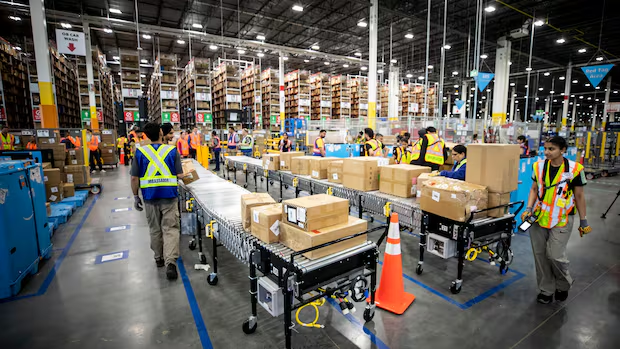
Deloitte Canada cuts GDP growth forecast by 20% as tariffs grip economy amid Trump's trade war
Statistics Canada says economic growth stalled in July
Deloitte Canada has shaved 20 per cent off its growth forecast for Canada's economy in 2027, citing increasingly tough conditions for consumers and businesses.
The accounting firm's latest outlook comes as a new American ban on select Canadian imports took effect on Tuesday.
Deloitte sees the fallout of recent escalations in the Canada-U.S. trade war causing a sharp economic slowdown in the final quarter of this year and into early 2027.
Chief economist Dawn Desjardins says the weight of billions of dollars in U.S. tariffs and Canada's reciprocal measures will not fall evenly across the Canadian economy, hitting some sectors hard, while others prosper. At the same time, the federal government's fiscal supports, investment initiatives and defence spending are positive signals for targeted growth, she said.
"For some, it's a little bit like the Earth is moving under their feet — and not in a positive way. While in other sectors, I think we can anticipate growth and job creation," Desjardins told CBC News in an interview prior to the report's release on Tuesday.
Canada's economy has found its footing. But is it enough to survive the U.S. trade war?
Deloitte's latest economic outlook for Canada calls for GDP to grow 1.6 per cent in 2027. In late June, the firm said it expected two per cent GDP growth next year.
Deloitte currently sees Canada's economy growing by 0.9 per cent in 2026 — a slight improvement from its June estimate of 0.7 per cent.
"It's so uncertain when we think about all the factors the Canadian companies are facing, whether it's the prospect of higher costs, the prospect of more friction with our largest trading partner or perhaps even higher interest rates. All these factors are just creating a very uncertain environment," Desjardins said.
"As a result, we do think that the economy probably is going to be on a slower growth trajectory."
U.S. ban on some Canadian imports
On Tuesday, the Canada-U.S. trade war escalated from tariffs to outright bans of certain products, as U.S. President Donald Trump's administration halted American imports of Canadian alcohol, motorcycles, molasses, and whey products. Earlier this month, the White House also added more Canadian goods to the list subject to 50 per cent tariffs.
These Canadian goods are now officially banned in the U.S.
Desjardins says today's seemingly unending stretch of economic uncertainty is impacting consumers, as well as businesses.
"We've got things that are just making us wobble a little bit in terms of our confidence that we should really be spending our money now," she said.
"Canadians are going to increase their savings a little bit. They're going to be more cautious about spending money. And so, to that end, it does suggest a very [much] slower pace of growth."
Canada's economic growth flat in July
Also Tuesday, Statistics Canada reported that GDP growth for July was essentially flat from the previous month, which came after three consecutive months of economic expansion.
"The goods-producing industries grouping was essentially unchanged in July, as increases in construction and utilities were offset by declines in the other sectors," the agency stated.
"The services-producing industries aggregate was essentially flat, as increases across several sectors were offset by declines in retail trade and wholesale trade."
Statistics Canada's flash estimate for August calls for GDP to resume growth at 0.2 per cent; the agency sees the mining and retail sectors partially offsetting decreases in oil and gas extraction.
Andrew Grantham, a senior economist at CIBC, says the flat July figure was no surprise, as the economy cooled down from a hot reading in the second quarter. Like Desjardins, he's now looking ahead to what happens as the latest tariffs start to bite.
"Given the escalation of U.S. trade uncertainty towards the end of August, today's data will likely be viewed as old news," he wrote in a research note after the data was released.
For the Bank of Canada, Grantham says the focus now shifts to the September jobs report, set to be released on Oct. 9, and the inflation data for last month, which is due to come out on Oct. 19. Canada's central bank is due to make its next interest policy rate decision on Oct. 28.
Jeff Lagerquist is a senior writer with CBC News based in Toronto. Originally from Erin, Ont., he studied journalism at Toronto Metropolitan University. Jeff previously worked as a senior reporter for Yahoo Finance Canada. He was also a reporter and digital producer for CTV National News, BNN Bloomberg and The Financial Post. He was also a Columbia University energy journalism fellow for 2025.
Related Stories
 Economy
Why gold and silver prices are on the decline as bond yields rise
5 hours ago
 Economy
‘The weaker he gets, the more dangerous he gets’: Trump lashes out as his power wanes
3 days ago
 Economy
Where things stand after Iran's new pitch for a deal to open the Strait of Hormuz
3 days ago
 Economy
Jack Mintz: Higher real interest rates are very bad news
3 days ago
 Economy
10-year JGB yield at 3
4 days ago
 Economy
A U.S. bond yield hit 5.1% for 1st time in 19 years. Here’s what it signals
4 days ago
 Economy
High borrowing costs push down American housing sales
4 days ago
 Economy
Even beloved hot dogs feel economic squeeze
1 week ago