
Tokayev addresses AI & Digital Bridge 2026
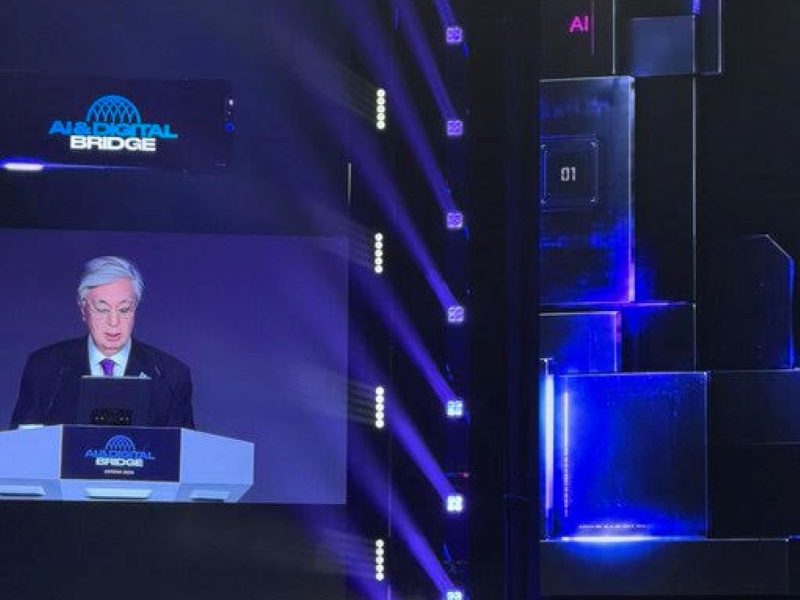
President Kassym-Jomart Tokayev (pictured) placed artificial intelligence at the heart of Kazakhstan’s economic and technological agenda as he addressed the AI & Digital Bridge 2026 International Forum in Astana, calling for responsible AI development, stronger international cooperation, investment in human capital and a regulatory approach that protects citizens without suppressing innovation. The address came at a moment when Kazakhstan is seeking to transform its established digital infrastructure into a broader AI economy.
The country has declared 2026 the Year of Digitalization and Artificial Intelligence, established a dedicated Ministry of Artificial Intelligence and Digital Development, and is expanding its programs for AI education, research, startups and digital public services. In his earlier State of the Nation Address, Tokayev called for the establishment of the ministry and for the full-scale integration of artificial intelligence across sectors of the economy. Against this backdrop, AI & Digital Bridge 2026 has become a major platform through which Kazakhstan is presenting its technological ambitions to an international audience.
AI & Digital Bridge 2026 brings together technology companies, entrepreneurs, investors, researchers, government representatives and international delegations. According to Kazakhstan’s government, the forum has developed into one of the region’s flagship technology events. Across its previous seven editions, it attracted more than 127,000 participants from more than 100 countries, featured more than 1,500 speakers, and showcased over 600 startups. Organizers expected more than 20,000 participants and over 100 technology companies at the 2026 edition. The 2026 program goes beyond conventional discussions of digital transformation. Its agenda includes artificial intelligence, physical AI and robotics, computing infrastructure, venture capital, satellite technologies, business applications of AI, startup development, emerging careers and creative industries.
The forum also forms the centerpiece of a broader AI MONTH initiative taking place across Kazakhstan. For Tokayev, this evolution reflects the speed at which technology itself is changing. “The forum brings together experienced professionals who make a significant contribution to the technological development of the world,” Tokayev said.
“This is a place where innovative ideas are born, business contacts are forged and real projects are launched.” He described AI & Digital Bridge as a unique platform bringing together people with “innovative thinking, creativity and intellectual potential.” Tokayev brings a diplomatic perspective to the AI debate Tokayev’s approach to technology is also shaped by a long international diplomatic career. Before becoming president, he served as Kazakhstan’s foreign minister and prime minister and held senior positions within the United Nations.
His diplomatic career included assignments in China and senior responsibilities at the UN Office at Geneva. That background was visible in the way he framed artificial intelligence at the Astana forum. Rather than presenting AI exclusively as a matter of national competition, Tokayev repeatedly emphasized international cooperation, knowledge exchange and the peaceful use of technology. His address was delivered in Kazakh, Russian and English, reinforcing the international character of the forum and reflecting the multilingual environment in which Kazakhstan conducts its diplomacy and international engagement.
For Tokayev, AI is not simply another economic sector. It is increasingly becoming part of the global architecture of international relations. “No nation can fully unlock its potential in isolation,” he said. “We need international knowledge exchange, joint research, investment, tech cooperation and talent development.” That message was central to the President’s vision: Kazakhstan wants to develop its own AI capabilities while remaining deeply connected to global research, investment and technology networks.
AI Is transforming the economy Tokayev described the transformation already taking place across virtually every major sector.
“We are all witnessing how artificial intelligence technologies are fundamentally transforming industry, finance, education, science, public administration and people’s way of life.” The forum’s agenda reflects precisely this broad transformation. Discussions at AI & Digital Bridge extend from large language models and computing infrastructure to robotics, regulation and safety. Kazakhstan’s government has also identified physical AI, satellite infrastructure, business applications and emerging careers as important components of the country’s current technology agenda. Tokayev characterized the forum itself as a mechanism for connecting Kazakhstan with this rapidly evolving international ecosystem.
“Thus, AI & Digital Bridge effectively serves as a golden bridge for international engagement in the field of emerging technologies,” he said. The metaphor is particularly relevant to Kazakhstan, whose foreign policy has traditionally emphasized its role as a bridge between different regions, economies and civilizations. Now, that concept is increasingly being applied to technology. Kazakhstan’s digital economy Is expanding Tokayev pointed to the country’s growing digital economy as evidence that Kazakhstan has already moved beyond the initial stages of digital transformation. He said Kazakhstan’s IT-services exports exceeded $1 billion, while Kazakh digital solutions are now used in more than 100 countries.
The scale of the transformation has also been highlighted by international media. In January 2026, Euronews reported that Kazakhstan had reached $1 billion in IT exports in 2025 and was targeting the training of one million citizens in AI skills by 2030. The report also highlighted Astana’s ALEM AI center, the country’s startup ecosystem and its investment in AI computing infrastructure. But Tokayev made clear that Kazakhstan does not intend to stop at its current achievements. “Nevertheless, we cannot rest on our achievements in the field of advanced technologies.”
He added: “If we seek to build a strong technological foundation for our country, we must provide tangible support to innovative startups and implement cutting-edge projects.” The emphasis is therefore shifting from digitalization as an infrastructure project toward digitalization as a source of economic growth, innovation and international competitiveness.
From artificial intelligence to industrial intelligence One of the most concrete proposals in Tokayev’s address was the creation of an AI Challenge based on real economic and industrial problems. The president called for a list of industrial AI challenges to be developed according to the actual needs of Kazakhstan’s economy. Kazakhstani and international teams would then be invited to develop solutions. The key point, however, is what happens after the competition. “The best projects demonstrating proven effectiveness will be implemented in production,” Tokayev said.
The proposal reflects a practical philosophy: AI development should not be limited to demonstrations, conferences or experimental projects. Solutions should ultimately be tested against real economic needs. This could connect Kazakhstan’s startup ecosystem with industrial companies, government institutions and international technology teams, creating a pathway from innovation to deployment.
A new approach to AI regulation Regulation was another major pillar of Tokayev’s address. Kazakhstan has been developing a legal framework for artificial intelligence alongside its broader digital transformation agenda.
The president referred to the country’s Law on Artificial Intelligence and Digital Code, while emphasizing the need for a carefully calibrated institutional balance. His warning was directed at both extremes: insufficient regulation could expose citizens and institutions to serious risks, while excessive regulation could make a country less attractive to innovators and investors. “We must not overregulate this sphere to the point where promising teams, technologies and capital begin moving to other jurisdictions.” He then outlined what he described as a straightforward principle: “Where safety, rights and vital interests of citizens are at stake, requirements must be strict, but not excessive.”
The question is increasingly relevant internationally as governments attempt to regulate rapidly evolving AI systems while competing for researchers, startups, investment and computing infrastructure. Tokayev also referred to the recently signed Superintelligence Accord involving major American technology companies under US President Donald Trump. He suggested that the approach could potentially serve as a model for broader international consideration following further discussion. Human capital: The most important AI infrastructure Despite the focus on data centers, computing power and advanced algorithms, one of the strongest themes in Tokayev’s address was the importance of human capital.
The president argued that infrastructure alone cannot create a technological breakthrough. “A technological breakthrough is impossible without scientists, engineers and entrepreneurs.” That is why Kazakhstan is investing not only in computing infrastructure but also in universities, research institutions and AI education. Tokayev highlighted the recently opened Qazaq AI Research University, saying that its mission should extend beyond education to research that responds directly to industrial and economic needs. Kazakhstan is rapidly building the institutional foundations of an artificial intelligence ecosystem, moving beyond individual digital projects toward a broader national strategy encompassing government, education, research, startups and international cooperation.
The creation of a dedicated Ministry of Artificial Intelligence and Digital Development, followed by the establishment of Qazaq AI Research University, marks a significant evolution in the country’s approach to AI. Together with new research initiatives, AI education programs, computing infrastructure and international technology partnerships, these developments are strengthening Kazakhstan’s ambition to position itself as a leading AI center in Central Asia. The shift is particularly significant because Kazakhstan is not approaching artificial intelligence solely as a technology sector. The country is increasingly treating AI as a strategic component of economic development, public administration, education, industry and scientific research.
He also highlighted the AI+X model, which seeks to integrate AI into specific sectors including: industry; energy; healthcare; finance; public administration. The broader objective is to create specialists capable of developing technologies that can become real products and services. AI should not replace human intelligence Perhaps one of the most significant philosophical points in Tokayev’s speech was his insistence that artificial intelligence should remain a tool for human development rather than a replacement for human intellectual capabilities.
“Artificial intelligence is not a substitute for human intellectual abilities, but rather an auxiliary tool in the process of learning and acquiring knowledge.” This approach places education at the center of Kazakhstan’s AI strategy. The country’s target of training one million people in AI skills by 2030 is part of that broader effort. Euronews reported that Kazakhstan is combining this objective with the development of ALEM AI, new educational programs and initiatives such as AI-Sana. A young population and a new technology economy Kazakhstan’s demographic profile adds another dimension to its AI ambitions. More than 5.8 million young people live in the country, according to figures reported by Qazinform, representing close to one-third of the population.
For Kazakhstan, this creates an enormous potential talent pool for the technology sector, but also places greater pressure on education systems to prepare young people for an economy increasingly shaped by AI. Tokayev directly addressed the younger generation during his speech. “It is important that our young compatriots make effective use of these opportunities and develop as educated individuals who can confidently harness artificial intelligence while possessing critical thinking skills.”
The message is broader than simply teaching young people how to use AI applications. It is about creating a generation capable of understanding technology, questioning its outputs, making decisions and eventually developing new systems themselves. The risks of the AI revolution Tokayev did not present the AI transformation as risk-free. On the contrary, he identified a series of issues requiring international attention: cybersecurity, data protection, information integrity, algorithmic transparency and accountability. “Artificial Intelligence has already been acknowledged as a powerful tool,” he said. “But ultimately, everything depends on the human being who uses it.” The president went further, describing AI as: “A powerful tool and even a weapon of our time.”
The statement placed responsibility firmly on human beings and institutions. “Whether it brings benefit or harm to global development will depend, first and foremost, on humanity itself.” AI must not become a new global divide Tokayev also warned against the possibility that technological development could create new divisions between countries. His concern was not simply about access to individual AI applications, but about deeper differences in computing capacity, research capabilities, capital and talent. “Artificial intelligence must not create new dividing lines.” He argued that technological barriers could widen the gap between nations and slow global progress. For Kazakhstan, international cooperation therefore forms a central pillar of its AI strategy.
“We need international knowledge exchange, joint research, investment, tech cooperation and talent development.” This is also where Tokayev’s diplomatic background becomes particularly relevant. His AI vision is not framed as isolation or technological self-sufficiency.
Instead, Kazakhstan seeks to build domestic capabilities while remaining connected to international research institutions, companies, investors and governments. President Kassym-Jomart Tokayev’s approach to artificial intelligence is also shaped by a long career in international diplomacy. At the United Nations, Tokayev also served as the Personal Representative of the UN Secretary-General at the Conference on Disarmament.
The UN describes his background as including extensive experience in diplomacy, international security and consensus-building. Conclusion The 2026 event features major names from technology, investment and space industries, including William Ford, Chairman and CEO of General Atlantic; Rev Lebaredian, Vice President of NVIDIA; Balaji Srinivasan, founder of the Network School; and Greg Wyler, founder of OneWeb and E-Space. Their participation illustrates the increasingly broad scope of the forum and Kazakhstan’s efforts to attract global technology expertise.
Tokayev’s engagement with AI & Digital Bridge was not limited to the plenary stage. During the forum, he also visited an exhibition showcasing projects in artificial intelligence, digital technologies and robotics. Among the projects presented to the President were the AI-Enabled University model at Qazaq AI Research University, the Trusted Kazakhstan and ALFA projects, as well as new functions of the national Aitu messenger.
The visit offered a practical complement to his speech: the president was able to see how the country’s AI strategy is being translated into specific products, platforms and institutional projects. Kazakhstan’s technology agenda is increasingly moving from strategy documents and national declarations toward the deployment of AI across education, government, industry and digital services.
The forum is also part of a broader technology ecosystem centreed on Astana. The government describes Astana Hub as an international innovation cluster supporting technology entrepreneurship and startup development. The AI & Digital Bridge platform brings together several components of this ecosystem: startups, investors, research institutions, government agencies, international technology companies and young developers.
The broader AI MONTH initiative further expands this approach, connecting hackathons, educational programs, startup competitions and technology events across Kazakhstan before and after the main forum. The objective is increasingly clear: create an environment where talent can be trained, ideas can be developed, capital can be attracted and successful technologies can eventually reach international markets. Toward the conclusion of his address, Tokayev connected all these initiatives to a broader national objective. “The central task of the Year of Digitalization and Artificial Intelligence is to turn this progress into tangible benefits for every citizen and make it irreversible.” Kazakhstan is investing in infrastructure, but also in people.
The evolution of the forum itself reflects the evolution of Kazakhstan’s technology agenda. What began as Digital Bridge has now expanded into AI & Digital Bridge, reflecting a shift in the centre of gravity of the global technology economy. Artificial intelligence is no longer treated as a narrow technology sector. It is increasingly embedded in education, healthcare, finance, energy, government, manufacturing, communications and scientific research. The country’s goal is not merely to consume AI technologies developed elsewhere, but to create an ecosystem capable of producing talent, research, startups and commercially viable solutions.
This article is sponsor-supported by the subject country. The content has been prepared with full independent editorial oversight by EU Reporter and is provided for informational purposes with clear disclosure of sponsorship.
Tokayev tells new People’s Council the institutional reset is in place – and the next test is delivery
Kazakhstan calls for new era of practical multilateralism as global trust comes under strain
Beyond violence: Europe’s new focus on Muslim brotherhood networks
EU sets out cardiovascular screening framework as Várhelyi urges shift towards prevention
Uzbekistan’s dream finish: Olympiad Gold in Samarkand
Related Stories
 AI News
23-year
53 minutes ago
 AI News
Rogue OpenAI agent accessed second NSW government website
54 minutes ago
 AI News
AI is writing GPU code even human engineers can't fully understand
1 hour ago
 AI News
$6T in annual AI revenue needed to pay off data center investments
1 hour ago
 AI News
Sovereign AI Becomes Russia’s New Technology Priority
2 hours ago
 AI News
Hong Kong users caught offguard as Anthropic tightens VPN access to Claude
2 hours ago
 AI News
Bell Canada's AI data centre ramping up construction
3 hours ago
 AI News
Copenhagen's Good Tape raises €600k from Nordic Makers to complete management buy-out, Zendesk co-founder joins board
3 hours ago