
23-year
The personal AI assistant seemingly came out of nowhere this summer, gaining traction among Silicon Valley insiders before raising $250 million at a $2.5 billion valuation in August.
Barely a month later, Instinct raised another $1billion, quadrupling its valuation to $10 billion. The Sept. 28 funding round drew investments from Sequoia Capital, Benchmark Capital and Coatue, Reuters reported.
The rapid rise has come even as Instinct remains available only by invitation. The company is approaching $1 billion in annual transaction volume, with travel accounting for about half, Shinn said on the "Invest Like the Best" podcast on Sept. 28. "We spent $0 on marketing so far," Shinn said, as quoted by Fortune.
Demand has become so strong that some users have even offered their invitations for sale on eBay.
"Instinct is a personal assistant that understands what you’re working on and what's important to you," reads the startup’s website. "It's trained to use a phone and a computer. You can text or call it. It uses its devices in the same way that humans do."
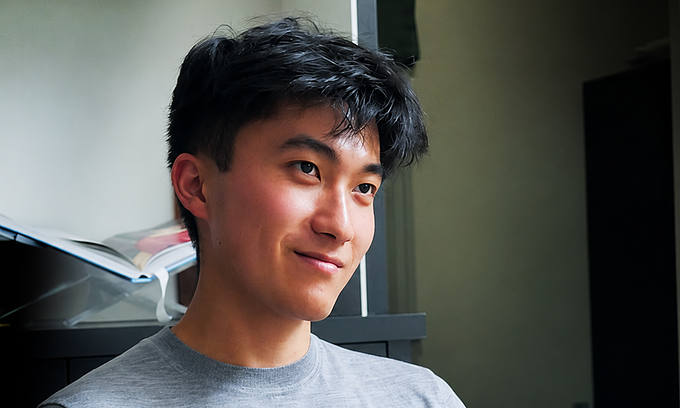
Noah Shinn, founder of AI startup Instinct. Photo from YouTube/Invest Like The Best
Shinn grew up in the San Francisco Bay Area and attended a private high school in San Jose, where he ran cross country and played basketball. He later enrolled at Northeastern University in Boston, pursuing interests ranging from programming and computational photochemistry to aerospace engineering.
Weeks after ChatGPT's launch in November 2022, Shinn responded to a LinkedIn post from then-MIT professor Ashwin Gopinath seeking students to experiment with the technology. Over the next three months, they and other researchers developed "Reflexion," a framework that helps AI agents learn from previous failures and improve subsequent responses.
Their work achieved 91% accuracy on a coding benchmark, compared with 80% for GPT-4 at the time, and was presented at leading AI conference NeurIPS in 2023. By March 2024, the paper had been cited around 200 times, according to Northeastern University.
"Many people have since reinvented it, but the basic technique is in a paper that a second-year college student wrote in 2023, before GPT-4," Northeastern computer science professor Arjun Guha told Business Insider. "Virtually zero students can write research papers as undergrads. Even fewer can do it without any assistance," he said.
Shinn did not stay at Northeastern long enough to graduate. In 2023, he dropped out to become one of the first employees at Sierra, a San Francisco AI startup co-founded by OpenAI chairman and former Salesforce co-CEO Bret Taylor.
There, he worked as an AI researcher across most of Sierra's core products while continuing to co-author papers on agents' ability to follow instructions, use software tools and write code.
Shinn left Sierra in September 2025 and founded Instinct the following month, according to his LinkedIn profile. The startup initially kept a low profile, with its personal AI assistant beginning private beta testing this February before becoming available by invitation in August.
Some of its earliest users were venture capitalists, helping the product spread through Silicon Valley by word of mouth. "In all the group chats you see people saying, 'I just used this new technology — OMG,'" Trace Cohen, co-founder of Six Point Ventures, told Business Insider. "Everyone is just hounding each other for access."
Unlike a conventional chatbot that primarily answers questions, Instinct is designed to carry out tasks on a user's behalf. People can text or call it and ask it to plan trips, buy groceries, book tickets or cancel subscriptions. Users have also employed it to plan weddings and eliminate hundreds of dollars in unwanted subscriptions.
The company is expanding the service with a concierge feature that can call businesses on a user's behalf to make bookings. Shinn wants the assistant to learn users' preferences over time so they do not have to repeatedly explain what they want.
"It will be able to use that memory and be able to, you know, now make it a much easier experience for you in the future to be able to book that according to exactly what you want," he said.
Instinct was valued at just $50 million in an early investment, before soaring to $10 billion within about five months, a 200-fold increase. The surge reflects growing investor interest in "agentic AI," systems designed to go beyond answering questions and independently carry out tasks for users.
That race has brought Shinn into direct competition with Meta. The tech giant launched its own personal AI agent, Muse, in September as part of CEO Mark Zuckerberg's broader push toward what he has called "personal superintelligence." Muse and Instinct share a similar ambition: to create AI assistants that can move beyond conversation and take action for their users.
Meta Chief AI Officer Alexandr Wang, a 29-year-old billionaire, has repeatedly poked fun at Instinct on social media, calling it "Insect" in one post and saying Muse was faster and "hotter" in another. Shinn responded to one of Wang's posts with a smiley face.
He has otherwise played down the rivalry, calling Muse a good product while saying he spends "very little of my time thinking about competition and other players in the space."
Meta enters the contest with advantages Instinct cannot easily match, including enormous computing resources, billions of users and distribution through some of the world's largest social platforms. Instinct, meanwhile, remains invite-only and has faced heavy demand for computing capacity.
Shinn has described the assistant as "almost like having access to a super-human operator." But giving an AI agent the ability to act for users also creates privacy and security concerns because it may require access to sensitive personal information. Some early Instinct users reported unexpected actions by the agent, The Wall Street Journal reported.
Shinn said the company was taking those concerns seriously and making product changes to prevent unwanted actions. Instinct has since introduced additional safeguards, including isolated computing environments and short-lived local credentials. It has also developed a detection system intended to catch subtle hallucinations in agents' responses.
For Shinn, however, the opportunity extends beyond the competition with Meta. "It's still an exciting time," he said.
Related Stories
 AI News
How the Smithsonian is using AI to connect artifacts from the American Revolution
24 minutes ago
 AI News
AI may not take over the world. We could simply hand it control one decision at a time
25 minutes ago
 AI News
What leaders actually need from AI in HR technology
1 hour ago
 AI News
Jay Clayton set to be tapped as administration's new AI czar
1 hour ago
 AI News
Grant helps N.C. community college expand AI training programs
2 hours ago
 AI News
BC NDP and Conservative leaders campaign in the Okanagan
3 hours ago
Industry Advocates Testify on Risks of Artificial Intelligence
6 hours ago
 AI News
Rice University launching AI master's program
6 hours ago