
Togetherness Startups Raised $513M. 88% Went to a Landlord.
A cohort of repeat founders is betting that bringing people back into the same room is an industry. The capital is betting on whoever owns the room.
The founder who sold Lululemon a $500 million screen for working out alone is now selling a $399 screen that only works when you invite people over. The founder who sold a grooming brand to Procter & Gamble is buying a leather school. The founder of Bonobos runs an app for run clubs, and the founder of The Wing stages a murder at dinner once a month in an 11-room inn.
TechCrunch’s Connie Loizos grouped them on September 20 as a small but growing cohort betting that bringing people together offline is its own industry, with the World Health Organization’s loneliness data as the backdrop.
Add up the disclosed funding in that same story, though, and the loneliness economy looks different. Board, Pie and Six Bells have raised about $62.8 million between them. Adam Neumann’s Flow, the rental housing company pitched on the same promise of ending loneliness, has raised more than $450 million on its own.
That is roughly 88% of the disclosed money in the group, and it went to the one company that rents apartments. The split is not a quirk of timing. It is the business model telling you which part of togetherness can hold capital.
The TechCrunch piece profiles four founders who each built and sold, or at least built and branded, one company already and have now come back to the same idea from different directions.
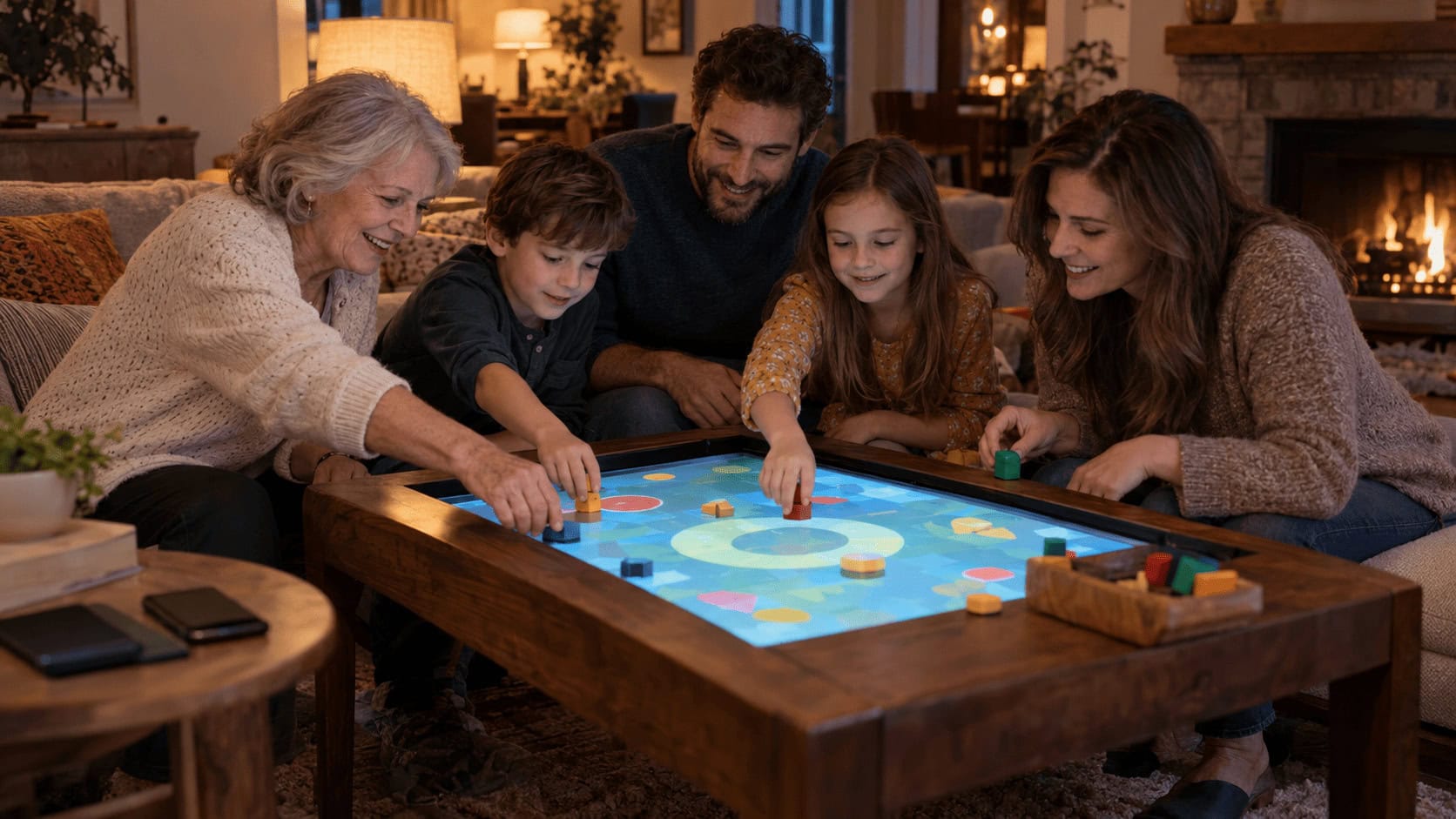
Brynn Putnam’s Board makes a 24-inch touchscreen table that recognizes physical game pieces, so a child and a grandparent can play the same game with no controller to learn. It is three years old and has raised $35 million, including a $20 million Series A led by Union Square Ventures in June.
Tristan Walker’s Heirloom, founded 11 months ago, is buying and scaling fine-craft trade schools, starting with a San Francisco leatherworking school founded by Hermès’s first American artisan-ambassador. Walker also runs Collaborative Holdings, a vehicle carved out of the venture firm Collaborative Fund for profitable, cash-flow-positive businesses that want to grow without chasing venture-style returns. Heirloom has not disclosed its funding.
Andy Dunn’s Pie, now five years old, has moved from friend-matching app to event-discovery tool to what he now pitches as an operating system for the social lives of recurring groups like run clubs. It has raised $24 million. Audrey Gelman’s Six Bells Countryside Inn, an 11-room guesthouse in the Hudson Valley, has raised roughly $3.8 million.
Then there is Flow, which TechCrunch flags as the exception, having raised more than $450 million, largely from Andreessen Horowitz.
The demand case rests on two numbers. The WHO’s Commission on Social Connection estimated in June 2025 that one in six people worldwide are affected by loneliness, linking it to roughly 870,000 deaths a year. And a Harris Poll sponsored by Marriott Bonvoy found that two-thirds of Americans say they are prioritizing experiences over material purchases this year.
The Money Went Where a Lender Could Follow
Flow’s first check was $350 million from a16z in August 2022, at a valuation above $1 billion, before the company had begun operating. It was, at the time, the firm’s largest single investment. According to reporting by The Wall Street Journal, a16z also received a stake in Flow’s real estate portfolio as part of the deal.
That detail is the whole story in one line. The venture money did not only buy a brand and an app. It bought a claim on buildings.
In April 2025, Flow raised more than $100 million more at a valuation of about $2.5 billion, with a16z’s stake rising from 20% to 25% and the majority still held by Neumann’s family office and employees. The same month, per Commercial Observer, Flow secured a $155 million financing package for a 466-unit condo development in downtown Miami. The equity sits on top of debt, the way every real estate business works.
The pattern holds outside the TechCrunch list. In July, Fortune reported that Ron Shaich’s Act III is adding $50 million to its commitment to Level99, a chain of in-person challenge venues, bringing its total to $100 million after a fourth location opened at Disney Springs. One investor’s commitment to one venue chain is larger than everything Board, Pie and Six Bells have raised combined.
Why does the money land there? Because a room at scale is an asset class capital markets already know how to price. A building has an appraisal, a lender, a cap rate and a buyer if things go wrong. A togetherness app has a retention curve. When the product is presence, the thing that holds value is the place where presence happens, and only the companies that own a lot of places can absorb nine figures.
The small rooms don’t get the same treatment. Six Bells also sells rooms. It has 11 of them.
Mirror Sold One Seat. Board Sells the Table.
The most useful comparison in the whole cohort is Putnam against herself.
Mirror was a roughly $1,500 device plus a $39 monthly subscription, built for one person at a time. Putnam told TechCrunch it was about “myself, my body, my fitness, my reflection.” Lululemon bought it for $500 million in cash in 2020. It then took a $442.7 million after-tax charge tied to Mirror in the fourth quarter of fiscal 2022, and another $72.1 million after-tax in fiscal 2023, when it stopped selling the hardware and handed content to Peloton.
That is about $515 million of after-tax charges across two fiscal years against a $500 million purchase price. Not all of it was purchase price written off; it includes inventory provisions and restructuring. But the solo-screen business ended up costing its buyer more than it paid. The Lululemon SWOT still carries Mirror as a scar for a reason.
Board flips the unit of sale. It is $399, it sits in the middle of a room, and it only makes sense with more than one person around it. The company says it is in tens of thousands of homes, schools, hospitals and restaurants, with 85% of customers averaging 30 or more sessions a month.
Run the per-seat arithmetic and the shift is stark. At four players, Board costs about $100 per seat. Mirror’s device alone was about $1,500 for one user at a time, before the subscription. Board is roughly one-fifteenth the price per participant.
The catch is who pays, and how often. Mirror billed a person every month. Board, on everything disclosed so far, bills a household once. Group products are cheaper to join and harder to meter, because the natural unit is the table, not the player.
That is why the most important thing in Board’s June announcement was not the $20 million. It was Board Studio, an AI tool meant to let anyone build games from plain-language prompts, plus a plan to sell accessories and collectible pieces. The USV partner leading the round cited Roblox as the model. The table is the distribution. The platform is where recurring money would have to come from.
Every business in this cohort that doesn’t own real estate at scale runs into the same wall: the product works because the room is small, and the room being small is what caps the revenue.
Six Bells is the cleanest example. Eleven rooms is at most 4,015 room-nights a year, and a monthly murder-mystery dinner is 12 events a year. The New York Times reported that guests routinely linger in the bar past midnight trading numbers with strangers. That effect is the product, and it depends on the room staying intimate. Our read is that the dinner works like the casino buffet that loses money to fill the floor: it is the reason to book, and the rooms are where the money is. Growing it means building another inn.
Heirloom has the same geometry with a classroom. More than half its first location’s capacity is filled by young tech workers looking for a creative outlet that keeps their phones out of their hands. A leather class holds as many students as there are benches and a master can supervise. So Walker is buying existing schools rather than building one app, and he is doing it next to a vehicle designed for companies that throw off cash rather than ones that promise a hundredfold return.
That choice is the most honest signal in the story. A founder who has raised venture money before, sitting inside a venture firm, decided the craft school needed a different kind of capital.
Pie is the control group. It is the only pure software company in the cohort, and it owns no room at all. It organizes people who meet in other people’s rooms: the park, the bar, the running track. It has been three different products in five years. Software without the room keeps having to reinvent the thing it sells.
Put the four side by side and you get four capital structures wearing one label:
The one with thousands of rooms raised seven times what the other three raised together.
Price the ceiling before you price the growth. In-person products have a hard capacity limit set by the space: rooms, benches, seats at a table. Before modeling revenue, model the maximum number of people the room can serve in a year, then ask what it costs to add another room. That ratio, not the loneliness statistic, decides whether the business is venture-shaped.
Match the capital to the asset, not to the mission. Four companies with the same stated purpose ended up with four different funding structures, and each fits its asset. Buildings attract debt and large equity. Devices attract venture. Cash-generating craft schools attract holding-company capital. A founder pitching the mission to the wrong kind of investor will lose the argument on the asset.
Group products need a second meter. When the buyer is the household or the group, the per-user subscription disappears. The escape routes are the ones Board is building: a content platform, accessories, collectible pieces, places rather than people as customers. Anyone building “together tech” should design the recurring revenue line on day one, because the hardware sale won’t repeat.
Loneliness is a demand signal, not a revenue model. The WHO measures how many people are affected. Nobody in this story has measured how much they will pay, how often, and for what. The experiences survey was sponsored by a company that sells hotel nights. Treat both as context, and underwrite on bookings.
The strongest argument against this reading has a name, and it is Neumann’s own. The last time a founder sold community on top of real estate, the WeWork business model peaked at a $47 billion valuation and ended in bankruptcy in 2023. Real estate absorbs capital, and it also absorbs losses. Leases and loans don’t flex when demand does, a point our look at Lululemon’s growing lease commitments makes from a completely different industry. The same property that makes Flow fundable is what would make a bad year expensive. Flow told staff it expected to be cash-flow positive in 2025, which is a claim, not a filing.
The second objection is that Board may be the one that scales like software after all. Tens of thousands of units in roughly eight months, high engagement and a creator platform are the ingredients of a console ecosystem, and consoles are not capped by any room. If Board Studio works, the most valuable togetherness company could be the one that owns no space.
Third, disclosed funding measures investor appetite, not customer demand. Heirloom’s number is unknown and could change the shares. Flow’s first check was written in 2022, when capital was cheaper and the Neumann brand was a fundraising asset in its own right.
Finally, Mirror is a warning about reading demand from a moment. Pandemic-era home fitness looked durable until it wasn’t. Survey data about valuing experiences over things may convert to spending, or it may be the 2026 version of a stationary bike in the spare room.
Is the loneliness economy a real market? The need is well documented. What is not documented is a repeatable way to charge for it at scale, which is why the funding has pooled in real estate, where the pricing model already exists.
Why did Flow raise so much more than everyone else? Scale and collateral. Flow manages thousands of apartments, has property-level financing and gave its lead investor a stake in the real estate itself. A venture fund can underwrite that the way it could never underwrite an 11-room inn.
Is Board a game console or a platform? Right now it is a console sold once per household. The bet behind the Series A is that it becomes a platform, with games created by users and sold alongside pieces and accessories.
What is Collaborative Holdings? A vehicle carved out of Collaborative Fund for profitable, cash-flow-positive consumer businesses that want room to grow on their own terms rather than on a venture timeline. Walker joined Collaborative as a partner in July.
What would change this picture? Heirloom disclosing a large raise, Board Studio producing a real content economy, or Flow testing public markets. Neumann has said Flow could go public one day and that there is no rush.
The Business Model Analyst Take
The coverage frames togetherness as a new category waiting for its first unicorn. The funding data says the unicorn already exists, and it is a landlord.
That is not cynicism. It is what happens when the product is people in a room. The room is where the value lives, it is what caps the revenue, and it is the only part of the business most investors know how to price. Board is trying to put the room in a box. Heirloom is buying rooms that already work and funding them with patient money. Six Bells is keeping its room small on purpose. Flow bought thousands of them.
If you are building for connection, the question is not whether people are lonely. It is whether your business owns the room, rents it or ships it, and whether your investors understand which one you chose.
Related Stories
 Business
General Oceans Announces New Executive Vice Presidents
2 hours ago
 Business
Why a good startup founder knows the secret to success is asking for help
3 hours ago
 Business
Highland housing trust faces closure amid financial challenges
4 hours ago
 Business
Hot startup of the month: Ghana's Complete Farmer
5 hours ago
 Business
18 years of Cornerstone
7 hours ago
 Business
David Raynor launches Funding Atlas for global funding
9 hours ago
 Business
How to ‘manufacture’ an Ivy League applicant
11 hours ago
 Business
ZAWYA: Dubai Chamber to enhance funding for 7 digital startups
11 hours ago