
Sask. farmers seeing gains from protein craze
Sask. farmers seeing gains from protein craze
Experts say high protein demand benefits Sask. agriculture
You can find it in everything from chips to lattés to Kraft Dinner. Protein and protein-fortified products are everywhere.
The demand for protein in the form of meat products, dairy products, eggs and protein powders has been on the rise for the past few years, despite price increases, says Craig Johnston, vice-president and chief economist with Farm Credit Canada.
In an interview with CBC Saskatchewan's Blue Sky, Johnston said despite a 17 per cent increase in beef prices in 2025, beef consumption increased by almost one kilogram per person.
"Whether it's meat, whether it's dairy, whether it's plants, people want protein and they want it in their foods, and they want it in a way that is convenient and cost effective," Johnston said.
Canadian producers are meeting the protein moment, he said.
"If you look at production in Canada so far this year in 2026, we're already up 75 per cent in terms of what we're producing from where we were about three years ago."
He said livestock producers are increasing herd sizes to meet demand.
Johnston said the high demand for whey protein is causing dairy farmers to favour milk with higher protein levels. (Olivia Stefanovich/CBC)
Milk boards across Canada are adjusting their pricing systems to reward milk with higher protein levels, though those changes will take time to reach the consumer as producers change the way they breed and feed dairy cows to get high-protein milk, he added.
Johnston said he's not concerned about the demand for protein going away anytime soon.
But with Canada putting a 50 per cent tariff on American whey and U.S. President Donald Trump banning American companies from buying Canadian whey, the high prices won't be going away anytime soon either, he said.
The demand for whey protein powder in both Canada and the United States exceeds the amount produced in the respective countries.
"Until the sector can really respond in a significant way to meet that demand, there will be a price pressure and scarcity for products like whey," Johnston said.
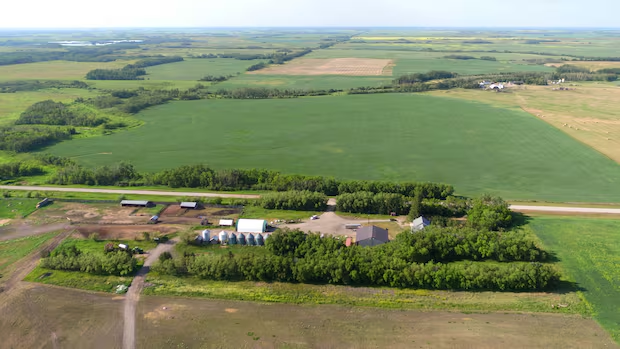
Johnston said the protein craze is good news for Saskatchewan farmers.
And livestock producers won't be the only ones who benefit.
"You think about feed grains, you think about oilseeds, pulses, food processing," Johnston said. "Those impacts do kind of filter through the sector and ultimately do end up back to the farm gate."
Johnston said the demand for protein presents a big opportunity for Saskatchewan crops like peas, lentils and even canola to be converted into protein powders.
Saskatchewan crops can be processed into protein powders to help meet high demand. (Natalie Crowell/CBC)
That's happening at a pea protein isolate facility run by the Louis Dreyfus Company in Yorkton, Sask.
Tyler Groeneveld, the CEO of Protein Industries Canada, told Blue Sky host Leisha Grebinski it's the largest pea processing plant in Canada.
Protein Industries Canada looks for ways to turn crops grown in Canada into value-added ingredients or food products and invests in those businesses or projects. Groeneveld said the goal is to keep money and jobs in Canada.
"We should be helping industry invest, to create this climate to build more manufacturing plants to turn the crops we grow into higher value ingredients and products and basically create more economic wealth for farmers and for Canadians at large," Groeneveld said.
The Yorkton plant processes peas into pea flour, which can be sold to companies to fortify their packaged food products or to make pea protein powder.
Phil Chilibeck, a kinesiology professor at the University of Saskatchewan, noted pea protein powder can be a substitute for dairy products like whey protein.
He told Blue Sky that based on his research, pea milk, a beverage fortified with pea protein powder, has similar benefits for muscles and bones as dairy milk.
"The pea beverage was surprisingly beneficial for [study participants'] bone health. It was comparable to the dairy for some measurements, and then for some of the other measurements it was a little bit better," Chilibeck said.
Whether it's beef, dairy or peas, Johnston said this is a moment Canadian producers stand to profit from.
"There's just such an opportunity here for Canada to really capture this enormous growing global demand for food — not just protein, just food in general."
Laura Gillis is a Regina-based journalist. You can reach her at laura.gillis@cbc.ca.
Related Stories
 Canada
’We can’t deal with it in Canada’: Some women turn to Mexico for endometriosis care
29 minutes ago
 Canada
Carney’s Thanksgiving message directed at Alberta ahead of separation referendum
29 minutes ago
 Canada
Carney speaks directly to Albertans in Thanksgiving message
30 minutes ago
 Canada
Can social media engage apathetic young voters in Ontario's elections?
1 hour ago
 Canada
Canada’s 2026 job gains have been erased. The hardest
1 hour ago
 Canada
‘Not as long as I’m premier’: Danielle Smith rules out 2nd separation referendum if Albertans vote to remain
2 hours ago
 Canada
Statement by Prime Minister Carney on Thanksgiving
2 hours ago
 Canada
Alberta separation referendum campaigns enter homestretch with speeches and rallies
2 hours ago