
Nuclear fusion conference spotlights Singapore as hub for spin
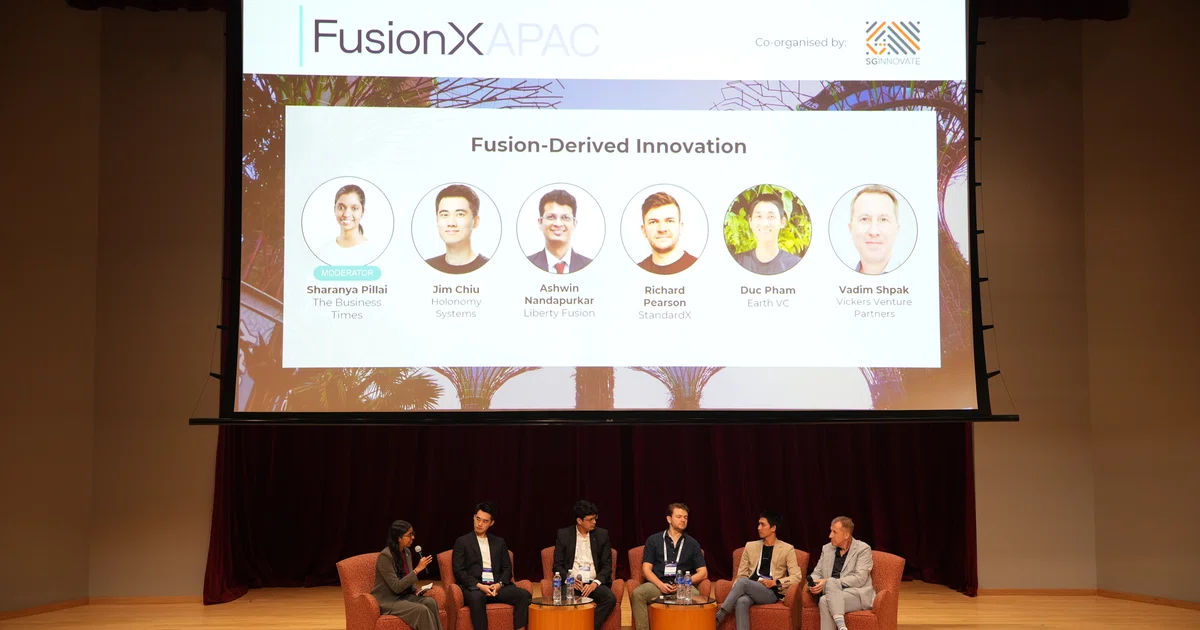
[SINGAPORE] Singapore could be an innovation hub for the supply chain around nuclear fusion, as well as a launchpad for startups to spin off and commercialise related technologies, according to industry panellists at the FusionX:APAC conference.
The city-state can act as a “leading hub” for the precision engineering and advanced manufacturing capabilities that fusion companies need, Nicolas Burkardt, chief financial officer of German startup Marvel Fusion said on Thursday (Oct 1) at the event organised by deep tech investor SGInnovate and nuclear fusion ecosystem builder FusionX.
He echoed Minister for Energy, Trade and Industry (Energy and Industry) Tan See Leng’s earlier comment that Singapore can contribute talent and expertise to fusion companies.
Burkadt also highlighted Singapore as a market for fusion companies to sell technologies that can be applied to other sectors – such as advanced lasers, isotopes for medical use and military technologies.
Investors are showing more interest in such spin-off innovations from nuclear fusion companies, given their near-term potential to generate revenue – compared to the timeline for achieving fusion power, which could still be a decade or more away.
Nuclear fusion, which involves fusing two variants of hydrogen at extreme heat to release energy, is not yet commercially available, although a growing number of startups are racing to make it a reality.
Get insights into businesses across South-east Asia
Fellow panellist Neil Fong, Asia head and managing director at Burda Principal Investments, noted that “everyone in the room isn’t just betting on fusion”.
“The whole process itself involves many, many other things, from magnets to superconducting materials. These all have very real commercial applications today,” he said.
Saemin Ahn, managing partner at Rakuten Capital, reckons that the need to navigate geopolitical sensitivities could also benefit the consulting sector: “This is not going to be an energy (source) and asset that can be freely applied and sold to all nations; this will be massively gated... And because of that, there will be massive business on the advisory and the lobbying side.”
Buoyed by the buzz, some investors are warming up to making bets in a sector often seen as being too risky.
Fong of Burda cites how the growing market for secondary sales of shares in fusion startups addresses concerns about the long timeline to realise returns.
“We don’t need – as a financial investor – for fusion to be working today. In fact, I don’t even need a power plant in the next 10 years,” said Fong, whose firm is invested in German fusion startup Proxima Fusion. He sees “enough capital in the system” for investors to sell their shares to sovereign wealth funds and private equity players, possibly seeing some liquidity within five to 10 years.
But not all investors have made the leap, as speakers in a separate panel shared.
Duc Pham, a Vietnam-based principal at venture firm Earth VC, is “very bullish in the long run” on nuclear fusion, but for now has invested only in fission players, since nuclear fusion could still be 15 to 20 years away – “still way beyond our fund cycle”.
Similarly, Singapore deep tech investor Vickers Venture Partners has invested in a laser technology company that could serve the fusion industry, but has not backed anyone building a fusion reactor, noted venture partner Vadim Shpak.
Many venture capitalists are looking for the “easiest and fastest way to make money” and see AI and semiconductors as the “flavour of the month”, he said, while fusion is still “too far away”.
Still, interest in fusion comes as energy-hungry Asian economies, including Singapore, are stepping up their exploration of nuclear power.
Despite the overwhelming focus on nuclear fission, nuclear fusion could be gaining ground.
For instance, India’s nuclear power industry was opened up to the private sector only late last year, noted Ashwin Nandapurkar, co-founder of US-based Liberty Fusion.
But, while talk of fusion is still “very nascent”, he believes that “it will eventually come up”, given that the technology already appears in the new market regulations.
Related Stories
 Technology
What Startups Can Teach Insurers About What's Next
3 minutes ago
 Technology
Coalition formed to advocate for biometric technology in Europe
3 minutes ago
 Technology
QNA Technology S.A. (QNA) Buy Reiterated; PLN 51 Target Kept
3 minutes ago
 Technology
SMX Technology Helping Prove "Made in America" is Great Again
3 minutes ago
 Technology
New website debuts for entrepreneurs, startups in Montgomery County
1 hour ago
 Technology
The Humble PB&J Sandwich Is Sparking a Food Fight Among Snack Giants and Startups
1 hour ago
 Technology
Blackstone announces $1B investment to launch defense technology company
1 hour ago
 Technology
30 Startups To Watch: Startups That Caught Our Eye In September 2026
2 hours ago