
3
Limited time: Save 25% on NBC News subscription
Get exclusive reporting, live Q&As and ad-free reading.
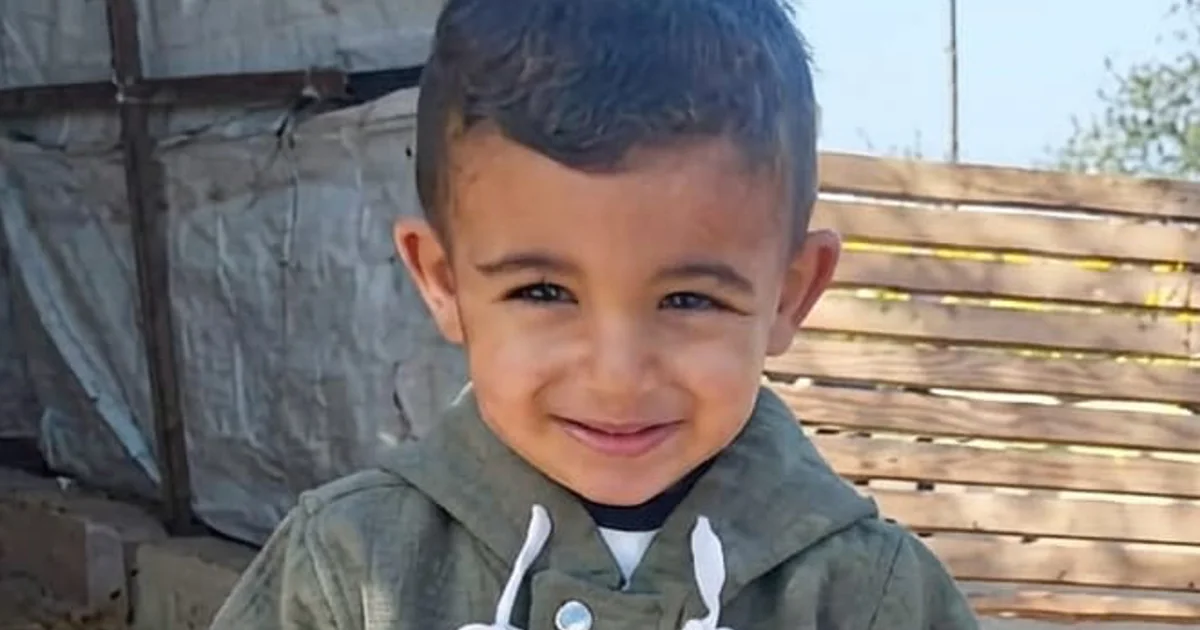
Bahaa Abu al-Ajeen was walking his 3-year-old son, Rayan, back to the tarpaulin-covered shack they called home, a makeshift dwelling providing some shelter from the sun on a war-ruined farm in central Gaza.
The father and son walked in what was designated as a safe area for civilians close to the “yellow line,” a boundary marked with yellow blocks and flags that divides Palestinian-controlled parts of the Gaza Strip from areas under Israeli military control. But al-Ajeen, 38, said that as they were confronted by Israeli soldiers, he froze.
“At that moment, I did not know whether to move forward or backward,” he said. As Rayan began screaming, al-Ajeen, whose family has long farmed in the area, picked up his son and began walking again.
That’s when the soldiers fired what the Israeli military later described as “warning” shots.
The third shot struck Rayan in the head, al-Ajeen told NBC News from al-Aqsa Hospital on June 15, a day after the incident. “After that, they shot at me, as well.”
Al-Ajeen tried to call for an ambulance but, he said, the soldiers took his phone and dragged him beyond the yellow line, still carrying Rayan, who was bleeding from his chest.
“I told them: ‘The child is dying. You killed him in cold blood,’” he said. “‘What has this child done wrong?’”
“No medical assistance whatsoever” was provided to his dying son, he said, and it was hours in detention before the gunshot wound to his own leg was treated.
Rayan’s death is the latest in a series of child killings feeding scrutiny over Israel’s treatment of Palestinian children. A United Nations report this month alleged that Israel has deliberately targeted children, resulting in genocide, crimes against humanity and war crimes in the occupied West Bank and the Gaza Strip, where shifting military boundaries have blurred the line between combat zones and protected civilian space.
The commission of inquiry said it has reasonable grounds to conclude that the acts “form part of a deliberate strategy to destroy the future of the Palestinians in Gaza by targeting their children.” Israel has strongly rejected the findings.
Asked about al-Ajeen’s case, the Israel Defense Forces said in a statement June 16 that troops had identified “several Gazans approaching them” as they carried out activity in the yellow-line area in central Gaza on June 14. It said the troops “initiated standard suspect apprehension procedures, which included warning fire.”
“It was reported that, as a result of the fire, one Gazan was killed and another was injured,” the Israeli military said, adding that the details were under review. Asked to confirm whether a child was killed, as well as how close those who were fired upon were to Israeli forces and whether the yellow line was visibly marked, it said it had no further comment.
The Israeli military launched its offensive in Gaza following the Hamas-led Oct. 7, 2023, attacks, in which around 1,200 people were killed and 251 were taken hostage. Since then, more than 70,000 people have been killed in Gaza overall, according to Palestinian health officials, including more than 20,000 children, with a further 44,000 injured. In the West Bank, a surge in settler violence and Israeli military operations since then had killed at least 1,103 Palestinians, including 241 children, as of June 5, according to the U.N.’s Office for the Coordination of Humanitarian Affairs.
The U.N. report, published June 18, alleged that Israeli authorities and security forces have “deliberately carried out acts inflicting death and severe bodily and mental harm on hundreds of thousands of Palestinian children” and that such killings continued even after the U.S.-brokered ceasefire in Gaza was agreed to in October. Since then, it says, 1,020 Palestinians have been killed, including 265 children, citing data from health officials.
Compiled through interviews with healthcare workers and lawyers and the review of medical records, the report set out a series of accounts it said supported the findings.
It detailed a number of incidents, including the killing of a 10-day-old boy who was shot by an Israeli quadcopter while his mother was breastfeeding him in their tent in Nuseirat refugee camp in central Gaza.
It also cited the case of 5-year-old Palestinian girl Hind Rajab, whose final pleas for help were captured on audio. She was left to die in Gaza among the bodies of six relatives, including her 15-year-old cousin, Layla, after an Israeli tank struck their car, leaving it with 335 bullet holes, according to Forensic Architecture, a research group.
“By targeting children, Israel is attacking the very capacity of the Palestinian people to exist and to determine their future,” said Srinivasan Muralidhar, an Indian jurist who chairs the commission.
The Israeli Foreign Ministry said it “utterly rejects” the report, calling it a “libelous sham” and “a propaganda piece as outrageous as its previous ones.”
It added that the report “completely erases Israeli children who were brutally murdered, kidnapped, and targeted by Hamas, while ignoring Hamas’ cynical use of Palestinian children as human shields and pawns of war,” and it accused the commission of lacking “any credible verification mechanism for its claims.”
At least 36 children were killed during the Oct. 7 Hamas-led attack on Israel, according to Amnesty International.
Rayan died amid growing concerns from aid groups and analysts that Israel’s expanding yellow line is exposing civilians to increasing danger.
Israeli Prime Minister Benjamin Netanyahu said last month that he had ordered the military to take control of up to 70% of Gaza’s territory, further shrinking the space within which Gaza’s 2 million Palestinians and aid groups are able to move freely. The peace plan laid out in October had indicated a phased-in withdrawal by Israeli troops in Gaza, rather than the increasing encroachment seen since.
Residents say the shifting boundaries of the yellow line have become increasingly difficult to interpret, creating confusion over where they can safely travel.
“We are farmers,” said Jaber Abu al-Ajeen, Rayan’s grandfather. “I have been a farmer for a long time and work in agriculture, and Bahaa is also a farmer. The army knows this. They have information about us and know that we are farmers.”
“We follow the instructions and stay away from the yellow line,” he told NBC News. “None of us goes near it.”
Gavin Kelleher, head of safety and security for Medical Aid for Palestinians, based in London, said aid organizations in Gaza have reported seeing yellow-line markers slowly creeping deeper into the territory in recent weeks, including around areas such as Rafah in the south.
“The percentage of Gaza that’s controlled by the Israelis is definitely increasing,” Kelleher said.
NBC News asked the Israeli military for an updated map of the yellow line’s boundaries in Gaza but was not provided one. The last time it is known to have distributed a map of Gaza showing the yellow line was Oct. 10.
When Israel introduced the yellow line, its boundaries were communicated only through a map, with no physical markings on the ground. Following public outcry after repeated incidents involving Palestinians near the invisible boundary, the Israeli military began placing yellow blocks to indicate it.
“If the blocks are spaced out, if they are being moved and if no updated map is publicly released, then the line is not a line in any meaningful civilian sense,” said Andreas Krieg, a senior lecturer at King’s College London’s School of Security Studies and a fellow at the Institute of Middle Eastern Studies. “It becomes a danger zone that Palestinians discover through drones, gunfire, bulldozed land, rumors or the sudden refusal of access.”
Rayan was killed days after a similar shooting in the West Bank, where baby Sam Abu Haikal was fatally shot in the head by an Israeli soldier who opened fire on his family’s car.
Kenneth Roth, former executive director of Human Rights Watch, said there was a concerning “pattern.”
“As Israeli forces keep killing wholly innocent Palestinian civilians, the protests of mere mistakes ring hollow,” he said. “Rather, the pattern shows the Israeli military’s wholesale devaluing of Palestinian life.”
For Jaber Abu al-Ajeen, official statements, investigations and promises of peace mean next to nothing in the aftermath of his grandson’s death.
“After all these agreements and ceasefires, our situation has become even harder,” he said.
Related Stories
 World
World
Global X Launches Global X Artificial Intelligence Memory Index ETF (DRAM), and Six Other ETFs
1 minute ago
 World
World
Trump to address U.N. General Assembly and meet with world leaders as he navigates Iran, Gaza, Ukraine conflicts
56 minutes ago
 World
World
Cream tea party for hospice breaks world record
56 minutes ago
 World
World
UN rapporteur condemns U.S. strikes on alleged drug boats as possible 'crimes against humanity'
56 minutes ago
 World
World
EU deadlocked on changes to Russia sanctions ahead of key Ukraine, Greenland talks
56 minutes ago
 World
World
UN general debate opens with wars, artificial intelligence and the Guterres succession
1 hour ago
 World
World
Provisional calendar confirmed for 2027 Hertz FIM Trial World Championship
1 hour ago
 World
World
Andy Burnham seeks common ground with Trump at the UN and pitches the UK as a major AI player
1 hour ago