
Integrated systems to lead AI boom: TSMC executive
Integrated systems to lead AI boom: TSMC executive
The next phase of artificial intelligence (AI) growth would be driven by the large-scale deployment of integrated computing systems as the industry enters the “true industrialization of AI,” Taiwan Semiconductor Manufacturing Co (TSMC, 台積電) AI and high-performance computing business development director April Li (李湘) said yesterday.
AI agents are moving into enterprise workflows, while investment in specialized data centers and physical AI is accelerating, Li said in a keynote speech at the Semicon Taiwan IC forum in Taipei.
“In this new era, market leaders will not be the ones who simply make better models, but those who build the most integrated systems,” Li said.
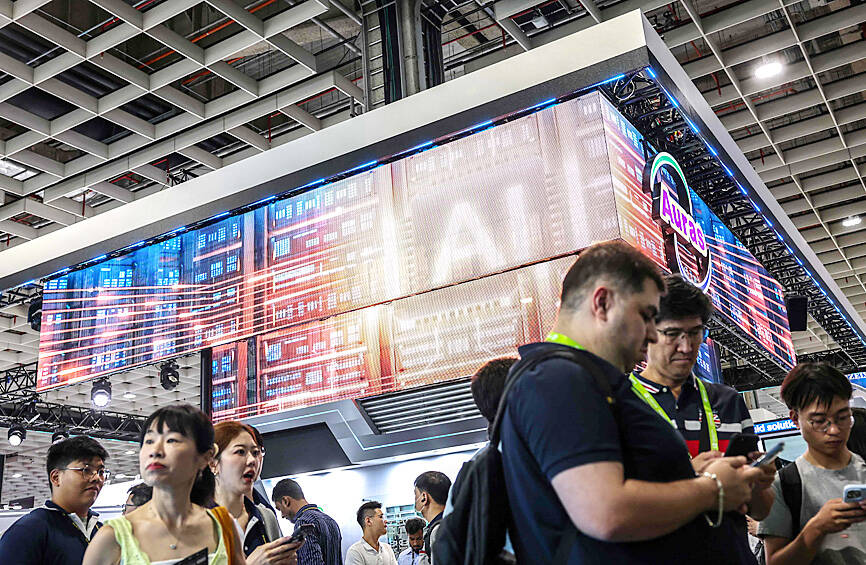
People walk past a display featuring artificial intelligence and data center imagery during Computex in Taipei on June 2.
Rather than relying on advances in individual chips or models alone, future AI infrastructure would increasingly need to integrate computing, memory, interconnects, storage and power management across chips, server racks and entire data centers, she said.
The shift is being driven partly by soaring demand for AI inference — the process of using trained models to respond to requests and perform tasks, Li said.
Global inference token volume has increased about 500-fold from its 2022 level, while more complex reasoning and agentic AI systems consume more tokens than conventional one-shot queries, she said.
“Inference is no longer a low-overhead task,” Li said, adding that it is becoming the dominant driver of system-level expansion as AI agents operate continuously in the background.
The growing workloads are putting pressure on four areas — logic scaling, interconnect efficiency, memory performance, and power delivery and cooling, she said.
Data movement alone can account for up to 60 percent of system activity in typical workloads, leaving accelerators operating at below 40 percent utilization, she added.
Meanwhile, AI packages might contain more than 1 trillion transistors by 2030, making multi-die architecture and heterogeneous integration essential, Li said.
To address those constraints, TSMC is developing technologies covering advanced logic, packaging and optical interconnects, she said.
She highlighted the chipmaker’s 3DFabric platform, which incorporates technologies such as system on integrated chips 3D stacking and chip-on-wafer-on-substrate advanced packaging, as well as its compact universal photonic engine platform for high-speed optical data transmission.
TSMC is also working to improve high-bandwidth memory performance by using advanced logic technology in high-bandwidth memory base dies, Li said.
In a question-and-answer session, Li said TSMC must develop an in-depth understanding of the supply chain “from silicon to the data center to the token” and work with ecosystem partners to validate its technologies as early as possible across that chain.
That reflects how TSMC’s role has expanded beyond manufacturing individual chips, she said.
“Gone are the days when we can just ship wafers across the fence,” Li said.
Related Stories
 AI News
A short postscript to my AI company adventure
50 minutes ago
 AI News
Hurricane model developed by Google boosted with artificial intelligence showing promise
51 minutes ago
 AI News
OpenAI Lets Some Customers Pay Only When AI Performs
51 minutes ago
 AI News
China blasts Anthropic and sets tough terms for U.S.
51 minutes ago
 AI News
‘Superhuman’ AI tool spots heart disease in less than 2 seconds
1 hour ago
 AI News
Physical AI at national scale: HUMAIN and Applied Intuition
1 hour ago
 AI News
This company designed a drug candidate with help from ChatGPT and Gemini
1 hour ago
 AI News
OpenAI's ad business shows blistering growth, hits $1 billion annualized revenue run rate
3 hours ago