
ChatGPT-6 Explained: The Future of Artificial Intelligence
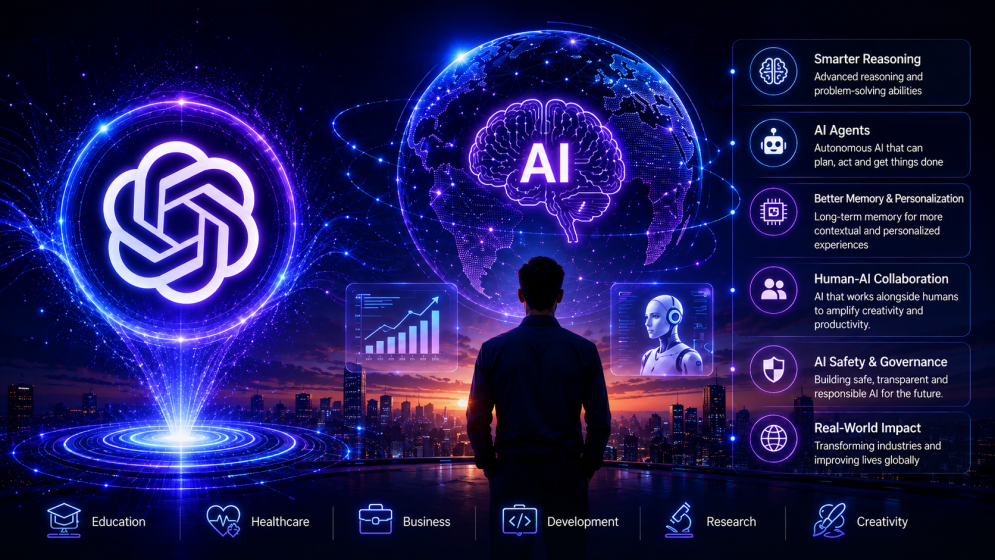
Artificial intelligence has evolved rapidly over the past few years, transforming from a research-driven technology into a powerful tool used by millions of people worldwide. As AI systems become more capable and integrated into everyday life, discussions are increasingly turning toward the next chapter of innovation and what future AI may look like.
ChatGPT-6 has become a focal point in these discussions because it represents broader expectations about the future of artificial intelligence. While the exact capabilities of future AI systems continue to evolve, current trends suggest that upcoming models may become more intelligent, context-aware, efficient, and useful across a wider range of real-world applications.
This article explores the technologies, opportunities, and challenges that could shape the future of artificial intelligence and why ChatGPT-6 has become an important part of that conversation.
The evolution from GPT-3.5 to modern multimodal AI systems has already demonstrated how quickly artificial intelligence can improve.
Support business and productivity workflows
These capabilities were considered highly advanced only a few years ago.
The next generation of AI is expected to build upon these foundations and expand them further. Read MoreChatGPT-6 Explained: How AI Evolved From GPT-3.5 to GPT-4o
One of the most anticipated developments in future AI systems is stronger reasoning.
While current AI models can already analyze information and assist with complex tasks, future systems may become significantly better at:
Improved reasoning could allow AI to provide more accurate, reliable, and context-aware assistance across professional and academic fields.
Rather than simply generating responses, future AI may become increasingly capable of helping users think through complex challenges.
One of the most discussed concepts in artificial intelligence today is the emergence of AI agents.
Unlike traditional chatbots that primarily answer questions, AI agents are designed to complete tasks, manage workflows, and perform actions on behalf of users.
Researching information across multiple sources
This shift could transform AI from a conversational assistant into a more active digital collaborator.
For businesses and professionals, agent-based systems may significantly improve efficiency and productivity.
Memory is expected to play a major role in the future of artificial intelligence.
Early AI systems often treated each conversation as a separate interaction. Future systems may become increasingly capable of maintaining context, understanding user preferences, and delivering more personalized experiences.
The goal is not simply remembering information but using context effectively to provide more useful assistance.
The future of artificial intelligence is unlikely to be defined by humans versus machines.
Instead, many experts believe the most impactful developments will come from collaboration between people and AI systems.
Productivity increases through collaboration
This approach allows individuals and organizations to benefit from AI capabilities while maintaining control over important decisions.
The strongest outcomes are likely to emerge when human expertise and artificial intelligence complement each other.
The development of multimodal AI has already changed how users interact with technology.
Future systems may become even better at understanding and combining information from:
This could create more natural and intuitive interactions between humans and machines.
Instead of switching between different tools, users may increasingly rely on a single AI system capable of understanding multiple forms of information simultaneously.
Industries That Could Be Transformed by AI
The future impact of artificial intelligence will likely extend across nearly every major industry.
AI may provide personalized learning experiences, adaptive tutoring, and improved access to educational resources.
Future AI systems could assist with research, administrative tasks, diagnostics support, and medical data analysis.
Developers may increasingly use AI for coding, testing, debugging, documentation, and system optimization.
Organizations could leverage AI to improve decision-making, automate workflows, analyze trends, and enhance customer experiences.
Researchers may benefit from faster data analysis, literature reviews, hypothesis generation, and collaboration support.
The long-term impact of AI may be comparable to previous technological revolutions such as the internet and smartphones.
As artificial intelligence becomes more capable, discussions about safety and governance become increasingly important.
The future success of AI will depend not only on innovation but also on responsible development.
Several key issues are likely to remain central:
Future systems must continue improving accuracy, transparency, and consistency.
As AI interacts with more personal and professional information, protecting user privacy will remain essential.
Most experts agree that humans should remain responsible for important decisions, particularly in healthcare, finance, law, and public policy.
Clear standards for AI development and deployment will be necessary to maintain public trust.
Balancing innovation with responsibility will be one of the defining challenges of the AI era.
What Could ChatGPT-6 Mean for the Future?
Although future AI capabilities continue to evolve,
[ represents growing expectations for the next generation of intelligent systems.
More importantly, ChatGPT-6 symbolizes a broader shift in artificial intelligence—from tools that simply generate information to systems that help people solve problems, complete tasks, and make better decisions.
The future of AI is not only about more powerful technology. It is also about creating systems that are more useful, trustworthy, and aligned with human needs.
ChatGPT-6 refers to the next stage in the ongoing evolution of AI language models and represents expectations for more advanced reasoning, memory, and AI assistance.
AI is expected to automate certain tasks, but many experts believe it will primarily augment human capabilities and create new opportunities rather than fully replace people.
AI safety helps ensure that increasingly powerful systems remain reliable, transparent, and aligned with human goals and societal values.
Artificial intelligence is entering a new phase of development. What began as a breakthrough in conversational AI has evolved into a technology capable of supporting education, research, business, software development, and countless other fields.
The growing interest in ChatGPT-6 reflects a broader recognition that AI will continue playing an increasingly important role in modern society. While the exact capabilities of future systems remain uncertain, current trends point toward smarter reasoning, better memory, stronger human-AI collaboration, and more advanced multimodal intelligence.
The future of artificial intelligence will not be defined solely by technological progress. It will also depend on how responsibly these systems are developed, governed, and integrated into daily life.
As AI continues to evolve, the focus should remain clear: building technologies that enhance human potential, support innovation, and create meaningful value for individuals and society.
Related Stories
 AI News
The 'infuriating' 999 calls made to police
53 minutes ago
 AI News
India’s AI opportunity could run into trillions of dollars, creating new possibilities for startups
1 hour ago
 AI News
Dublin-based LearnUpon secures €44.5 million to scale its agentic learning platform
1 hour ago
Strasbourg-founded Goodweek raises €10.69 million to become the AI Manager for SMBs
1 hour ago
 AI News
'AI artists' perform improvised music at Jarasum Jazz Festival
2 hours ago
 AI News
How my son showed me AI is now the world’s biggest lose
4 hours ago
 AI News
Artificial intelligence enters the corporate sphere: how can companies turn it into an opportunity?
4 hours ago
 AI News
AI agents on Tencent Cloud try to break into Alibaba’s Amap: researchers
7 hours ago