
India’s AI opportunity could run into trillions of dollars, creating new possibilities for startups
India’s artificial intelligence (AI) opportunity could extend well beyond the $100 billion discussed by industry leaders, with the technology potentially adding $1 trillion to the country’s GDP by 2035. For startups, the opportunity lies in using AI to address large, underserved markets and building businesses that can scale across India and beyond.
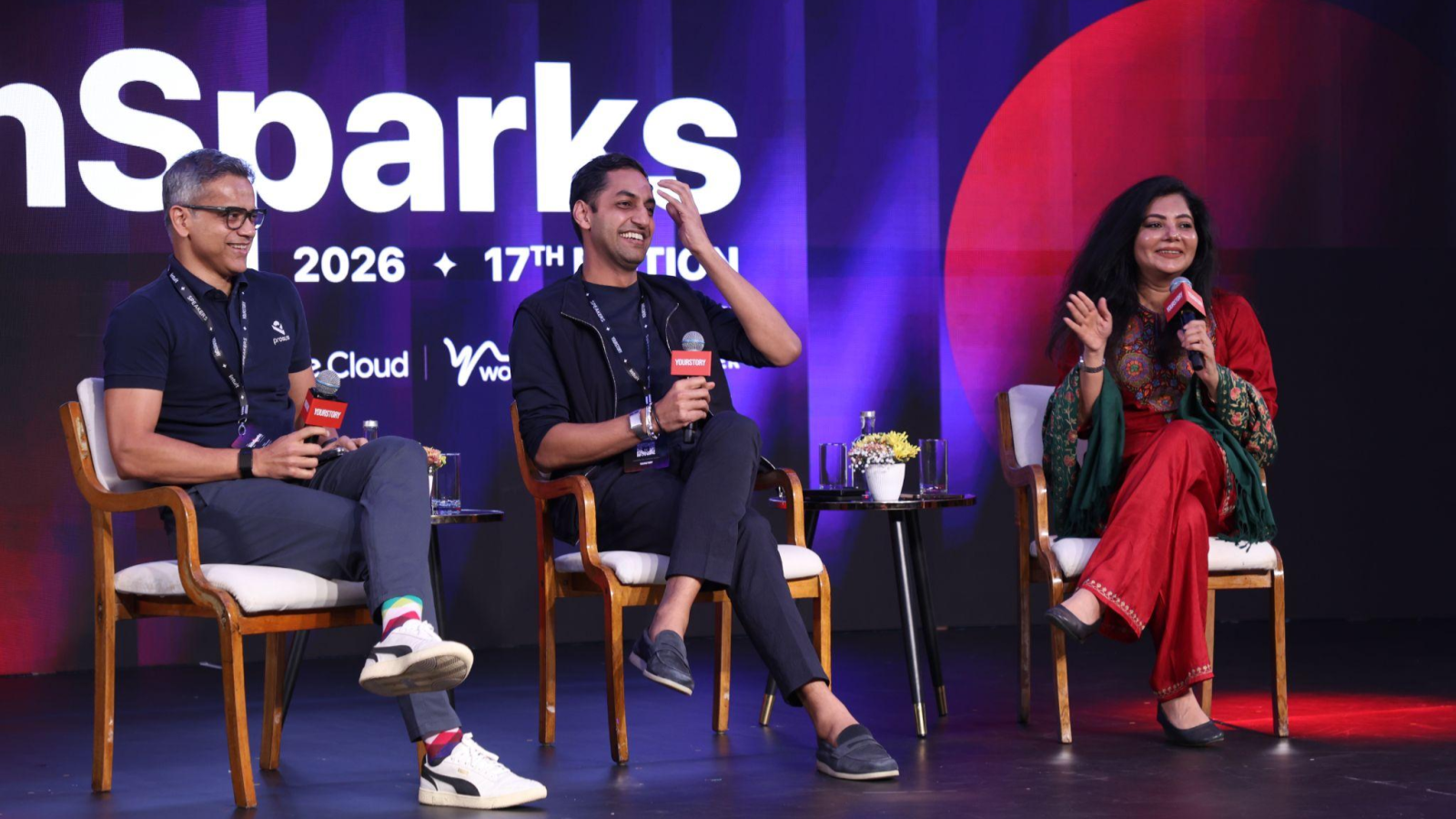
At a fireside chat with Shradha Sharma, founder & CEO, YourStory and The Bharat Project at Techsparks 2026 on the topic - India’s $100 Billion AI Opportunity, Ashutosh Sharma, Head of Investments and M&A, India, Prosus, and Keshav Reddy, Founder and CEO of Equal AI, highlighted how the technology could transform businesses, improve productivity and create new categories of consumer and enterprise companies.
Ashutosh Sharma said previous technology waves, particularly the internet and smartphones, created large businesses by democratising access to products and services. AI could take this transformation further by democratising access to intelligence.
“We are taking one more step. We are democratising something else, something new, and something much more powerful, and that’s intelligence. Everyone, after the proliferation of AI, will be more intelligent, more productive than before,” he said.
He added that the internet and smartphone revolutions had already generated businesses worth billions of dollars by helping consumers meet previously unmet needs.
“There is no doubt in my mind. With something that is more powerful, the outcomes will only be larger. $100 billion, trillion? I don’t know,” he said, pointing to the potentially enormous scale of the AI opportunity.
For Indian startups, Ashutosh Sharma believes the opportunity exists across virtually every sector. India has a large consumer market, a substantial talent pool and access to venture capital and private equity funding. More importantly, the country has numerous problems that could be addressed using AI.
He identified the shortage of quality education as one example of an area where AI-powered products could bridge the gap between demand and supply. Healthcare and other essential services offer similar opportunities for entrepreneurs to develop scalable solutions.
Reddy said India’s large-scale adoption of AI presents an opportunity for domestic companies to capture more of the value generated by the technology.
“We are the largest consuming AI country in the world, and it is only going to get more and more and more, and we need to make sure that that value is captured by Indian companies, by Indian consumers,” he said.
Reddy cited Equal AI’s experience as an example of how addressing a specific consumer problem can create opportunities for rapid growth. The company developed an AI-native call assistant in response to the prevalence of spam calls in India, where phone calls and messages remain important modes of communication.
According to figures shared during the discussion, Equal AI grew from around 70,000 monthly active users in January to 3.5 million in the preceding month. It was forecasting 15 million monthly active users by March. The company had also crossed one million daily active users and was targeting 10 million daily active users over the following 12 months.
“You have to go deep, find a problem, solve it well, and then just expand from there,” Reddy said, explaining the approach that startups could adopt to build successful AI businesses.
He also stressed the need for Indian companies to build consumer technology platforms capable of competing with global players. However, he identified computing costs as a major constraint on AI businesses seeking to serve millions of users.
Ashutosh Sharma said local understanding would be a key differentiator for Indian startups competing with international companies. Businesses that understand the nuances of Indian consumers and their everyday challenges could develop products better suited to the domestic market.
The panellists also urged entrepreneurs to focus on building sustainable competitive advantages. Sharma said falling product development costs and faster innovation cycles made it essential for founders to identify what would protect their businesses over the long term.
“The market is not a moat anymore,” he said, urging founders to think from the outset about the competitive advantage they were building.
Reddy emphasised the need for patient capital and a long-term commitment to entrepreneurship, noting that building large technology businesses often involves years of experimentation and failure.
For India's startup ecosystem, the opportunity is therefore not limited to the size of the AI market itself. The larger prize lies in converting the country's consumer scale, technology talent and unmet demand into globally competitive AI products and platforms. Whether the opportunity ultimately reaches $100 billion or extends into trillions of dollars will depend on how effectively Indian businesses deploy AI to solve real-world problems and capture the resulting economic value.
Related Stories
 AI News
AI
24 minutes ago
 AI News
Mini brain organoids ‘reading’ Braille marks key step towards biohybrid computing
25 minutes ago
 AI News
Africa, C’bean can become AI contributors
1 hour ago
 AI News
AI labs are buying data from dead startups to train their models
1 hour ago
 AI News
Elon Musk's AI company to testify at NYC Council hearing on artificial intelligence safety and regulations
1 hour ago
Lithuanian startup raises $5 million seed to expand beyond AI
2 hours ago
 AI News
Cyberattack AIs must be trained only on air
2 hours ago
 AI News
The 'infuriating' 999 calls made to police
3 hours ago