
Change in Canada’s citizenship law hitting U.S. archives
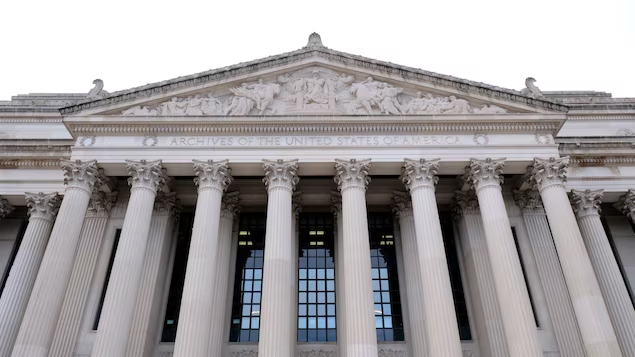
The U.S. National Archives and Records Administration is among the U.S. institutions that have seen an increase in records requests following Canada's adoption of Bill C-3 which extends Canadian citizenship to those who can show they have a Canadian ancestor. (Mark Tenally/The Associated Press)
Photo: (Mark Tenally/The Associated Press)
Elizabeth Thompson (new window) · CBC News
Sitting in their archive in Lafayette, Louisiana, Barbara Dejean and Stephanie Simon first heard about a change in Canada's citizenship rules in December, when they read an online news story.
Then the calls started coming in.
Calls from Americans who wanted to document their Canadian ancestry to apply under the new rules for Canadian citizenship certificates.
It started a bit earlier in January, but now we have over 450 requests waiting to be processed, said Simon, associate archivist at the Diocese of Lafayette, whose records include those of many Acadian families.
The same day that we mail out 40, 40 more come in the mail, so it's not like we can make some headway on it. It's just kind of keeping up with them.
Dejean estimates their two-person archive has received 1,350 requests for records since Bill C-3 went into effect on Dec. 15, 2025. Turnaround time for those requests is currently 12 to 16 weeks.
It used to be two to three days.
They're from all over, all over the United States where we've been getting requests for our records, said Dejean. A lot of them are no longer here. The families have branched off and moved on.
Lafayette's archive is not alone.
Citizenship demand spreads to U.S. archives
While the increase in requests for genealogical records has not yet made it onto the radar of national associations of archivists in the U.S., many American archives — both large and small — are experiencing unintended consequences from Bill C-3.
Bill C-3 allows Canadian citizenship for those who can prove they're descended from a Canadian ancestor, even if that ancestor left the country several generations back. It was adopted after the courts ruled that limiting citizenship to the first generation born outside Canada was too restrictive.
It has become very popular — particularly with Americans.
According to the most recent figures available from Immigration, Refugees and Citizenship Canada, 6,635 people received Canadian citizenship certificates as a result of Bill C-3 between Dec. 15, 2025 and June 30, 2026. More than half of the newly recognized Canadian citizens under Bill C-3 – 3,510 people — were born in the United States.
Another 19,160 people have received certificates as a result of having a Canadian parent — 9,150 of them from the U.S. Prior to the bill's adoption, those who were born outside Canada had to have a Canadian parent to qualify for citizenship.
The certificates allow the 25,795 newly recognized Canadian citizens to apply for Canadian passports and live and work in Canada.
However, the backlog of applications for Canadian citizenship certificates has soared. It currently stands at 136,000 applications, with an estimated processing time of 33 months.
Last October, Immigration Minister Lena Metlege Diab told the House of Commons immigration committee that she didn't expect a flood of applications for citizenship certificates once Bill C-3 went into effect and she only expected volumes in the tens of thousands over time.
Estimates of just how many people could qualify for Canadian citizenship as a result of Bill C-3 vary widely.
Some point to a period spanning more than 100 years, in the 1800s and 1900s and even earlier, when hundreds of thousands of Canadians — particularly from Quebec — crossed the border for jobs in the U.S.
Small archives struggle with the workload
One area that saw an early influx of French-Canadian immigrants was southern Illinois, where Mike Heithaus serves as a part-time archivist with the Diocese of Belleville.
He said the number of requests began to climb around May or June before subsiding a bit in September.
From roughly June 1st to the beginning of September, I had 32 requests, which I know doesn't sound like a ton, Heithaus said. But when it's just me and I'm here 10 to 15 hours a week, that is basically consuming all my time to do those.
WATCH | Immigration officials paused 'lost Canadians' applications for a quality check after Bill C-3:
'Lost Canadian' applications paused for 'quality check': immigration minister
Immigration Minister Lena Metlege Diab says officials in her department paused applications for 'lost Canadians' — people living in other countries who can trace their lineage from Canadian ancestors — as part of a departmental 'quality check' on the program put in place after the passage of Bill C-3. 'It was normal that these things happen with quality assurance checks and it was determined at the time that things could be strengthened a bit more,' Diab told reporters in Winnipeg on Monday.
Heithaus said the diocese debated whether to continue responding to the requests. Instead of refusing requests, it decided to increase Heithaus's hours from 10 to 15 a week and more than triple the fee for requests from $10 to $33 US.
Pressure reaches larger archives, too
The U.S. National Archives and Records Administration's (NARA) collection includes different kinds of documents (new window) that can help establish ancestry, such as naturalization records, census records, passenger records and Canadian border-crossing records.
While NARA's public affairs department declined an interview, sources who spoke on condition of anonymity because of concerns for their jobs said archivists are seeing an increase this year in requests from people seeking Canadian dual citizenship under Bill C-3. They are also seeing an increase in requests from Americans who could qualify for dual citizenship in other countries, such as Italy or Germany.
Archivists have a variety of tasks, and the increase in requests by prospective dual citizens has created a backlog and led to longer processing times.
It's become untenable, one source said. It's become an unstable situation. People are seeking these records out and it's become most of our job.
Anderson Smith, an archivist with the Acadian Archives at the University of Maine at Fort Kent, said the number of requests related to documents for Canadian citizenship jumped from one each in 2024 and 2025 to 72 in 2026. However, a change to IRCC regulations in June that spelled out the need to provide original or certified copies of documents led to a decline in requests.
Early on, we were getting a lot more traffic from people because I think we were able to provide the records that they needed but then those regulations kind of changed in June and so we saw a decrease in the amount of people who were coming in with requests for these records.
WATCH | Canada looks to recruit U.S. doctors and scientists as Trump policies push talent abroad:
How Canada is trying to tap America’s brain drain
There’s a global rush to recruit America’s top talent as Trump administration policies push many professionals to explore career and study plans abroad. CBC’s Eli Glasner takes a closer look at efforts to bring some of those doctors and scientists to Canada.
Smith said staff at the archives are now helping requesters find the original sources or locate the original institutions that can provide certified copies of the records they need.
American archives aren't the only ones feeling the impact of Bill C-3.
Normand Deragon is president of the American French Genealogical Society (new window) based in Woonsocket, Rhode Island, which helps people research their French-Canadian roots. He says it has processed an estimated 200 requests since Bill C-3 came into effect and currently has a backlog of about 150 more.
We're an all-volunteer organization, nobody gets paid, said Deragon. Our libraries open only two days a week, so you can see how it would be easy for us to get backlogged…. But we do the best we can. We're cranking them out as quickly as we can.
Related Stories
 Canada
U.S. shouldn’t buy ’blood potash’ from Belarus, Sask. premier says
10 minutes ago
 Canada
Canada’s economy is losing $100B a year to illness and caregiving: report
10 minutes ago
 Canada
Canada’s privacy czar launches investigation of major driver’s licence hack
10 minutes ago
 Canada
Police say two men kidnapped 15-year
10 minutes ago
 Canada
Confused by what's going on in B.C. politics? Catch up on the disarray
10 minutes ago
 Canada
‘Pretty surreal’: Halifax home cook to compete on new season of ‘MasterChef Canada’
1 hour ago
 Canada
Canada to face fourth
1 hour ago
 Canada
New major projects bill, rowdy question period kick off Parliament's fall sitting
1 hour ago