
Eric Ries: How to scale without losing your soul
Eric Ries: How to scale without losing your soul
The Lean Startup author's new book argues that growth itself can corrupt founders' missions – and lays out the governance tricks to stop it happening to you.
Ask a founder which book rewired how they think about their business, and there is a good chance they will reach for the same answer: The Lean Startup.
15 years after Eric Ries first told entrepreneurs to stop writing five-year plans and start testing hypotheses instead, his ideas have become the default language of scaling businesses everywhere, from Silicon Valley unicorns to a crumble stall on a British high street.
Now Ries is back with a warning for founders who took his advice and made it work. In his new book, Incorruptible, he argues that success itself is the danger. Scaling a company, he says, tends to corrupt it, pulling it away from the mission that made it worth building.
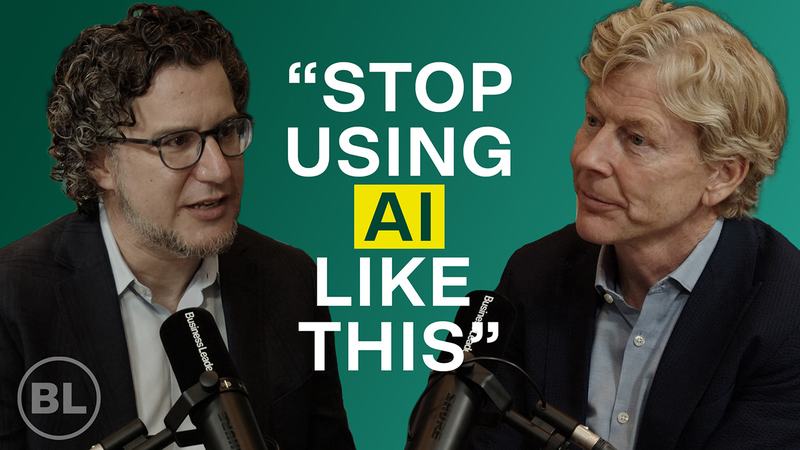
Speaking to Sir Richard Harpin on the Business Leader podcast, Ries explained how that corruption creeps in, and the practical steps founders can take to stay true to themselves however big they get.
In our interview, you will learn about:
Get insights straight to your inbox
When we spoke to Kim Innes, founder of Humble Crumble, she revealed that The Lean Startup by Eric Ries was the book that had the biggest influence on her. The success of her original market stall came from experimenting with different flavours to find what kind of crumble the customer liked best.
She assumed it would be exotic ones, but good old apple was a hit. Then again, so too was pumpkin flavour. She had to keep testing the market.
This “validated learning” is an example of just one of the key ideas that Ries has pioneered and popularised in The Lean Startup. He encourages founders to think of their businesses as machines that must continually test hypotheses.
Ries has drawn on this experience, including his more recent access to larger companies, to formulate the ideas in his new book Incorruptible. In some ways, this book is part two to The Lean Startup. It explains how successful startups can retain their integrity and find long-term growth.
His thesis is that the process of scaling a company typically corrupts it. Not in the sense of financial corruption by deliberate bad actors. Rather, this is corruption in the sense that a good idea is being spoilt by forces larger than the individuals involved.
Corruption is, of course, a powerful and loaded word. Ries toyed with others, like “mission drift” and “bureaucracy”, but none were powerful enough. “It finally dawned on me that our grandparents had a word for this that we don't use anymore,” he recalls. “They would have called it corruption. We, in our modern times, have this incredibly narrow view of the word, applying it to embezzlement or fraud.”
“I think that anybody who's found a way to make money without creating value is corrupting the moral logic of our economic system,” he says. “That would have been a very obvious idea in older generations. That was the unlock for me that allowed me to really put this book together.”
Eric Ries's warning for new founders
An inexperienced entrepreneur, Ries cautions, will become subject to “financial gravity”, as investors, lawyers and even independent board directors will subtly push them to follow the logic of a system that prioritises short-term financial gain. The entrepreneur's original vision comes crashing down to earth.
Ries's argument is that the current system prioritises extracting money from successful scaling companies, rather than long-term value creation. “We live in the era of shareholder primacy in the US and in the UK,” says Ries. “The idea that a corporation is fundamentally a financial instrument designed to enrich its shareholders.”
A classic example of this comes courtesy of American entrepreneur Sol Price, founder of FedMart and Price Club (which eventually became Costco). Price trained as a lawyer and built his businesses on the principle that the customers were his clients and he was acting in their fiduciary interest.
He did everything he could to keep his prices down, symbolised by the company's famous $1.50 hot dogs, which defy inflation, despite continual pressure from investors and analysts to raise prices.
“One of my favourite quotes in the book,” says Ries, “is from a Wall Street analyst who wrote: 'Costco is a company that takes money that rightfully belongs to shareholders and instead invests in the customer experience.' That's meant to be a criticism of Costco! It's like we have somehow got this idea that sucking the marrow out of the thing is what boards are supposed to do.”
Why you should resist 'financial gravity'
Costco has endured not because it is worth $400bn and is too big to be corrupted, Ries argues, but because it has a “governance fortress” in the legal documents that underpin it, including its corporate charter. These help it to resist outside pressure. Investors cannot easily sell the company or force the board to do things.
Many US companies are now going down the route of the Public Benefit Corporation (PBC). “The PBC is the critical antidote to the fiduciary duty trap,” Ries believes.
Anthropic has done this, for example. It means the mission is coded into the DNA of the company and can make some resistance to “financial gravity” easier later on.
Why Eric Ries built a stock exchange
Long-term missions can also be preserved through thinking carefully about the voting power that comes with shareholding. Super-voting powers for founders, or other trusted individuals, may frighten investors looking for an easy life, but they empower the mission. This is what allowed Mark Zuckerberg to resist Yahoo!'s early offer to buy Facebook for $1bn.
You can also offer tenured voting: those who commit to the company for longer get more of a say over its future. Or let employees, or indeed customers, own the company, through steward ownership, which lets a trust hold the shares on their behalf. Or put employees on your board, as is common in Germany. “There's a lot of data that shows that employee-owned companies grow faster,” says Ries.
If you get really big, you can protect yourself by forming a “constellation”, as seen in Sir Richard Branson's Virgin empire, Ikea, or Spain's Mondragon group of cooperatives. Family businesses offer a strong model too, Ries adds, if they have someone who can act as a “mission guardian”.
Ries's commitment to these ideas rests not just in his book, but in something tangible he has created: the Long-Term Stock Exchange, approved by the US Securities and Exchange Commission in 2019. “It has standards,” he explains, “that require companies to think in a long-term way as a condition of being listed.” Better-known names on it include Asana and Thredup.
Eric Ries's four lessons for leaders
Build your governance fortress before you need it. Ries argues that founders should not wait until they are already under investor pressure to protect their mission. Safeguards like super-voting shares or Public Benefit Corporation status belong in the legal architecture early, while a founder still has the leverage to insist on them.
A stubborn price can be a strategy, not a mistake. Sol Price's refusal to raise the price of Costco's hotdog became a cultural touchstone because it signalled where the company's loyalties lay. For founders under pressure to protect margins, some pricing decisions are about trust, not just economics.
Once you scale, you become the investor, not the entrepreneur. Ries told Harpin that leaders who accumulate power often get isolated by deference, as employees quietly withhold what a founder needs to hear most. See your teams as the little startups now working for you and back them rather than trying to be the all-seeing founder.
Use AI to learn, not to do the thinking for you. Founders who delegate tasks wholesale to AI risk losing their own skills, and their ability to judge whether they are making real progress. Ask it to teach and critique your thinking, not to replace your judgement.
You can watch Eric Ries's full conversation with Sir Richard Harpin on the Business Leader podcast.
Sharmadean Reid: How a pandemic pivot led to 39BC
From a pandemic-forced pivot to a Cleopatra-themed birthday party, Sharmadean Reid takes us through the journey of her fourth business
Sharmadean Reid: The anthropologist mindset that built a business empire
Sharmadean Reid explains how a gap in the nail art market and one bold pitch built the foundations of WAH Nails
Paula MacKenzie: PizzaExpress CEO shares her turnaround playbook
Seven CEOs in 11 years, a billion-pound restructuring and 73 closures. Paula MacKenzie on how she's turning PizzaExpress around
How Zoom is scaling beyond the video call
Zoom UK & Ireland head Louise Newbury-Smith on the strategy behind the company's reinvention and what leaders can learn from it
Barclays CEO Venkat on running a bank through cancer
The CEO has added roughly £40bn in shareholder value to Barclays, all while battling cancer
Related Stories
 Business
Cyera raises $400 million from Goldman Sachs, bringing 2026 funding to $1.4 billion
2 hours ago
 Business
Heidi raises $475 million, hits $1.26 billion valuation in blockbuster funding round
3 hours ago
 Business
Fixing agent memory
5 hours ago
 Business
What's next for the A303 after Stonehenge tunnel scrapped?
9 hours ago
 Business
Furniture rental company Furlenco gears up for Rs 1,200
9 hours ago
 Business
How two 23-year
9 hours ago
 Business
Global Startup Festival 'COMEUP 2026' Opens Pre
12 hours ago
 Business
Ministry of SMEs and Startups to Boost Social Solidarity Economy Enterprises... Expanding Funding and Market Support
14 hours ago