
AI debt flood is stoking bond yields, Pimco says
AI debt flood is stoking bond yields, Pimco says
The flood of debt financing for artificial intelligence (AI) capital expenditure is causing “indigestion” in fixed-income markets and fueling yields, but that dynamic should result in decent longer-term returns for investors, Pacific Investment Management Co (Pimco) said.
“There’s too much, too fast” AI-related issuance, Marc Seidner, Pimco’s chief investment officer of non-traditional strategies, said on a podcast with colleagues Pramol Dhawan and Gregory Hall.
It is “very possible” that helped drive the 10-year US Treasury yield to about 4.75 percent earlier this month, the upper end of a multi-year range, in a crowding out effect, Seidner said.
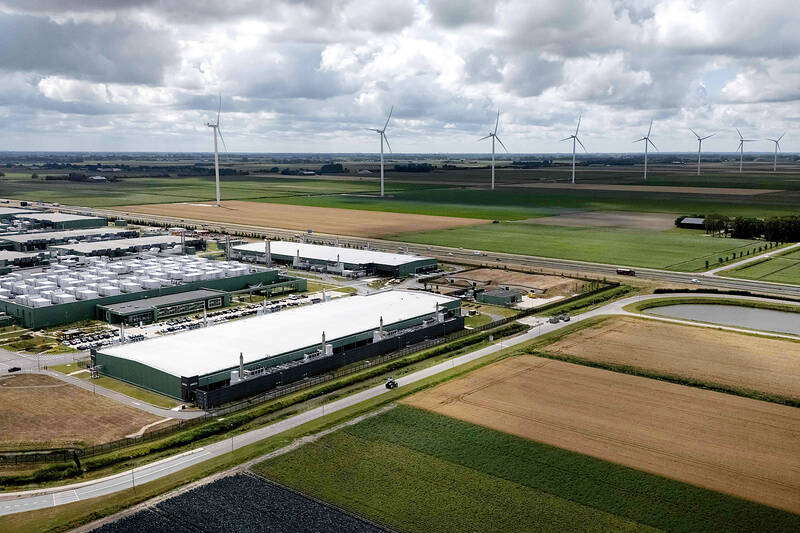
A Microsoft data center is pictured in Middenmeer, the Netherlands, on July 27.
Highly-rated large US tech companies including Amazon.com and Alphabet Inc have sold hundreds of billions of dollars of bonds combined this year, putting their debt in competition with the funding of governments that are struggling to repair their finances.
The upshot of it all is not necessarily bad news for fixed-income investors because the AI build-out is driving global growth and productivity, which is naturally going to push yields higher too, said Dhawan, Pimco’s head of emerging markets portfolio management.
“The AI capex story is beyond the US borders,” Dhawan said on the podcast recorded earlier this week. “You’re seeing Taiwanese real growth at 12 percent, [South] Korean growth, gangbusters.”
Seidner and Dhawan were discussing a recent note they published.
Current bond yields offer a “compelling entry point for long-term investors,” they wrote.
For one, investors can lock in yields now at a time when the macroeconomic outlook is far from certain, Seidner said, citing weak consumer confidence data and a recent disappointing jobs report.
“There are enough scenarios where you do really well as bond investors that we shouldn’t get all emotional and worked up about being at the top end of the range” in yields, Seidner said. “Many of us that are in the weeds looking at consumer related debt and other data and statistics worry quite a bit about the lower arc of the K-shaped economy.”
Related Stories
 AI News
Andreessen Horowitz Raises $1.1B to Fund Hardware Startups as AI Racks Near 1 Megawatt
3 minutes ago
 AI News
Enterprises Tap the Brakes on Tech Budgets While Demanding AI ROI
3 minutes ago
 AI News
The Pope says states struggle to control the concentration of artificial intelligence
3 minutes ago
 AI News
Cleveland Clinic AI Summit Highlights Growing Role of Artificial Intelligence in Healthcare
4 minutes ago
 AI News
CEO Jensen Huang went on an AI deal spree in August. Nvidia plans to invest $18 billion more this fiscal year.
1 hour ago
 AI News
Andreessen Horowitz Targets AI Supply Crunch With New $1.1 Billion Hardware Fund
1 hour ago
 AI News
Banks Turn to AI to Stop Overstocking ATMs
1 hour ago
 AI News
How AI is quietly reshaping chemical sciences
1 hour ago