
Unlocking a 400-year
Unlocking a 400-year-old mystery in a Nova Scotia marsh
Poutrincourt gristmill believed to be oldest mill in North America
On a river in southwest Nova Scotia, an investigation by a historical sleuth is uncovering long-lost traces of North America’s past.
Allains River (formerly Lequille River) is a winding tributary of the Annapolis River, flowing from the interior of the province to what is now Annapolis Royal.
Four hundred years ago, the river was home to one of the earliest industrial operations established after colonization: a flour mill built in 1607 and destroyed by fire in 1643.
For centuries, the exact location of that mill was a mystery. But now, an amateur historian from the U.S. and a team of researchers and archeologists are getting closer to pinning down its location — shedding light on the history of colonization, contact and millennia of Mi’kmaw presence in Nova Scotia.
“It's a fascinating mystery to solve, and it is a phenomenally important site,” said Mark Borton, a writer from Connecticut who initiated the hunt for the Poutrincourt gristmill.
“An astonishing number of things took place at this location.”
Gristmill needed to produce flour
In 1605, a fortified fur-trade post was built at what Samuel de Champlain called Port Royal, on the Annapolis Basin.
Colonists needed a mill to make flour. “Twenty-five per cent of [French] dietary intake at that time was bread,” said Borton.
The Poutrincourt gristmill — a water-powered mill for grinding grain — appears on maps from the period, including Champlain’s map.
That map caught the eye of Borton, who previously had a career making boating guide books of the East Coast of the United States. Eventually, he retired early and took a trip to the Maritimes in 2018.
That sparked an interest in tidal power and the Bay of Fundy. In researching a book, Borton saw a copy of Champlain’s map, and right away, he knew that the mill was significant.
“What we're looking for is the oldest mill in North America. It's also the beginning of industrial power in North America. So it's an enormous inflection point.”
The problem for Borton — and for generations of historians before him — was that contemporaneous maps did not accurately represent the landscape.
Over the centuries, historians have advanced different theories about where the mill could be.
But Borton believes the mill could be at a location “way outside” historians’ theories.
Taking elements from Champlain’s map and mapping them onto current-day geographical features, Borton was able to narrow down a site. From his home in Connecticut, Borton used Google Maps to look at that location and saw a faint square on the edge of the marsh that could be a foundation.
“You don't get squares in tide marshes unless it's man-made,” he said. “I was thinking, well that's what I'm looking for, where I'm looking for it.”
Borton applied for a permit from the Nova Scotia Museum and continued to investigate.
Area also featured dikes, fishing weir
One clue was that on Champlain’s map, there was a Mi’kmaw fishing weir in the river, opposite the mill. Zooming in on Google Maps, Borton could see a pile of rocks at that spot on the riverbank. “You can't account for the presence of that through natural stream processes.”
Today, the area between the weir and the potential mill site is a marsh, but on Champlain’s map, it’s an island. For Borton, that made sense, since the French could well have diked that part of the river. But there was a hiccup: historical maps did not show any dikes in that area.
Borton approached the Nova Scotia Community College and asked if they would make a lidar map (lidar is a remote sensing method used to make highly accurate 3D maps).
On the resulting maps, Borton could see straight lines and other traces of diking, suggesting a series of dikes dating back to the early 17th century.
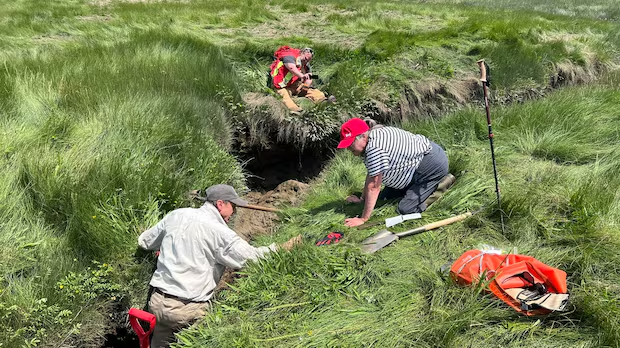
This summer, Borton and staff from the Nova Scotia Museum collected samples from the piles of wood and brush that made up the interior of each of those dikes for radiocarbon dating.
“And that's how we move from a good theory to something more solid,” Borton said.
Borton has also enlisted the help of archeologists at Kwilmu’kw Maw‑klusuaqn — the group tasked with protecting archeological resources by the Assembly of Nova Scotia Mi’kmaw Chiefs — and Saint Mary’s University.
Jonathan Fowler, professor of anthropology at Saint Mary's, said Borton’s project is closely aligned with his team's research on this era, which is consequential as a period of contact and exchange between the French and the Mi’kmaq.
Allains River is an important part of that history, Fowler said.
“In this one place archeologically, you get the European story and European land use, nesting right next to a much older story of human land use: a Mi’kmaw travel corridor and fishing site.”
Fowler’s team is planning to use ground-penetrating radar to further investigate the mill site.
“It's a story of a shared landscape,” Fowler said. “This early period is a period of co-operation. It's a negotiated settlement with Indigenous people. That's interesting, and I think it might hold some lessons for the present and the future.”
Fowler said the project to uncover historical sites on Allains River has itself brought people together, and he commends Borton for being a catalyst.
As for Borton, his investigations have also brought to light a number of other mill sites in the area.
“There are possibly eight national historic sites … in the Allains River, in an area that's only half a kilometre. That’s really extraordinary.”
Borton said as an outsider, it’s not up to him to decide what happens, but he hopes uncovering the truth will make a case for preservation.
“If you think about this as a multicultural landscape, it is Mi’kmaq, it is French-Acadian, it is British … that’s an extraordinary coincidence of activities, so it’s worth preserving.”
Nova Scotians wait over 500 ‘painful’ days for surgery consultations
Don't blame shelters alone for client behaviour, says N.S. minister
Charges laid following investigation into alleged illegal landfill outside Halifax
Teardown of former Northern Pulp mill could begin next month
No charges to be laid in death of N.S. boy killed by 3 dogs, say RCMP
Related Stories
 Community
Wainwright community grapples with aftermath of military base disaster
2 hours ago
 Community
Dawson Creek voters embrace Dwaine Dilworth as their newly elected mayor
2 hours ago
 Community
'Looking for a change': Fort Nelson mayor eager for B.C. election
3 hours ago
 Community
Calm space garden needs younger helpers to survive
1 day ago
 Community
Israel-Lebanon agreement shines light on long
1 day ago
 Community
As the new film hits theaters, we rank Street Fighter's LGBTQ+ characters
1 day ago
 Community
Teacher threw cellphone, tackled shooter who killed 4 at Oregon school, police say
1 day ago
 Community
3 children, 1 teacher dead after shooting at Oregon elementary school, police say
2 days ago