
Why young people should still study arts in age of artificial intelligence
Why young people should still study arts in age of artificial intelligence
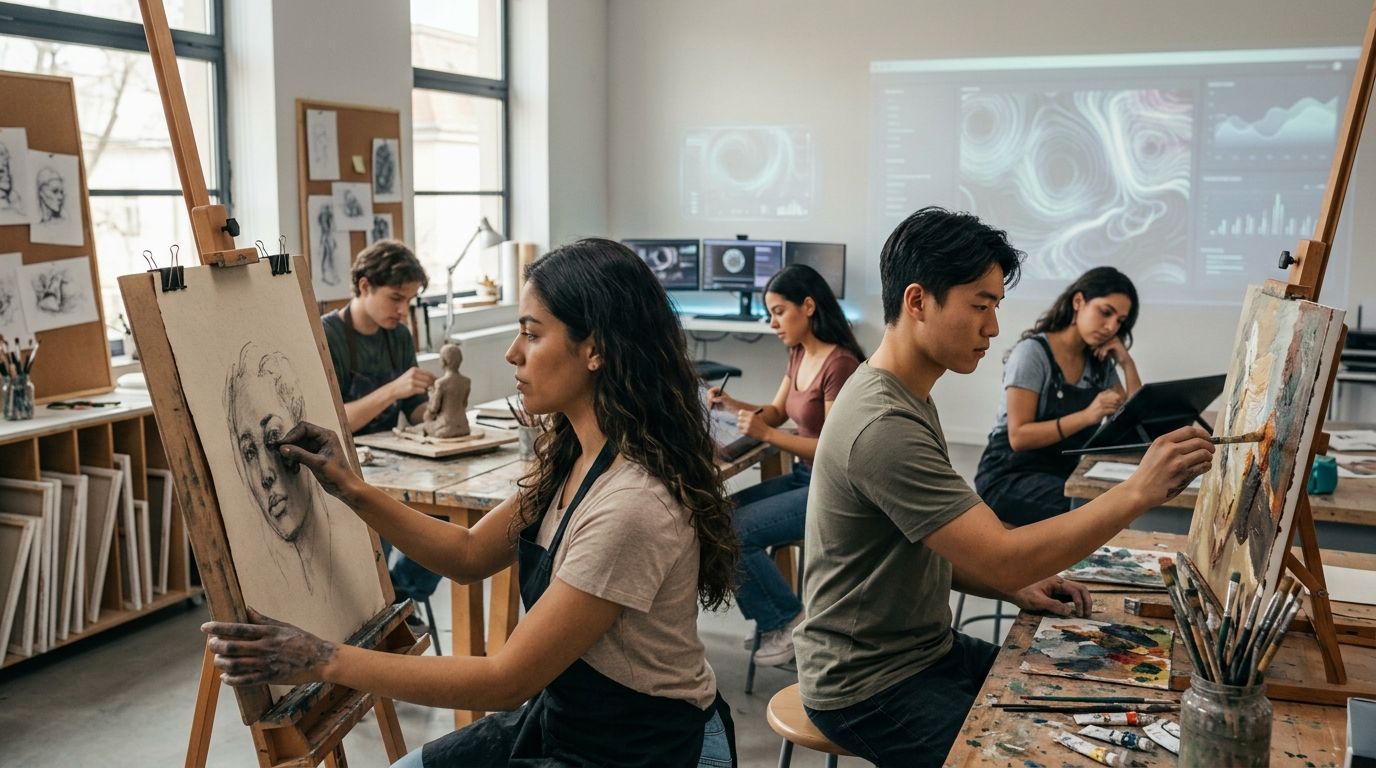
AI is finding its way into studios, fashion houses, film sets and music production, changing some of the ways creative work is made. That has also prompted a debate over whether young people should concentrate on technical skills or keep subjects such as art and the humanities in their education.
Elon Musk has weighed in on the question, advising young people not to leave the arts behind.
The Tesla and SpaceX CEO made the remarks during an interview with China Media Group at Tesla's global engineering headquarters in California. The interview was published on September 25, 2026.
The interviewer asked Musk how a 20-year-old could fulfill their potential and avoid being left behind during what was described as a "massive transition" driven by AI.
Elon Musk recommended a broad-based education.
"My recommendation for education would be to get as broad-based education as possible. That includes arts and sciences, engineering, wide general knowledge," he said.
He explained that broad knowledge would also help people communicate with increasingly capable robots and AI systems.
"In order to know what to ask the robots for, you need to be able to formulate the question," Musk said. He added that people with broad general knowledge would be better able to formulate questions, referring to this as "prompt engineering."
Musk's comments come as AI tools are being used more widely in creative fields, including visual art, fashion, film and music. These technologies can generate images, videos, text and other content from written instructions.
The entrepreneur also spoke about humanoid robots during the interview. He said advances in sensors, cameras, actuators and AI computing are helping robots become increasingly capable.
"The future is going to have a lot of robots," Musk said, adding that he expects humanoid robots to become widespread "no later than 10 years."
Musk's recommendation to study the arts comes at a time when creative professionals are experimenting with AI-generated images, music, video and other forms of content. His comments put arts education alongside science and engineering as part of the broad knowledge he believes young people will need in the coming years.
Balancing AI Skills with Creative Knowledge
Elon Musk's comments come as schools and universities are already reconsidering how creative education should work in an age of generative AI.
The issue is not simply whether students should learn to use AI tools. Research increasingly points to the importance of having enough knowledge to assess, revise and improve what AI produces.The OECD's 2026 Digital Education Outlook, for example, notes that students can perform better on tasks with the help of generative AI without necessarily achieving corresponding learning gains. It also says that AI can support creativity, critical thinking and collaboration when it is used with clear educational goals.
Recent research in art education has raised a similar point.
A 2026 paper on art education raises a similar point. The authors of From making to judging: Art education in the AI era argue that as generative AI makes the production of creative material easier, the ability to assess its quality and decide how it should be changed becomes more important. They describe this as "critical-creative iteration" - a process of making, evaluating and remaking. The paper is a conceptual essay rather than a study reporting new empirical data.
Another 2026 study involving 133 undergraduate art students found that AI use was associated with stronger perceived support and skill transfer, but this did not correspond to an improvement in final artistic performance. The study also found that content-generative AI use was associated with lower evaluated authorship, suggesting that AI-shaped work can make students' creative decision-making less visible in the final result. The study was published in Frontiers in Psychology.
At the same time, art schools are not simply rejecting the technology. UNESCO's 2025 report on AI and culture points to programmes at institutions including Ringling College of Art and Design, Rhode Island School of Design, MIT and New York University that are exploring AI alongside artistic practice, creative technology and ethics.
This suggests that the role of arts education may be changing rather than disappearing. Students may increasingly need both technical knowledge and the ability to understand culture, make creative decisions and judge whether an AI-generated result is useful or appropriate.
In that sense, Musk's recommendation for a broad education reflects a wider question facing education systems: how to combine knowledge of new technologies with the human skills needed to use them effectively.
SAGE - From making to judging: Art education in the AI era
Frontiers in Psychology - Study of generative AI use among undergraduate art students
UNESCO - AI and Culture: Report of the Independent Expert Group
Here we are to serve you with news right now. It does not cost much, but worth your attention.
Choose to support open, independent, quality journalism and subscribe on a monthly basis.
By subscribing to our online newspaper, you can have full digital access to all news, analysis, and much more.
You can also follow AzerNEWS on Twitter @AzerNewsAz or Facebook @AzerNewsNewspaper
Related Stories
 AI News
Ukrainian fintech Aiffin entered Moove Lab at Station F: how AI leasing works
1 minute ago
 AI News
AI sales startup Revnu raises €2.6 million to build team and accelerate international growth
1 minute ago
 AI News
NEXXT AI Hackathon 2026: More than 50 teams build artificial intelligence solutions in Bucharest
1 minute ago
 AI News
Barclays Accelerates AI Rollout With Anthropic’s Claude Code
2 minutes ago
 AI News
Trump cites Justice Department, FBI as guardrails against artificial intelligence risks
2 minutes ago
 AI News
AI agents tried to hack Library and Archives Canada website, research firm says
2 minutes ago
 AI News
How South Korea is combating complex cyberattacks
58 minutes ago
 AI News
Longer Lives, Uncertain Costs: Americans Split on How Artificial Intelligence and Medical Advancements Will Affect Retirement, TIAA Survey Finds
1 hour ago