
Why founders need to adopt a global mindset from day one

It’s vital to help our best startups take on the biggest markets on the planet, says Anais Guillemaud
Commentators regularly concur that Scotland has ambitious technology startups and the talent to build globally competitive businesses. One challenge is ensuring our brightest tech companies think internationally early enough, and have the networks and support to turn that ambition into reality.
For many Scottish founders, the biggest opportunities lie in the vast US market to the fast-growing economies of Asia. Reaching those markets requires more than a good product. It requires connections, confidence and an understanding of how to navigate unfamiliar ecosystems.
I have seen this first-hand through Techscaler, which CodeBase runs on behalf of the Scottish government. Since the first international delegation to San Francisco and Silicon Valley in 2024, we have helped Scottish founders take their businesses into markets including the US, Singapore, Japan and the UAE.
The numbers are encouraging. Our international programmes have generated almost 3,000 connections, more than 400 commercial leads and around 60 contracts. But perhaps what matters most is what sits behind those metrics.
Successful international expansion relies on understanding a market, building trust, testing your proposition and learning how buyers in another country think. Often, that can only happen when you are there, face-to-face.
One Scottish deeptech company, weeteq, used a Techscaler mission to Japan to revive commercial discussions that had stalled remotely, securing a pilot with a leading semiconductor company. In New York, LiberEat turned years of groundwork into a meeting with a major US supermarket chain, triggering a formal contract and integration process. Tethered arrived in the city with one meeting in the diary and left having held 19, opening conversations with seven major hotel groups.
Wellness startup danceSing landed in the US with no clients, but now has contracts signed and a clear strategy for how to scale in the world’s largest lifestyle market. LifeLens VR used the market validation and commercial strategy developed in Singapore to help secure an external investment round. Stemming from our UAE programme, Simple Online Healthcare progressed supply chain and manufacturer agreements.
Sometimes the most valuable outcome is discovering that a market is not right for you, allowing scarce time and capital to be deployed elsewhere. Either way, internationalisation needs to become part of a company’s DNA.
Scotland is a small nation with a relatively small domestic market. But that need not be a disadvantage if our companies are encouraged to build with a global mindset from day one.
We have the talent, ideas and technology. Now we need to give our best startups the connections and confidence to take on the biggest markets on the planet.
The next generation of Scottish technology success stories will not be defined by how well they conquer Scotland, but by how successfully they compete globally.
And this is only the beginning. Next month, our fifth Techscaler cohort heads to Silicon Valley, followed by a third Singapore programme in October, while our first Hong Kong programme is already open for applications. If Scotland’s tech startups are going to compete globally, we need to keep opening doors.
Anais Guillemaud, Head of International, CodeBase
Related Stories
 World
World
Final entry lists published for World Athletics Road Running Championships Copenhagen 26
42 minutes ago
 World
World
World News in Brief: September 5
43 minutes ago
 World
World
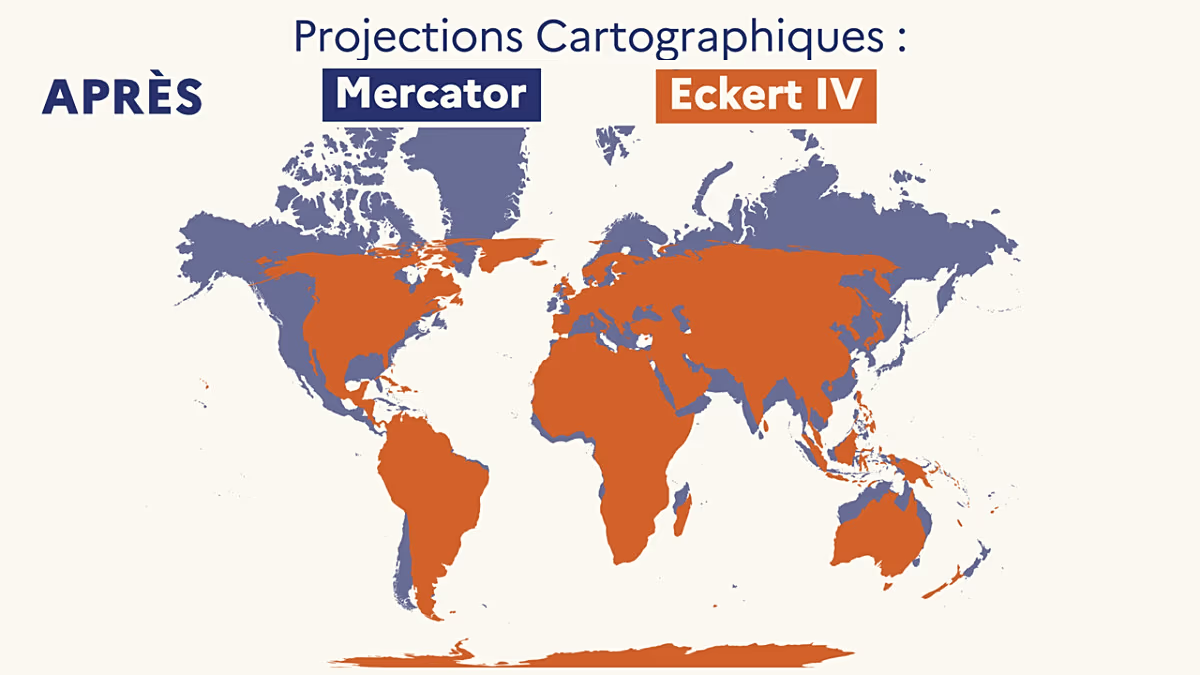
Paris drops Mercator projection: France now looks smaller on world maps
1 hour ago
 World
World
Prince William to represent King Charles at funeral of Norway’s King Harald V
1 hour ago
 World
World
‘Radical’: U.S. rejects U.N.
2 hours ago
 World
World
Katie Taylor retires as world champion after Flora Pili victory
2 hours ago
 World
World
US hits three Iranian oil tankers after saying its warships were targeted
3 hours ago
 World
World
More torrential rain forecast to pound southwestern Japan | NHK WORLD
4 hours ago