
What has happened to the 2022 Leicester disorder inquiry?
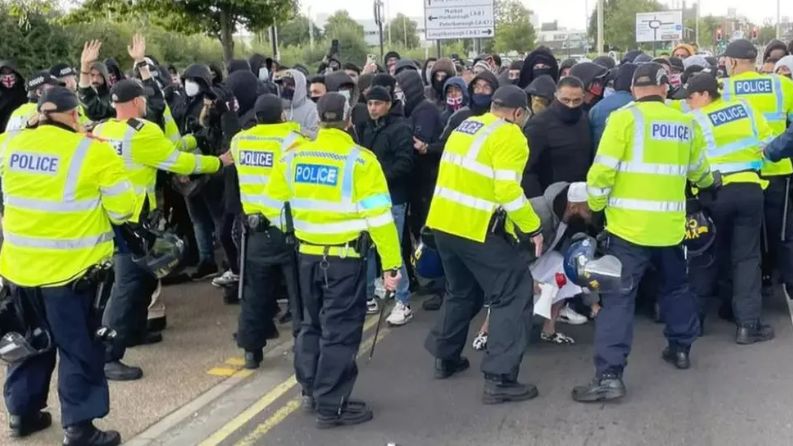
It is exactly four years since violent unrest in Leicester raised fundamental questions about the city's reputation as a model of community cohesion.
Tensions erupted as hundreds of mainly young men from Hindu and Muslim communities faced off across police lines on 17 and 18 September.
The 2022 disorder prompted international headlines, with rival narratives about how agitators stoked tensions on social media, and whether divisive South Asian religious politics were playing out on UK streets.
The government commissioned an independent review into what happened. Former Labour MP Lord Ian Austin was appointed to lead the review when it launched in 2023.
But with no publication date in sight, what has happened?
Lord Ian Austin was appointed to lead the independent review [UK Parliament]
The independent review into unrest in Leicester was commissioned by Lord Michael Gove, who was secretary of state for levelling up, housing and communities in the then Conservative government.
The Austin-led panel heard from "hundreds of local people", as well as faith and voluntary organisations, political leaders, the police and city council.
They were asked to establish what happened in Leicester and why, what could be done to improve social cohesion and prevent similar issues in the UK in the future.
The government defended Austin's appointment after his appointment was criticised.
Rita Patel is a community activist and former Leicester city councillor [BBC]
Rita Patel said she was trapped in a restaurant in Belgrave Road as the violence unfolded and gave evidence to the Leicester review.
The community activist, who was a Labour city councillor at the time, said she was "really concerned" the review had still not been published.
"A lot of people in Leicester believed that because communities had always got on harmoniously, it was always going to be like that," she said. "It's quite easy for us to sleep-walk again into a situation like that.
"It's a folly to think we can just forget about it and carry on. Unless we learn the lessons of the issues created by that perfect storm, we're doomed to it happening again."
Suleman Nagdi, from the Federation of Muslim Organisations, said publishing the review would not serve any useful purpose, and he was now focusing on building bridges between Muslim and Hindu schools.
The previous government said the panel would report back their findings and recommendations for Leicester and national government late in 2023, and Austin said they aimed to publish them in the October of that year.
But his report was not released before the Conservatives lost the 2024 general election, so it went into the new Labour government's in-tray.
Over the past few months, the BBC has repeatedly asked officials when Austin's report will be published.
In response, the Ministry of Housing, Communities and Local Government (MHCLG) has pointed us to the following parliamentary response in November 2025.
"The government is reviewing the panel's findings and recommendations and will respond in due course," it said.
But will this response involve releasing those details to the public?
Leicestershire and Rutland's police and crime commissioner, Reform UK's Rupert Matthews, told the BBC he has heard nothing about publication, and fears it is being "brushed under the carpet".
Matthews said the report was absolutely crucial, because of "enormously controversial" tensions between newly arrived Hindu workers from Daman in India, and Muslim residents who settled decades ago.
"It was being fed by religion, ethnicity, geo-politics going on in the Indian subcontinent between India and Pakistan and other factors, so it doesn't fit the [usual] narrative.
"Publish it. If you don't face up to awkward questions, they're only going to get worse and fester," he said.
Matthews added Leicestershire Police would have been conducting murder inquiries if seriously injured victims had not received such good hospital treatment.
He said the Leicester review was "hugely expensive", and the force had to divert hundreds of hours of officer and staff time away from policing Leicestershire and Rutland.
The police arrested dozens of men in the wake of the disorder, and said most were from Leicester and Birmingham.
More than 30 people were eventually convicted of crimes ranging from making threats to kill and assaulting an emergency worker, to public order and driving offences.
It emerged one Daman man jailed for a possessing an offensive weapon, with marchers chanting Hindu slogans, was from an Indian Christian family.
It followed weeks of escalating tension over issues ranging from the celebration of religious festivals and a cricket match, to car convoys that were interpreted as a provocation.
Police and Crime Commissioner Rupert Matthews told the BBC it is "absolutely crucial" the findings are published [BBC]
Leicester's Labour city mayor Sir Peter Soulsby, Leicestershire Police and Gove all declined our invitation to comment on the progress of the Leicester review.
Some community leaders told us the city had moved on since a weekend of violence that did not represent their wider communities.
The BBC also approached Austin and the review's two other panel members, Prof Hilary Pilkington and Dr Shaaz Mahboob.
No-one who responded to us could tell us whether the report will be published, and several did not expect it to be released at all.
In May this year, the BBC attempted to obtain a full or redacted copy of the review's findings and recommendations by submitting a freedom of information (FOI) request.
That request also asked for correspondence about whether and when the review would be published.
The MHCLG argued releasing the information was not in the public interest while the panel's findings were being reviewed by officials and ministers.
An appeal against this initial ruling found the information was exempt from FOI on cost grounds, and said more than 5,000 relevant items would need to be checked for personal details.
A line of police officers stopped protesters moving back on to Belgrave Road after a night of violence [BBC]
So what has emerged about the religious dynamics of the 2002 unrest?
In the days immediately afterwards, local Hindu and Muslim leaders issued a joint unity statement that blamed "small groups of people from both communities" for causing division.
The governments of India and Pakistan both "strongly condemned" the violence in Leicester, but blamed opposing sides.
Speaking to the BBC in November 2022, Leicestershire's then chief constable Rob Nixon said he was disturbed by the way people on all sides spread misinformation on social media.
A month later, the Bishop of Leicester, Martyn Snow, called for government action on disinformation, adding "political affairs in other countries have ripple effects here in the UK".
In February this year, academics at the University of London made a series of recommendations in a separate Independent Commission of Inquiry into the Violence in Leicester.
Its report concluded the unrest was preventable and inflamed both by "political Islamist" influencers in the UK and "Hindu nationalist actors" in India.
It called for an independent public inquiry into all forms of extremism, and a rapid response unit to tackle disinformation in Leicester.
Several other reports have reached opposing conclusions, which blamed agitators on either side of the religious divide.
So where does that leave the government-commissioned, Austin-led review?
This week the BBC made a further approach, requesting an interview with a government minister and answers to these questions about its progress:
Can you confirm the Leicester review will be definitely be published?
Has the Leicester review been shelved?
How much has the Leicester review cost?
We also asked whether the government was still considering any of the following options: Publication, sharing the findings with Leicestershire Police and Leicester City Council, sharing the review within government only, or shelving the review.
The MHCLG did not provide answers to any of those questions.
An official said they had nothing to add to previous responses, and would not be able to put a minister up for interview.
Listen to BBC Radio Leicester on Sounds and follow BBC Leicester on Facebook, on X, or on Instagram. Send your story ideas to eastmidsnews@bbc.co.uk or via WhatsApp on 0808 100 2210.
'Significant failings' during city disorder - report
Call for evidence in Leicester disorder review
City disorder shows need for integration - bishop
Did misinformation fan the flames in Leicester?
Large-scale disorder breaks out in Leicester
Related Stories
 India
India
Ukraine
1 hour ago
 India
India
Indian Ambassador Srivastava pays farewell call on FM Khanal
1 hour ago
 India
India
India’s Youth and the Politics of Jobs, Exams and Identity
1 hour ago
 India
India
PM Modi turns 76: The making of India’s longest
2 hours ago
 India
India
Failed asylum
2 hours ago
 India
India
'Keep Sports Free From Politics': Pakistan hockey team won't travel to India; wants ACT shifted to neutral venue
10 hours ago
 India
India
Nuclear Rivals at Sea: India
11 hours ago
 India
India
Whose Periyar? How the rationalist leader’s legacy shapes Tamil Nadu politics across party lines
12 hours ago