
India’s Youth and the Politics of Jobs, Exams and Identity
India’s youth were never meant to sit in the audience and applaud. Throughout India’s political history, young people have questioned power, challenged the system and, at times, changed the direction of the country’s politics.
Go back nearly fifty years, and you find the student movements of the 1970s. Students in Gujarat and Bihar raised their voices against inflation, corruption and the system. Under the leadership of Jayaprakash Narayan, that movement did not remain limited to students. It changed the course of the country’s politics. Then came 1975, when protecting democracy and civil liberties itself became the question. In the 1980s and 1990s, the Mandal debate gave youth politics a new direction, and the Anna movement brought a whole generation onto the streets over corruption and accountability. Across all these movements, one thing was common: young people were not followers of any ideology. They were asking questions about their own future.
“Caravans do not stop because someone turns away; the question stays alive with every generation that arrives.”
From JP to Anna, Youth Have Always Asked Questions
This is the point from which the two upcoming programmes in Ujjain and Indore should be understood.
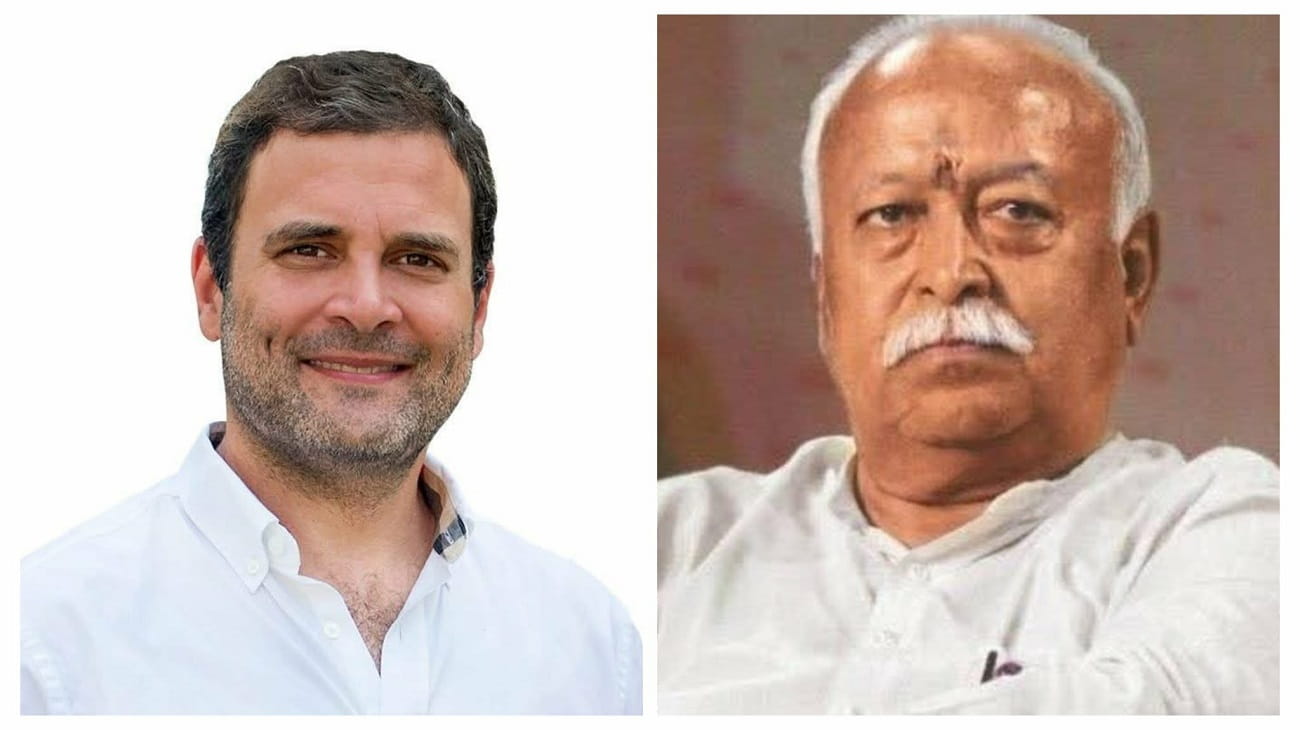
The Yuva Dharma Sansad is being held in Ujjain, with more than 1,700 young people from 24 states expected to take part. The programme will discuss religion, culture, nation, education, science and the challenges of modern life. RSS chief Mohan Bhagwat will address the youth there on September 18. The very next day, on September 19, Rahul Gandhi will be at Chhatron Ki Goonj in Indore.
At first glance, the two programmes may look similar. Both are engaging with young people. Both are going out to meet them. Both are saying that youth are the country’s future. But the real difference is not in the stage. It is in the direction of the question. One stage asks: Who are we? The other asks: What is happening to us? That is the basic difference.
Who Are We, or What Is Happening to Us?
There is nothing wrong with talking about religion, culture, civilisation and our roots. Such conversations are necessary to understand India’s soul. But when a young person spends five years preparing for an exam and the paper is leaked, when a family spends lakhs of rupees educating a child who still cannot find a job, when competitive exams keep getting caught in controversy, when education keeps getting costlier while jobs remain scarce — at that moment, their first question is not what their cultural identity is. Their first question is: When will my exam happen? When will I get a job? When will I get justice?
This is where Chhatron Ki Goonj comes in. Rahul Gandhi launched this campaign in June 2026, asking students to speak up and share their views on paper leaks, high fees, the examination system and jobs.
This difference is not small, because in politics there are only two ways to address young people. One way is to remind them of their identity, and hold their attention for a while with religion, nation and dreams that never come true, so that they never really look at the ground reality. The other way is to remind them of their rights, make a real effort to secure those rights, and hold the government accountable for solving their problems. The first creates emotion. The second creates accountability. And the real test of democracy lies more in accountability than in emotion.
Youth Need More Than Recognition of Their Pain
There is a notable shift in Mohan Bhagwat’s recent statements about youth. In his August 2026 remarks on Gen Z, he said that young people’s grievances are genuine and that protest can be a form of dialogue in a democracy. He also stressed the need for reform in education and for listening to youth. This is welcome, because in a democracy, listening to dissent cannot belong to only one party or one ideology.
So the question arises: should young people only be heard, or should there also be a political cost for their problems? It is not enough to tell a young person that their pain is real. The next question is: what will actually change in the system because of that pain?
“Hearing with the ear is not enough, O ruler; changing what is in people’s hearts is the real justice.”
Rahul Gandhi’s politics perhaps takes a different path from here. If we judge his last nearly two decades only by electoral wins and losses, we miss an important side of his politics. In 2007, when he was given charge of the Youth Congress and NSUI, he began pushing for youth participation and internal democracy in these organisations. Since then, his political journey has kept connecting with the questions of youth, students, farmers, workers and social justice. Chhatron Ki Goonj today is a new chapter of that same journey.
Here, Rahul Gandhi is not telling young people to follow his thinking or just listen to him. He is telling them: share your experience, tell me about it. This difference matters. During Chhatron Ki Goonj in Prayagraj, students and young people preparing for competitive exams shared their pain over the examination system, jobs and an uncertain future. Anyone who listens to this carefully cannot stay unmoved by the state of the country’s youth. For Rahul Gandhi, young people are not just a future political force. The present condition of youth is itself a living problem for India.
From Listening to Youth to Giving Them a Voice
Now this debate is not religion versus democracy. It is about the priorities of young people. It would also be wrong to turn this into religion versus secularism. India has religion, and it always will. It has faith, and it always will. It has culture, Sanatan tradition, Jain philosophy, Buddhist thought, Sikh tradition, and India’s beauty is that democracy lives alongside all of this.
But democracy means something very practical. It means a student should get a chance based on merit, not because of their faith. It means an exam paper should be protected by a fair system, not by anyone’s political identity. And it means a young person should not be called anti-national for asking their own government about their future.
This is the real test on which every political effort aimed at youth should be judged. The real question is not whether the Yuva Dharma Sansad in Ujjain is bigger, or Chhatron Ki Goonj in Indore is more important. On September 17–18, Ujjain will hold the Yuva Dharma Sansad, and on September 19, Rahul Gandhi will be among youth in Indore for Chhatron Ki Goonj. The media and political parties may present this as two political camps facing off, but seen through the lens of history, the bigger question is: what kind of citizen will India’s youth become?
Will they only be citizens proud of their identity, or also citizens who can question their own government? Will they only be told about the greatness of the past, or also be allowed to question the shortcomings of the present? Will they only be told India is great, or also told that keeping India great means fighting the flaws in the system?
India’s Youth Must Inherit More Than the Past
This is perhaps both the biggest strength and possibly the biggest challenge of Rahul Gandhi’s politics today: he is trying to turn youth dissatisfaction into questions, not just emotion. And in a democracy, there is no political tool more powerful than a question, because the day young people stop asking questions, democracy itself starts to weaken.
So the real contest is not between two leaders, not even between two individuals. It is a difference between two political viewpoints. One view places the young person inside a larger cultural story and keeps asking: who are you? The other starts from the young person’s lived experience and asks: what is happening to you?
India probably needs both questions. But if I had to say which question matters more for taking democracy forward, my answer is clear: before asking “who are you,” we must ask “what is happening to you.” Identity connects us to the past. Questions take us towards the future. And India’s youth are not just heirs of the past — they are the builders of India’s future.
That is why Chhatron Ki Goonj should not be seen as just another political programme of Rahul Gandhi. It should be seen as part of a larger democratic question: will we let young people speak for themselves, or will we keep speaking on their behalf?
This is where I see the most important part of Rahul Gandhi’s engagement with youth. His message is not “follow me.” It is “raise your own voice.” And perhaps, in a democracy, there can be no more modern, democratic or necessary beginning to youth politics than that.
“Do not ask for borrowed light; ask for a flame of your own.
Learn to question — that is where the real revolution begins.”
Related Stories
 India
India
Ukraine
24 minutes ago
 India
India
Indian Ambassador Srivastava pays farewell call on FM Khanal
51 minutes ago
 India
India
PM Modi turns 76: The making of India’s longest
1 hour ago
 India
India
Failed asylum
1 hour ago
 India
India
'Keep Sports Free From Politics': Pakistan hockey team won't travel to India; wants ACT shifted to neutral venue
9 hours ago
 India
India
Nuclear Rivals at Sea: India
10 hours ago
 India
India
Whose Periyar? How the rationalist leader’s legacy shapes Tamil Nadu politics across party lines
11 hours ago
 India
India
People and the politics of contest, construction and compensation
11 hours ago