
USC at the Leading Edge of AI
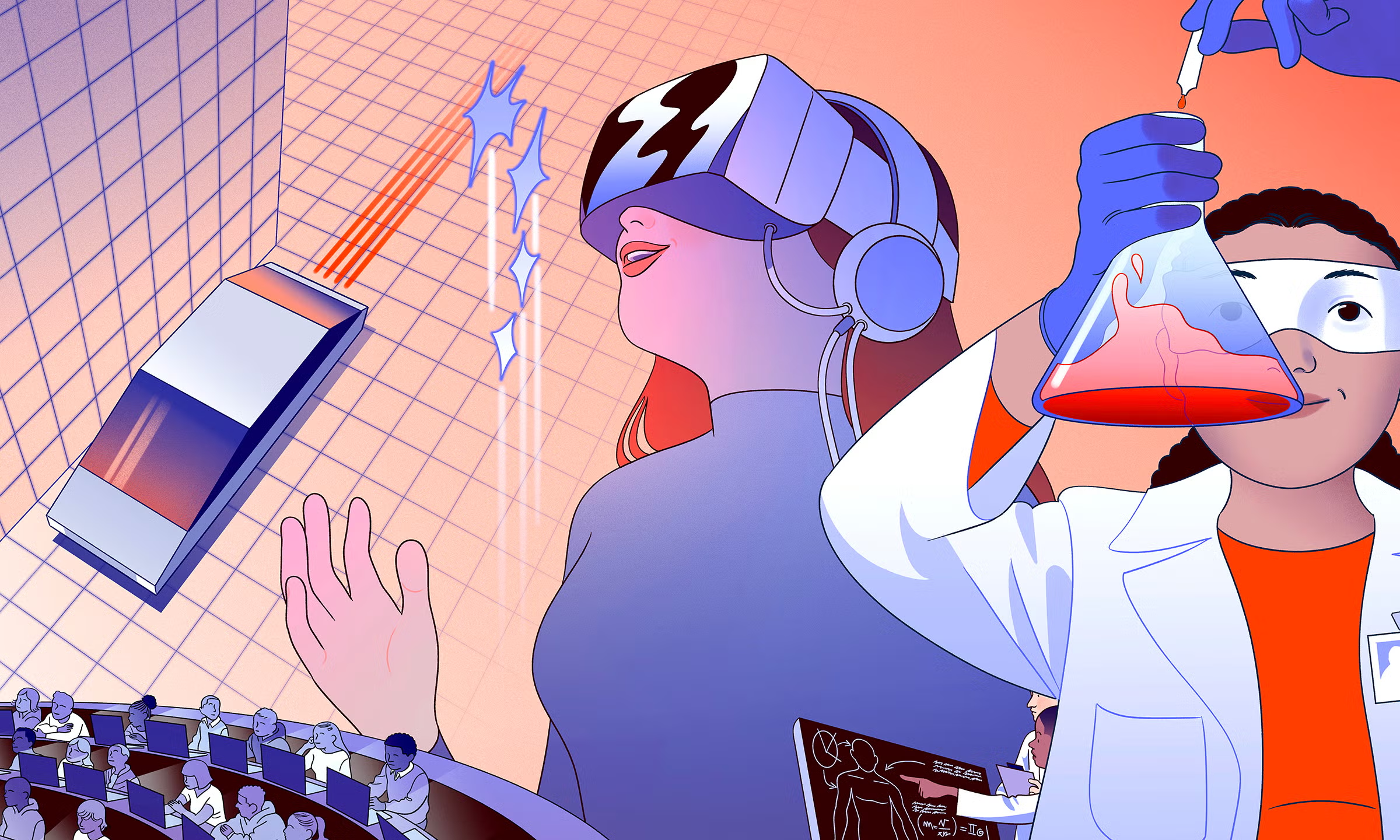
Under USC President Beong-Soo Kim’s leadership, advancing ethical AI that puts people first has become a university priority. (USC Illustration and animation/Bianca Bagnarelli)
From diagnosing disease to accelerating drug development, USC researchers are using artificial intelligence to tackle urgent real-world challenges — while keeping ethics, empathy and human impact at the center of innovation.
Improving drug safety. Creating a new medication delivery system for the eye. Preparing Los Angeles for the 2028 Olympic and Paralympic Games.
At USC, artificial intelligence is moving beyond theory and into everyday problem-solving.
Across USC’s schools and campuses, researchers, faculty and practitioners are developing innovative solutions for societal issues, imagining new approaches to making art and finding ways for creators to prepare for a shifting landscape as AI increasingly intersects with different fields.
“USC is uniquely positioned at the forefront of responsible and trustworthy AI,” says Shrikanth Narayanan, vice president for presidential initiatives, University Professor and Niki & C. L. Max Nikias Chair in Engineering. “USC is ready to lead by bridging engineering and computing excellence with ideas and perspectives from across the rich human-centered domains.”
Under USC President Beong-Soo Kim’s leadership, advancing ethical AI that puts people first has become a university priority — building on USC’s legacy of innovation while preparing the next generation of researchers, scientists, engineers, entrepreneurs, artists and health professionals.
A recent transformational gift of $200 million from USC Trustee Mark Stevens and his wife, Mary, underscores that ambition. Past gifts from the Lord Foundation of California, USC alumnus Daniel J. Epstein and ophthalmologist Allen Ginsburg and his wife, Charlotte, have helped launch the USC Mark and Mary Stevens School of Computing and Artificial Intelligence and build the Dr. Allen and Charlotte Ginsburg Human-Centered Computation Hall, among other AI-centered efforts. Together, these investments have strengthened USC’s efforts to become a national leader in AI-powered research, education and innovation.
The future of artificial intelligence will be shaped not by algorithms, but by the choices people make about how those algorithms are used, Narayanan says. He adds that emphasis on social good is at the core of USC’s embrace of artificial intelligence.
“USC’s AI vision has trust at its core,” Narayanan says. “By integrating computational thinking and AI tools directly into our laboratories, studios and classrooms, our faculty are not just conducting research and artistic endeavors — they are cultivating an ecosystem that prepares our students to be the ethical leaders and innovators of tomorrow.”
Perhaps the best way to tell the story of AI at USC is through the people putting it to work.
Read the entire series: USC at the Leading Edge of AI
Part 1: The Business Students Who Want to Use AI for Good
Part 2: The Researchers Making Drug Development Safer
Part 3: The Creatives Preparing for a Shifting Landscape
Part 4: The Filmmaker Who is Demystifying AI Through Storytelling
Part 5: The Team Preparing Los Angeles for the 2028 Olympics And Beyond
Related Stories
 AI News
Bill Gross bets AI can help mass
2 days ago
 AI News
Nigeria records 93% rise in AI micro
2 days ago
 AI News
The Italian gelato maker using AI to invent new flavours
2 days ago
 AI News
Closing the Gap Between Agentic CX Pilots and Production
2 days ago
 AI News
New Brunswick data centre debate highlights cross
2 days ago
 AI News
How to Structure an AI Agent Referral Fee Agreement Between Startups
2 days ago
 AI News
No, AI didn’t delete a Swedish reality TV series
2 days ago
 AI News
There is no AI in Armageddon. Artificial intelligence is a tool, not an apocalypse
2 days ago