
Social intelligence Arises Between Minds
Social intelligence Arises Between Minds
Neuroscience and AI research reveal cooperation as a shared neural emergence.
Updated June 7, 2026 | Reviewed by Kaja Perina
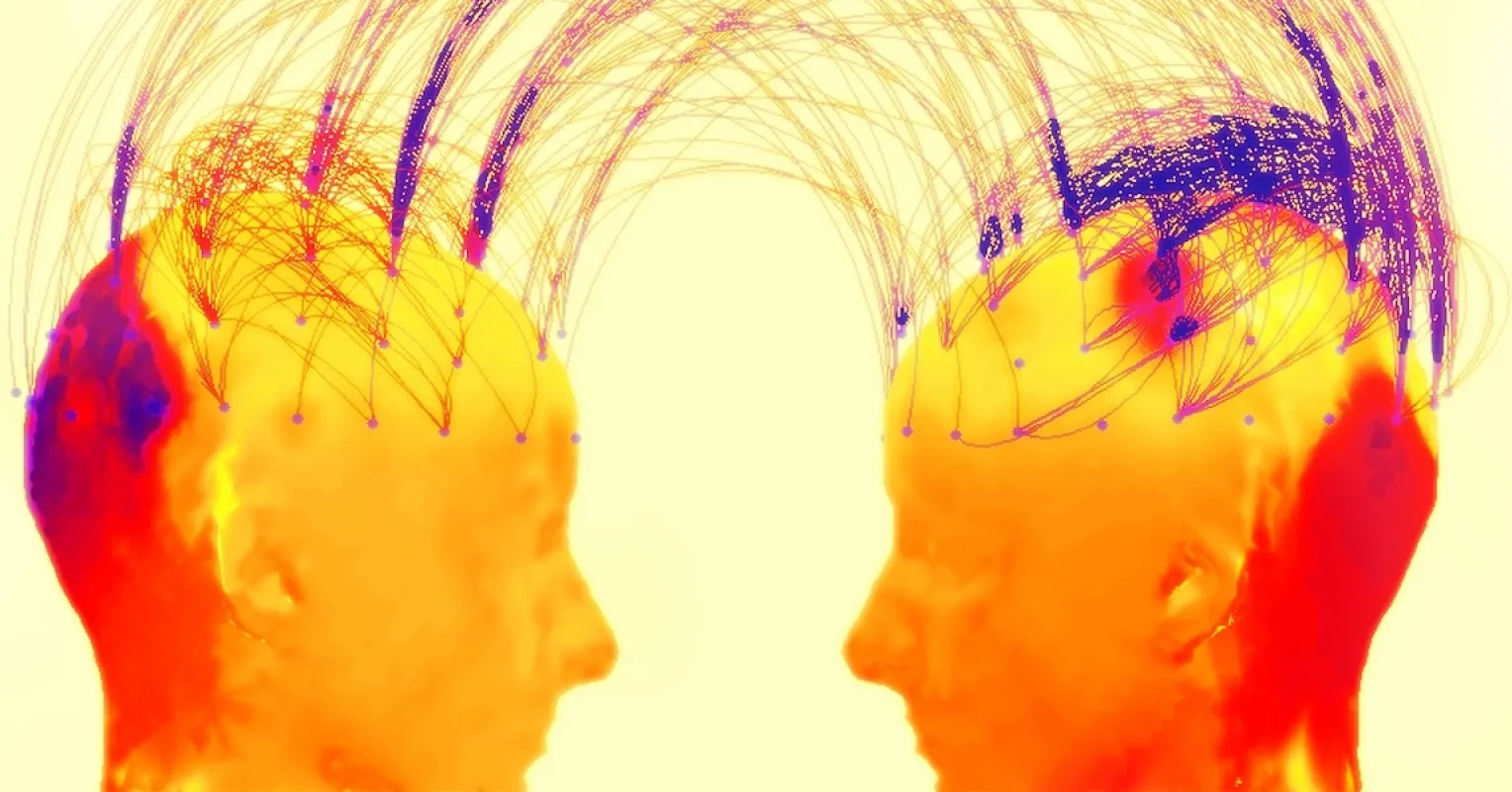
Here is something odd about the most powerful artificial minds ever built. They can translate between a hundred languages, predict protein structures, and beat grandmasters at chess. Yet not one of them has ever truly interacted with another mind. Not in the way a three-month-old infant does when she locks eyes with her mother, their neural rhythms falling into sync, a feedback loop of mutual recognition spinning up between two brains that, for a few seconds, function as one.
We have built solitary thinkers at an extraordinary scale. What we have not built, or barely attempted, is intelligence that emerges in between.
Social Interaction as the Dark Matter of AI
Three years ago, my colleague Samuele Bolotta and I published a perspective paper arguing that social interaction is the "dark matter" of AI. The metaphor was deliberate. In physics, dark matter is not some exotic footnote; it constitutes most of the universe's mass and shapes the structure of everything we can see. We argued that the social dimension plays an analogous role: not a feature to bolt onto an already intelligent system, but the missing substrate without which certain forms of intelligence simply cannot arise.
The argument rests on a straightforward observation. Human cognition did not evolve in isolation. Theory of mind, metacognition, language: these are not fully hardwired modules. They are shaped through social interaction during development. As Cecilia Heyes has compellingly argued, they are "cognitive gadgets" assembled from cultural learning, not evolutionary instincts. From birth, we use other minds as scaffolding for building our own. Yet mainstream AI proceeds as if intelligence were a property of the solitary agent, a Cartesian thinker alone in its digital room, optimizing reward functions against an environment that happens to contain other agents but treating them as furniture.
We proposed three axes for what we called Social Neuro-AI: biologically inspired cognitive architectures, temporal coordination grounded in dynamical systems theory, and social embodiment. The framework was a roadmap. What we did not anticipate was how rapidly the empirical evidence would arrive.
Key Discoveries in Two Body Neuroscience: Shared Neural Subspaces
In 2025, two landmark papers, published simultaneously in Nature and Science, have brought the neuroscience of social interaction into direct dialogue with artificial intelligence.
Weizhe Hong's group at UCLA tackled a question that sits at the heart of what I have called "two-body neuroscience": what happens in the neural space between interacting brains? Using calcium imaging to record from molecularly defined neurons in the dorsomedial prefrontal cortex of socially interacting mice, they discovered something elegant. The high-dimensional neural activity within each animal's brain can be decomposed into two distinct subspaces: a shared subspace, capturing shared dynamics across both animals, and a unique subspace, encoding what is specific to each individual.
The surprise was in the cell types. GABAergic inhibitory neurons, a minority population in the cortex, contained a considerably larger shared neural subspace than excitatory glutamatergic neurons. The inhibitory architecture, it turns out, is disproportionately tuned to the social dimension. Notice that this shared subspace was not merely a byproduct of perceiving the same stimuli. It arose from the behaviours of both self and other, and it required direct, ongoing interaction to emerge.
Here is where it gets provocative. Hong and colleagues then trained reinforcement learning agents in a multi-agent environment and found that, as social interactions emerged, shared neural activity patterns also emerged between the artificial agents' networks. The patterns bore remarkable structural similarity to those observed in the mice. When they selectively disrupted the neural components sustaining these shared patterns, the agents' social behaviours collapsed. The shared subspace was not epiphenomenal. It was functional.
How Cooperation Emerges in Biological and Artificial Systems
Their companion paper in Science pushed the question further. Can we observe the emergence of mechanisms of cooperation in both biological and artificial systems? Jiang and colleagues designed an operant task requiring two mice to coordinate their nose-pokes within a narrow time window to receive mutual rewards. Through a series of elegant controls (opaque barriers blocking visual information, unilateral reward conditions), they demonstrated that success required genuine active coordination, not mere mimicry or coincidental timing.
The mice developed sophisticated strategies: approaching the action zone, waiting for the partner, holding back when the partner was absent, proceeding when coordination was possible. Neural recordings in the anterior cingulate cortex revealed that these decision processes — hold versus proceed, self-action versus partner-action — were explicitly represented in distinct neural populations. In the vocabulary of dynamical systems, the dyad had settled into a stable attractor that neither animal could have reached alone.
Then came the artificial parallel. Reinforcement learning agents trained on an analogous task independently developed convergent behavioural strategies and neural representations. Specific subpopulations within the artificial networks encoded cooperation-relevant decisions in ways that mirrored the biological brain. Targeted perturbation of these subpopulations disrupted coordination, revealing functionally distinct roles.
The implication is clear: the computational architecture of cooperation may not be species-specific, or even substrate-specific. It may be a convergent solution, a kind of universal grammar of coordination, that any sufficiently complex system discovers when the task demands genuine joint action.
Studying AI As We Study Animals: A Neuroethological Approach
This convergence between biological and artificial systems is not a coincidence. It reflects a deeper methodological insight. A recent preprint from Kanaka Rajan's group at Harvard argues that deep reinforcement learning agents need to be studied the way neuroscientists study animals: with the tools of neuroethology (the study of neural systems in naturalistic behavioural contexts), not just reward curves. Using a complex foraging environment, Simmons-Edler and colleagues demonstrated that model-free agents can exhibit structured, planning-like behaviour through emergent activity alone, without explicit memory modules or world models. The key was looking beyond aggregate performance to analyze the joint structure of behaviour and neural representations.
This is exactly the kind of bridging that Social Neuro-AI demands. If we want to understand how social intelligence emerges in artificial systems, we need the same rigour we bring to studying it in biological ones. Beyond the technical challenge, there is a conceptual one: we lack the equivalent of ethograms for multi-agent AI, systematic catalogues of social behaviour that would let us compare artificial sociality with its biological counterparts.
The Question We Are Not Asking in AI
These papers collectively point toward a thesis that is both scientifically fertile and philosophically unsettling. Intelligence may not be a property that individuals possess. It may be a property that emerges between them. The shared neural subspaces Hong discovered are not confined to a single brain. They exist in the relational space between two. The cooperative strategies Jiang's mice invented were not individual solutions. They were dyadic achievements, irreducible to either animal alone. The neurobiologist Francisco Varela had a word for this: enaction, the idea that cognition is not representation of a pregiven world but the bringing forth of a world through interaction.
If this is true for mice and for artificial agents trained with simple reward signals, what does it mean for the systems we are currently building at scale? Large language models are trained on the products of human social interaction (text, dialogue, arguments), but they have never participated in such interactions. They have consumed the residue of inter-brain coupling without ever coupling. They are, in a sense, raised on books about swimming without ever touching water.
The field of AI stands at a crossroads it has not yet fully recognized. We can continue building ever-larger solitary minds and hope that social intelligence emerges as a byproduct of scale. Or we can take seriously what neuroscience is telling us: that interaction is not a feature of intelligence but a constitutive condition for it.
The dark matter is not optional. It is what holds the galaxy together.
Bolotta, S., & Dumas, G. (2022). Social Neuro AI: Social interaction as the "dark matter" of AI. Frontiers in Computer Science, 4, 846440. https://doi.org/10.3389/fcomp.2022.846440
Heyes, C. (2018). Cognitive gadgets: The cultural evolution of thinking. Cambridge, MA: Harvard University Press.
Dumas, G., Nadel, J., Soussignan, R., Martinerie, J., & Garnero, L. (2010). Inter-brain synchronization during social interaction. PLoS ONE, 5(8), e12166. https://doi.org/10.1371/journal.pone.0012166
Zhang, X., Phi, N., Li, Q., Gorzek, R., Zwingenberger, N., Huang, S., Zhou, J. L., Kingsbury, L., Raam, T., Wu, Y. E., Wei, D., Kao, J. C., & Hong, W. (2025). Inter-brain neural dynamics in biological and artificial intelligence systems. Nature, 643. https://doi.org/10.1038/s41586-025-09196-4
Jiang, M., Kao, J. C., & Hong, W. (2025). Neural basis of cooperative behavior in biological and artificial intelligence systems. Science. https://doi.org/10.1126/science.adw8151
Simmons-Edler, R., Badman, R. P., Berg, F. B., Chua, R., Vastola, J. J., Lunger, J., Qian, W., & Rajan, K. (2025). Deep RL needs deep behavior analysis: Exploring implicit planning by model-free agents in open-ended environments. arXiv. https://doi.org/10.48550/arXiv.2506.06981
Varela, F. J., Thompson, E., & Rosch, E. (1991). The embodied mind: Cognitive science and human experience. Cambridge, MA: MIT Press.
Related Stories
 AI News
Bill Gross bets AI can help mass
1 week ago
 AI News
Nigeria records 93% rise in AI micro
1 week ago
 AI News
The Italian gelato maker using AI to invent new flavours
1 week ago
 AI News
Closing the Gap Between Agentic CX Pilots and Production
1 week ago
 AI News
New Brunswick data centre debate highlights cross
1 week ago
 AI News
How to Structure an AI Agent Referral Fee Agreement Between Startups
1 week ago
 AI News
No, AI didn’t delete a Swedish reality TV series
1 week ago
 AI News
There is no AI in Armageddon. Artificial intelligence is a tool, not an apocalypse
1 week ago