
Silicon Valley of Europe 2026: Top Tech Hubs & AI Startups
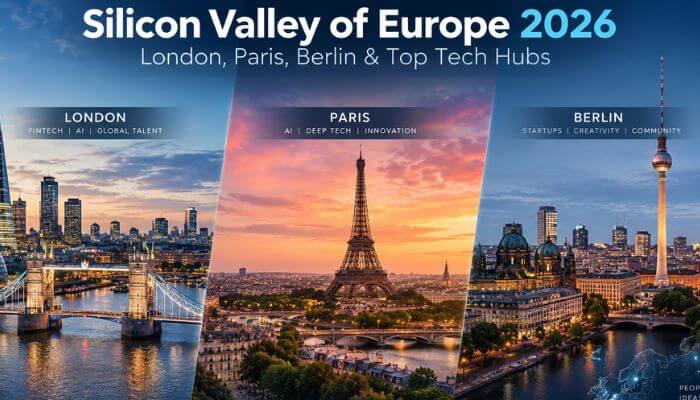
Which city deserves to be called the Silicon Valley of Europe in 2026? There is no official European equivalent of California’s Silicon Valley, but current startup ecosystem data gives London the strongest overall claim. Startup Genome ranks London as the world’s #3 startup ecosystem in 2026, behind Silicon Valley and New York City, while London also holds the top position in Startup Genome’s European regional ranking.
Dealroom reaches a similar conclusion using a different methodology. Its 2026 Global Tech Ecosystem Index ranks London fourth among its Global Champions, behind the Bay Area, New York and Boston.
These rankings help explain why London is frequently described as the Silicon Valley of Europe, especially when overall startup scale, access to capital, international talent, fintech strength and AI activity are considered.
However, calling London the only European technology powerhouse would oversimplify the continent’s fast-changing startup economy.
Paris is becoming a major AI and deep-tech center. Berlin remains one of Europe’s most established startup communities. Stockholm and Amsterdam have globally ranked ecosystems, Munich is building strength in AI and defense technology, while Cambridge remains unusually influential in research-driven innovation.
For that reason, the Silicon Valley of Europe is increasingly better understood as a network of specialized technology hubs rather than one direct copy of California’s Silicon Valley.
Quick Answer: What Is the Silicon Valley of Europe?
The Silicon Valley of Europe is not an official location, but London has the strongest overall claim in 2026 based on major startup ecosystem rankings. Paris and Berlin are also leading European tech hubs, while cities such as Munich, Stockholm, Amsterdam, and Cambridge stand out in areas including AI, deep tech, fintech, and research-driven innovation.
What Does “Silicon Valley of Europe” Mean?
The Silicon Valley of Europe is an informal term used to describe a European city or region with a strong concentration of technology startups, venture capital, skilled engineers, research institutions, universities, startup accelerators, unicorn companies, and international technology talent.
California’s Silicon Valley became a global technology center because many of these elements developed within one highly concentrated region. Europe follows a different model, with startup activity, investors, universities, and technology companies spread across several countries and cities.
London is known for finance, fintech, venture capital, and AI. Paris combines entrepreneurship with engineering, scientific research, and deep tech. Berlin has a strong international founder community, while Munich connects technology startups with manufacturing and industrial innovation. Cambridge is recognized for university-driven research and commercialization, and Stockholm has produced several globally successful technology companies relative to its population.
This diversity explains why there is no single universally accepted Silicon Valley of Europe. Instead, several European cities have developed specialized technology ecosystems that compete and complement one another.
How We Compared Europe’s Top Technology Hubs
There is no single measurement that determines which city should be considered the Silicon Valley of Europe. To make the comparison more balanced, this article considers several factors, including:
Startup Genome’s 2026 ranking evaluates ecosystems using six major factors: Performance, Funding, Market Reach, Talent and Experience, AI-Native Cluster, and R&D Engine. Performance carries the largest weighting at 27.5%, while Funding and Market Reach each account for 20%.
Dealroom uses a different methodology that considers areas such as investment, innovation, talent, and technology outcomes. It also groups ecosystems into categories including Global Champions, Density Leaders, and Rising Stars.
Because these organizations use different methodologies, their rankings and ecosystem values should not be treated as directly interchangeable. Looking at several indicators instead provides a more complete picture of which cities have the strongest claim to the Silicon Valley of Europe title.
Europe’s technology landscape includes several globally competitive startup ecosystems, each with different strengths. The table below compares some of the leading hubs using 2026 ecosystem rankings and areas of specialization.
Startup Genome places London, Paris, and Berlin in the top three positions in its 2026 European regional ranking. Stockholm also climbed eight positions to #23 globally, tying Amsterdam-Delta.
The comparison shows why Europe’s technology economy cannot be defined by a single type of startup hub. Some cities lead in overall scale, while others stand out in AI, fintech, deep tech, research, or industrial innovation.
Why London Has the Strongest Claim
London’s biggest advantage is not dominance in one technology sector. It is the breadth and scale of its startup ecosystem.
Startup Genome estimates London’s ecosystem value at approximately $438 billion and identifies 72 active unicorns under its 2026 methodology. By comparison, Paris has an estimated ecosystem value of about $169 billion and 37 active unicorns, while Berlin stands at roughly $89 billion with 20 active unicorns.
These differences in ecosystem scale, combined with London’s strength in venture capital, fintech, AI, research, and international business, help explain why London currently has the strongest overall claim to the Silicon Valley of Europe title.
London is especially strong in:
London’s financial-services industry gives fintech companies access to potential customers, investors and experienced workers.
The city’s universities, research organizations and multinational companies also support startups outside finance.
Artificial intelligence is strengthening London’s technology position.
Startup Genome estimates London’s AI-native ecosystem value at approximately $26.3 billion, representing growth of 79% compared with its earlier measurement period.
That makes London Europe’s largest AI-native startup ecosystem under Startup Genome’s 2026 methodology.
This combination of AI, finance, capital and talent is one of the strongest reasons London leads the Silicon Valley of Europe discussion.
Paris: Europe’s Major AI and Deep-Tech Challenger
Paris has undergone one of Europe’s most significant startup transformations and has strengthened its position among the continent’s leading technology hubs.
Startup Genome ranks Paris #13 globally and #2 in Europe in 2026. Its ecosystem value increased from approximately $85 billion in Startup Genome’s 2022 report to $169 billion in 2026, while its active unicorn count rose from 14 to 37 over the same comparison period.
This growth strengthens Paris’s claim as one of the leading contenders for the Silicon Valley of Europe, particularly in technology sectors built around AI, engineering, and scientific research.
Paris has developed a diverse technology ecosystem with particular strengths in:
The city’s universities, engineering schools, research institutions, investors, and growing startup community provide an important talent pipeline for industries that depend heavily on scientific and technical expertise.
Artificial intelligence has become one of Paris’s most important competitive advantages.
Startup Genome estimates Paris’s AI-native ecosystem value at approximately $20.2 billion, representing an increase of 156% compared with its earlier measurement period.
London remains larger under this particular metric, but Paris has developed into Europe’s second-largest AI-native ecosystem. Its combination of AI startups, engineering talent, scientific research, and deep-tech activity makes the city an increasingly important part of Europe’s technology landscape.
Berlin: Germany’s Startup Capital
Berlin represents a different model of technology growth from many other major European hubs. While Munich benefits from close connections with industrial corporations and advanced manufacturing, Berlin is better known for independent startups, software companies, international founders, and a diverse technology workforce.
Startup Genome ranks Berlin #22 globally and #3 in Europe in 2026, with an estimated ecosystem value of approximately $89.5 billion.
Although Berlin is smaller than London and Paris by overall ecosystem value, its international founder community and broad startup base make it an important part of the debate over the Silicon Valley of Europe.
Berlin has notable startup and technology activity across:
Startup Genome estimates Berlin’s AI-native ecosystem value at approximately $4.8 billion.
Berlin’s strength therefore comes less from dominating a single technology sector and more from its diverse startup community, international workforce, software expertise, and established entrepreneurial culture.
London, Paris, and Berlin occupy the top three positions in Startup Genome’s 2026 European regional ranking, but their ecosystems differ significantly in scale and specialization.
Figures use Startup Genome’s 2026 methodology to provide a more consistent comparison across the three ecosystems.
London leads the group in overall ecosystem scale and capital access, while Paris stands out for its rapidly developing AI and deep-tech ecosystem. Berlin is smaller by the financial measures shown above but remains a major European startup center, particularly across software, fintech, climate tech, and other digital industries.
Stockholm: Small City, Major Technology Impact
Stockholm demonstrates why population alone does not determine the strength of a technology ecosystem. Startup Genome estimates its ecosystem value at approximately $56 billion, and the city climbed eight positions in the 2026 ranking to reach #23 globally, tied with Amsterdam-Delta.
Stockholm has developed particular strengths in:
Companies such as Spotify, Klarna, and King have demonstrated Sweden’s ability to produce technology businesses with international reach. Startup Genome also estimates Stockholm’s AI-native ecosystem value at approximately $5.8 billion.
For a relatively small city, Stockholm has had an unusually large influence on European technology and entrepreneurship.
Amsterdam: Europe’s Connected Digital Hub
Amsterdam-Delta tied Stockholm at #23 globally in Startup Genome’s 2026 ranking. Startup Genome estimates the ecosystem’s value at approximately $83 billion, with around $2.5 billion in total early-stage funding during its H2 2023–2025 measurement period.
Important technology sectors include:
Amsterdam also benefits from the Netherlands’ international business environment and its connections with research, corporate, and technology centers elsewhere in the country.
Munich: Industrial AI, Deep Tech and Defense Tech
Munich represents a different side of European technology. Its ecosystem combines research universities, engineering expertise, established corporations, and technology startups.
Startup Genome estimates Munich’s AI-native ecosystem value at approximately $6.2 billion, representing growth of 330% compared with its previous measurement.
Dealroom’s 2026 index also places Munich third worldwide for defense technology, 21 positions above its overall all-sector ranking.
Munich demonstrates why the Silicon Valley of Europe does not have to be defined only by consumer software or venture capital. Specialized ecosystems built around engineering, AI, manufacturing, and deep tech can also achieve international importance.
Cambridge: Europe’s Research-Driven Technology Cluster
Cambridge is much smaller than London, Paris, or Berlin, yet it has an exceptionally dense research and technology ecosystem.
The University of Cambridge and the surrounding research community support innovation in:
Dealroom places Cambridge third globally among its 2026 Density Leaders and reports approximately $264.2 billion in enterprise value per million residents under its methodology.
Cambridge illustrates how universities can help create powerful technology clusters by connecting scientific research with talent, entrepreneurship, investment, and commercialization.
Helsinki: Gaming, Telecom and Deep Tech
Helsinki has long been associated with telecommunications and gaming, but its technology ecosystem increasingly extends into advanced and research-intensive industries.
Finland’s engineering expertise and research institutions make Helsinki particularly relevant for technically complex startups. The city also hosts Slush, one of Europe’s best-known gatherings for founders, startups, and technology investors.
Barcelona and Madrid: Spain’s Major Technology Centers
Spain has developed two complementary startup and technology hubs, with Barcelona and Madrid serving different but overlapping roles.
Barcelona has notable activity across:
Its international workforce and established startup community have also helped attract founders and technology professionals from outside Spain.
Madrid benefits from its position as Spain’s major financial, administrative, and corporate center.
Its technology ecosystem includes:
Rather than treating them as identical competitors, Barcelona and Madrid can be viewed as complementary parts of Spain’s broader technology economy.
Dublin: International Technology Connections
Dublin occupies a distinctive position in Europe’s technology landscape because of the combination of multinational technology operations and domestic startup activity.
Large international technology companies operating in Ireland have helped create a workforce with experience in:
Dublin also has domestic startups operating across SaaS, fintech, cybersecurity, health technology, and artificial intelligence.
The presence of multinational technology companies can contribute to the wider startup ecosystem by developing experienced employees who may later become founders, executives, mentors, angel investors, or startup employees.
Emerging European Tech Hubs to Watch
Europe’s technology landscape continues to expand beyond established centers such as London, Paris, Berlin, Stockholm, and Amsterdam. Several smaller or rapidly developing ecosystems are gaining greater visibility in European startup rankings.
Startup Genome ranks Istanbul #8 in Europe in its 2026 regional ranking. Its large domestic market, growing entrepreneurial community, and expanding startup ecosystem are strengthening its position as an important regional technology center.
The Greater Lausanne Region ranks #13 in Europe in Startup Genome’s 2026 regional ranking. Switzerland’s universities, scientific institutions, engineering expertise, and research environment make the region particularly relevant for research-driven and science-based technology businesses.
North Rhine-Westphalia ranks #14 in Europe in Startup Genome’s 2026 regional ranking. Its position demonstrates that Germany’s technology economy extends beyond Berlin and Munich, with additional opportunities emerging around established industrial and business centers.
Together, these emerging ecosystems reinforce a central point in the Silicon Valley of Europe debate: European technology growth is increasingly distributed across multiple cities and regions rather than concentrated in a single location.
Which European Tech Hub Is Strongest by Sector?
The answer to “Where is the Silicon Valley of Europe?” depends partly on the type of technology company, because Europe’s leading startup cities have developed different areas of specialization.
This sector-by-sector comparison explains why Europe does not have one technology capital that leads every industry. London stands out for overall scale, fintech, and AI, while Paris is particularly important for AI and deep tech. Munich has strong connections to industrial technology and engineering, Cambridge is notable for research-intensive fields, and Stockholm and Helsinki have established strengths in areas such as fintech and gaming.
For this reason, identifying the Silicon Valley of Europe depends not only on overall ecosystem size but also on the technology sector being considered.
AI Is Reshaping Europe’s Technology Map
Artificial intelligence has become one of the biggest forces reshaping Europe’s startup landscape. Startup Genome reports that Europe’s AI-native ecosystem value increased by 84% to approximately $98.2 billion compared with its GSER 2024 measurement.
London leads this group by AI-native ecosystem value, while Paris has recorded particularly rapid growth. Munich also demonstrates how a technology ecosystem built around engineering and industry can develop a significant position in AI.
These figures add another dimension to the Silicon Valley of Europe discussion. Rather than concentrating AI innovation in one dominant location, Europe is developing several AI hubs with different strengths and areas of specialization.
European Startup Funding Is Recovering
Europe entered 2026 with signs of improving early-stage investment conditions.
Startup Genome reports that European Series A funding increased by approximately 10% from 2024 to 2025. In Q1 2026, Series A investment was also 56% higher than the average quarterly level recorded in 2025.
This improvement matters because access to early-stage capital helps startups hire employees, develop products, enter new markets, and prepare for further growth.
However, stronger early-stage funding does not automatically solve one of Europe’s biggest startup challenges. Creating promising companies is only the first stage. Successful startups also need sufficient growth capital and access to large markets to scale internationally.
Europe’s Scale-Up and Exit Challenge
Europe generates substantial startup activity, but turning promising companies into very large global businesses remains a challenge.
Startup Genome reports that Europe accounted for approximately 37% of global startup exit volume but only 11% of total global exit value. Its analysis also found that Europe’s top-quartile exit was approximately $68 million, compared with a roughly $70 million median exit value in North America.
Several factors can make international expansion and late-stage growth more difficult, including:
Europe’s long-term technology competitiveness may therefore depend not only on creating more startups but also on helping successful companies access capital, expand across borders, and grow into globally competitive businesses.
The European Commission proposed EU Inc. on March 18, 2026 as an optional, digital-by-default European corporate framework designed to make it easier for companies to start, operate, and expand across the European Union.
The proposal addresses a major challenge for European startups: companies seeking to expand across the EU currently face 27 national legal systems and more than 60 company legal forms.
Proposed EU Inc. features include:
EU Inc. is still a proposal, not a corporate framework that founders should assume is already available throughout the European Union.
The proposal is being considered by the European Parliament and the Council. If adopted and implemented as intended, it could reduce some of the legal and administrative friction startups face when expanding across EU borders.
That could make it easier for startups in cities such as Paris, Berlin, Amsterdam, Madrid, and Helsinki to operate within a more integrated European market. In the longer term, reducing these cross-border barriers could also strengthen the network of technology hubs competing for recognition as the Silicon Valley of Europe.
How the EU AI Act Affects European Tech Hubs
Regulation is becoming an increasingly important factor in Europe’s competition for AI startups, investment, and technology talent.
Transparency obligations under Article 50 of the EU AI Act began applying on August 2, 2026. Depending on the type of AI system and how it is used, the requirements can include:
Enforcement involves national market-surveillance authorities, with the AI Office responsible for certain systems under its supervision and the European Data Protection Supervisor responsible for relevant systems used by EU institutions.
The regulatory distinction is particularly relevant when comparing London with EU technology centers such as Paris, Berlin, Munich, and Amsterdam. The UK is outside the European Union, so London operates under a different regulatory framework.
For founders deciding where to establish or expand an AI company, regulation may therefore be considered alongside talent, investment, customers, research capabilities, infrastructure, and access to markets. This regulatory difference adds another dimension to the debate over the Silicon Valley of Europe.
Defense Tech Is Becoming More Important
Defense and dual-use technology is another rapidly developing part of Europe’s startup landscape.
Startup Genome reports that global DefenseTech Series A value grew by approximately 60% over the previous year, while deal counts increased by around 15%, making it the fastest-growing sector outside AI in its 2026 analysis.
This trend is particularly relevant to European ecosystems with expertise in:
Munich’s position in defense technology illustrates how Europe’s established strengths in engineering, manufacturing, research, and deep tech can contribute to emerging startup sectors.
Silicon Valley vs the Silicon Valley of Europe
Europe’s strongest startup ecosystems have grown considerably, but California’s Silicon Valley continues to operate at a much larger overall scale.
Startup Genome reports that Silicon Valley’s ecosystem value has surpassed $3 trillion and continues to rank it #1 globally. Dealroom also places the Bay Area first among its 2026 Global Champions, reporting roughly $20 trillion in enterprise value and 738 unicorns under its own methodology.
These figures should not be compared directly because Startup Genome and Dealroom use different definitions and methodologies. However, they illustrate the exceptional scale of the original Silicon Valley and provide useful context when evaluating the Silicon Valley of Europe.
The funding gap remains particularly important. Startup Genome reports that North America currently accounts for approximately 64% of global late-stage startup funding, giving companies in the region access to a significantly deeper pool of growth capital.
Europe’s challenge is therefore not simply creating more startups. It is also helping promising companies obtain the capital, customers, talent, and market access needed to scale into large global businesses.
Why Europe May Never Have Just One Silicon Valley
Searching for the Silicon Valley of Europe can create the impression that one European city must eventually dominate the continent’s technology economy in the same way Silicon Valley dominates the global perception of technology in California.
Instead, Europe’s leading technology hubs have developed different strengths:
Rather than developing one direct replica of California, Europe appears to be building a polycentric technology ecosystem in which multiple cities specialize in different industries.
This distributed model may ultimately be the most accurate way to understand the Silicon Valley of Europe: not as a single city, but as an interconnected network of startup, research, investment, and technology centers across the continent.
What Could Make European Tech Stronger?
Europe already has several globally important technology hubs, but strengthening the broader Silicon Valley of Europe ecosystem will depend on whether startups can access capital, expand across borders, commercialize research, secure computing infrastructure, and benefit from experienced founders.
European startups need deeper pools of growth capital after reaching the scale-up stage. Greater access to late-stage funding could help promising companies continue expanding from Europe rather than relying heavily on investors from other regions during larger funding rounds.
Reducing legal, corporate, and administrative differences could make it easier for startups to operate across the European Single Market.
Initiatives such as the proposed EU Inc. framework are intended to address some of this fragmentation by making cross-border company formation and expansion simpler.
European universities and research institutions produce significant scientific and technical research. The challenge is turning more discoveries into commercially successful companies.
Stronger connections between universities, founders, investors, and industry could particularly benefit research-intensive ecosystems such as Cambridge, Paris, and Munich.
Advanced AI companies increasingly depend on access to specialized computing infrastructure, including:
Access to affordable computing capacity could become an increasingly important factor in determining where European AI startups choose to build and scale their businesses.
Successful technology ecosystems can become self-reinforcing. Founders and employees who gain experience building and scaling successful companies often return to the startup ecosystem as:
More successful scale-ups and exits can therefore contribute not only to today’s technology economy but also to the next generation of European startups.
Future of the Silicon Valley of Europe
Several trends could reshape Europe’s technology landscape beyond 2026:
These trends suggest that the future Silicon Valley of Europe may remain a network of specialized technology hubs rather than develop into one dominant city.
Final Comparison: Which City Has the Strongest Claim?
Based on the 2026 ecosystem data discussed above, London has the strongest overall claim in the Silicon Valley of Europe discussion, with advantages in startup scale, venture capital, fintech, AI, international talent, and access to global markets.
However, Europe’s technology landscape is highly specialized. Paris stands out in AI and deep tech, Berlin for its international startup community, Munich for industrial AI and defense tech, Cambridge for research-driven innovation, and Stockholm and Amsterdam for strong digital technology ecosystems.
The evidence therefore supports London as the leading overall European technology hub in 2026, while other cities may be more relevant when comparing specific industries or areas of specialization.
The Silicon Valley of Europe is not an official place, but in 2026 London has the strongest overall claim to the title. Its combination of startup scale, venture capital, international talent, fintech, AI, research, and access to global markets places it at the center of Europe’s technology economy.
However, the Silicon Valley of Europe extends beyond London. Paris is emerging as a major AI and deep-tech center, Berlin remains an important founder ecosystem, Munich is strengthening its position in industrial AI and defense technology, and Stockholm, Amsterdam, and Cambridge contribute their own specialized strengths.
Europe still faces challenges involving late-stage capital, cross-border expansion, and the ability to turn successful startups into very large global companies. At the same time, its distributed structure allows different cities to specialize in AI, fintech, SaaS, biotechnology, climate tech, cybersecurity, gaming, deep tech, and advanced engineering.
Rather than becoming one direct copy of California’s Silicon Valley, Europe is developing an interconnected network of technology and research centers. That network may ultimately be the most accurate definition of the Silicon Valley of Europe in 2026.
FAQs About the Silicon Valley of Europe
Startups may choose a Silicon Valley of Europe hub for access to investors, skilled technology workers, research institutions, corporate customers, accelerators, and international markets.
Yes. Major European tech hubs offer startup communities, early-stage investment, accelerators, universities, and experienced founders that can support young technology companies.
Cambridge, Paris, Munich, and other research-intensive ecosystems are particularly relevant to university spinouts because of their connections between scientific research, engineering, investors, and entrepreneurship.
Important growth areas include artificial intelligence, deep tech, fintech, cybersecurity, biotechnology, climate tech, quantum technology, robotics, and defense-related technologies.
Many leading European technology hubs have international startup communities. Cities such as London, Berlin, Amsterdam, Dublin, and Barcelona are particularly associated with internationally connected technology ecosystems.
Universities provide research, technical talent, intellectual property, laboratories, and potential startup founders. They are particularly important for deep-tech, biotech, AI, semiconductor, and quantum startups.
Yes. Technology ecosystems do not need enormous populations to become influential. Strong research, specialized talent, investment, and successful startups can help smaller cities develop internationally relevant technology clusters.
Investors commonly consider startup quality, founder talent, market access, funding activity, research strength, sector expertise, growth potential, and the ability of companies to scale internationally.
Related Stories
 Technology
Adidas To Cut 300
30 seconds ago
 Technology
The Importance of Balancing Technology with the Human Experience
33 seconds ago
 Technology
SK Telecom CEO Turns to Startups for New AI Businesses
59 minutes ago
 Technology
REG - Technology Minerals
1 hour ago
 Technology
Merger Brings Startups Beep & Freebee Together
1 hour ago
 Technology
Apple weighs Nvidia technology for potential server market return, The Information reports
2 hours ago
 Technology
Senior technology executive to lead Ontario Tech University's Board of Governors
2 hours ago
 Technology
Calian partners with Ukrainian tech and defence company SkyFall for drone training
3 hours ago