
Sask. print
Sask. print-art studio among small businesses facing loss of U.S. customers
$75,000 worth art stuck at customs warehouse amid trade war
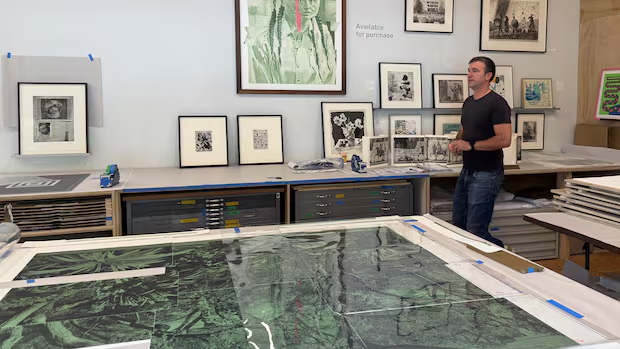
The impact of the Canadian-American trade war is "a disaster," says Brendan Copestake, who runs Jillian Ross Print, a collaborative print/art studio in Saskatoon.
Copestake has artwork worth $75,000 stuck at a customs warehouse.
He sent it south before U.S. President Donald Trump imposed new tariffs, but by the time the package arrived at the border, the tariffs were in place and his American customer refused to pay another $35,000, Copestake said in an interview with CBC Saskatchewan.
“We've got multiple artworks in customs at the moment that are stuck in customs and are now being returned because our American clients are refusing to pay the 50 per cent tariffs, which is completely understandable."
Canada’s counter-tariffs take effect on more than 700 American products on Tuesday, matching Washington’s tariffs dollar for dollar after the U.S. hit $27.6 billion in Canadian goods with 50 per cent duties in August.
"Most of the Canadian artists, and there's thousands of them, are in a similar situation — printmakers, painters, drawers, sculptors, most of their market is U.S.-based. And if they're having a 50 per cent tariff slapped on their artworks, they're going to lose their customer base," Copestake said.
Ottawa is rolling out millions of dollars in tariff relief to companies across Canada, including to Great Western Brewing in Saskatoon.
“The biggest area is in the cost of our aluminum cans,” said Great Western's chief financial officer, Brendan Halbgewachs.
He’s glad the federal government is helping, he said.
“The raw material cost is way up, and as a result we pay a lot more for every can that we need to purchase."
Ottawa giving combined $11.6M to 8 Saskatoon companies for tariff relief
Copestake said his studio doesn’t qualify for any such relief.
“Most businesses that are eligible need to have $1,000,000 revenue or more and be incorporated. And artists and studios like ourselves just don't fall into that category. I’ve yet to find any federal support for micro businesses like ourselves,” he said.
$75,000 worth of art stuck at border amid trade war
“Artists are no longer shipping to the U.S. They all need to pivot the way that they're working. They're looking at opening up workshops so that they can teach local people to print and draw and paint and sculpt, just as a way to survive."
Buckley Belanger, Canada's secretary of state for rural development, said Prairies Economic Development Canada (PrairiesCan), the government agency choosing who gets the money, has been travelling the province to assess where tariffs are landing and what gaps need to be filled.
“I'll say whatever help that we could afford to, whatever agency to assist in this regard, let's examine that in a fair and obviously a concise manner. So there's no question in my mind that PrairiesCan is doing a wonderful job,” Belanger said last week at a news conference.
“Are we missing a few pieces here and there? Well, I think so,” he said. “But [PrairiesCan] could address that.”
Trampoline business hopes to bounce back
Luke Shaheen of Regina has about $100,000 in finished trampolines sitting at the border.
“There is a concern that if we do pay these tariffs and get these products across the border, the tariffs could be called off the next day,” he said. “And if that happens, you don’t get the money back.”
Shaheen is managing partner at Crazy Ape Extreme Equipment, which makes trampolines. The business has roots going back to farmers in Herbert, Sask., in the 1970s. It built the world’s longest trampoline, a 192-foot model certified by Guinness earlier this year.
Its trampolines run from $2,500 to $50,000. More than half of sales go to the U.S., and all are now tariffed at 50 per cent.
“We’re seeing a $30,000 order become a $45,000 order,” he said.
This Sask. company in danger of getting tariffed twice on the same trampoline
He hopes Crazy Ape qualifies for government relief and he plans to apply.
“The government subsidies are great. They’re really positioned to help businesses pivot,” he said. “It doesn’t necessarily solve the immediate problems of the $50,000 trampoline that’s in our warehouse.”
Shaheen said he’s concerned about the smaller businesses that may not be able to access government support.
Back in the print studio, Copestake said he wants help from the provincial and federal governments in the form of interest-free loans, but Canadians can also help.
“If the community could buy local, that would be great. That’s a good start,” he said. “We love what we do. So when you love what you do, you find a way.”
Aishwarya Dudha is a reporter for CBC Saskatchewan based in Saskatoon. She specializes in immigration, justice and cultural issues and elevating voices of vulnerable people. She has previously worked for CBC News Network and Global News. You can email her at aishwarya.dudha@cbc.ca
Related Stories
 Canada
Alleged killers of Australian, U.S. surfers go on trial in Mexico
1 hour ago
 Canada
Trump to Canadian plane maker Bombardier: You can’t sell in U.S. unless you build in U.S.
1 hour ago
 Canada
If Canada
1 hour ago
 Canada
Trump threatens Bombardier, Canadian dollar as counter
1 hour ago
 Canada
Cape Breton storm yet another one for the history books
2 hours ago
 Canada
Tornados tore through Windsor, Wheatley Thursday, tornado project confirms
3 hours ago
 Canada
Phones, habits and wildlife: Experts warn of Maritime road hazards
3 hours ago
 Canada
Trump threatens to block Canada’s Bombardier sales unless planes made in US
3 hours ago