
Punjab politics takes a religious turn
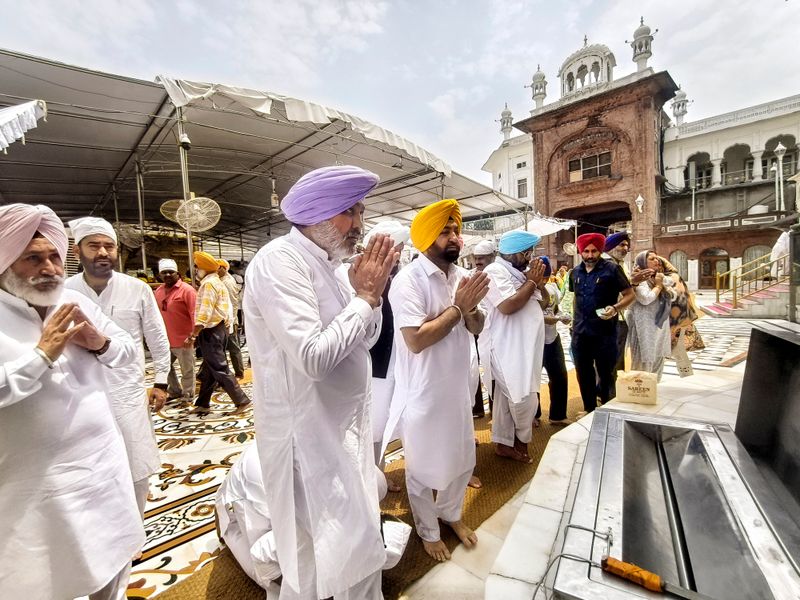
HISTORY was made on June 29, 2026, when an Akal Takht Jathedar summoned members of the elected legislature to his durbar and asked them to explain why they had passed a particular law. Constitutionally, what legislators say or do in the Assembly is unchallengeable. They are answerable to the Speaker, the courts and the electorate.
Well-prepared, Jathedar Kuldeep Singh Gargaj treated the people's representatives from various political parties as schoolchildren, scolding them at times for not giving proper answers, and sent them back with homework to be completed within a month.
One thing became very clear: legislators do not care to read laws they pass. Many of them pleaded ignorance when asked by the Akal Takht Jathedar to explain certain provisions of the Jaagat Jot Sri Guru Granth Sahib Satkar (Amendment) Act.
As it heads for elections, the Aam Aadmi Party definitely needs better-informed, more educated candidates for governance rather than just having seat occupants in the Assembly. The party seems to have reset its priorities. Moving away from embracing secularism, the AAP now competes with the Akali Dals and the BJP in pandering to voters' religious impulses.
A government has chosen to obey a religious diktat in a departure from the time-honoured principle of governance of keeping state and church separate. The AAP is exploring new avenues of appeasement, including religion.
Emulating the BJP's Ram temple example, AAP leader Arvind Kejriwal has announced that the Punjab government will build and repair temples, organise devotional events and extend the free pilgrimage scheme to more religious places. Kejriwal is concentrating on Hindu votes in cities, leaving rural voters to Bhagwant Mann.
This is a first of its kind religion-driven move to woo Hindu minority voters in Punjab. How it unfolds remains to be seen. The BJP's Hindutva brand of politics is widely known and accepted, though currently, it is selling a secular image in Punjab.
Lately, the party has been hawking the "Sarkar-e-Khalsa" model, little realising that Maharaja Ranjit Singh's was a secular, sovereign state — a dream project of Khalistan advocates. For the AAP, playing to the religious gallery may be a gamble in a largely secular state.
Bhagwant Mann has been in politics for long enough to understand games political rivals play. The misuse of religion for political gain is common, justified under the Sikh Miri-Piri concept. Yet he and his Cabinet colleagues seem to have coolly walked into the well-laid trap by the Akali Dal.
The AAP is damned if it implements the Akal Takht Jathedar's list of amendments and damned if it does not.
Bhagwant Mann has publicly ruled out any changes in the law. He may have to eat his words. If the party turns down the Jathedar's suggestions, the whole purpose of Monday's gathering stands defeated.
Before passing the anti-sacrilege law, the Mann government could have made wider consultations. Had the Chief Minister taken the SGPC on board and not gone to town congratulating himself for the achievement, his zealous opponents might not have taken so unkindly to it.
Sukhbir Badal controls the SGPC that picks and drops Akal Takht Jathedars at will without following any due process. His calculated strategy was to put Mann on the spot. And he has succeeded. Desperate for a comeback, he is trying every available trick.
That ordinary Sikhs had wholeheartedly welcomed the anti-beadabi law set alarm bells ringing. Sukhbir sensed a possible loss of Sikh votes. He would not forgive Mann for that. The custodial interrogation of his chartered accountant and a former Jathedar's statement to the SIT further rattled him.
After Mann was declared "Guru Dokhi" and "Panth Virodi", the Chief Minister's first response was appropriate. He denied that he was the man in the controversial video. People generally accepted it, as was clear from the crowds at his public meetings.
However, by reportedly sending cops to Gurugram and making claims about the use of a mask, Mann just messed it up. Or, is it someone in his own tent trying to throw him under the bus? Anyway, his own role in tying himself in knots cannot be underestimated.
A leader, it is said, should speak softly and carry a big stick. Mann speaks loudly and carries a twig. As the Home Minister, he has much to answer for. The continuance of problems he had inherited — drugs, gangsters, illegal mining, among them — speaks of his failure.
Other than reconstituting SITs, Mann has done pretty little in taking the Bargari, Behbal Kalan and Kotkapura sacrilege and firing cases to their logical conclusion. The 2017 Maur Mandi bomb explosion that claimed seven lives, including five children, remains stuck. These issues also surfaced on Monday.
Mann may have his compulsions in appearing before Akal Takht, but the Chief Minister broke decisively with norms that hold sway. When summoned, former President Giani Zail Singh and five-time Chief Minister Parkash Singh Badal did not rush to Akal Takht. They chose their own timings. Surjit Singh Barnala (former Chief Minister) and Buta Singh (former Union Home Minister) presented themselves before Akal Takht to seek pardon only after relinquishing their constitutional positions.
Playing politics on emotive issues cuts both ways. Who knows it better than the once ruling Akali leadership, now reduced practically to one MLA. Kejriwal may be patting his own back for his clever idea of courting urban Hindu voters. However, if votes are cast on religious lines, Hindus may opt for the more promising BJP rather than settle for its B-team.
Sukhbir Badal's identity politics too can drive Sikh voters to Amritpal Singh's camp. Thanks to the BJP-AAP strategy of keeping Amritpal in Dibrugarh jail for so long, he has emerged as a victim who is likely to get Sikh sympathy votes. The Akali Dal Waris Punjab De, despite organisational handicaps, may well emerge as the dark horse.
The biggest gainers in the ongoing political drama may well be the BJP and the Congress. Now, in a slow-motion process of leadership reshuffle, the Congress may well become the first choice of secular voters. And their number is not small.
The Tribune, now published from Chandigarh, started publication on February 2, 1881, in Lahore (now in Pakistan). It was started by Sardar Dyal Singh Majithia, a public-spirited philanthropist, and is run by a trust comprising five eminent persons as trustees. The Tribune, the largest selling English daily in North India, publishes news and views without any bias or prejudice of any kind. Restraint and moderation, rather than agitational language and partisanship, are the hallmarks of the newspaper. It is an independent newspaper in the real sense of the term. The Tribune has two sister publications, Punjabi Tribune (in Punjabi) and Dainik Tribune (in Hindi).
Remembering Sardar Dyal Singh Majithia
Related Stories
 India
India
India seeks Japanese capital for technology & manufacturing growth
3 hours ago
 India
India
Panthic politics finds new vehicle as Amritpal’s ADWPD gears up for 2027 polls
7 hours ago
 India
India
Bangladesh
7 hours ago
 India
India
'Nothing to do with politics': Nitin Gadkari clarifies amid retirement buzz over 'can't work much now' remark | India News
8 hours ago
 India
India
The whitewashing of the Green India Mission forest expansion initiative
9 hours ago
 India
India
The return of profanation as a new political language
11 hours ago
 India
India
How has the Cockroach Janta Party changed India’s politics?
11 hours ago
 India
India
‘Honest leaders are the first step to a better future’: Cockroach hunger striker targets India’s political class
17 hours ago