
Nexstrom raises US$12 mil seed round to commercialise first 12-Inch Single
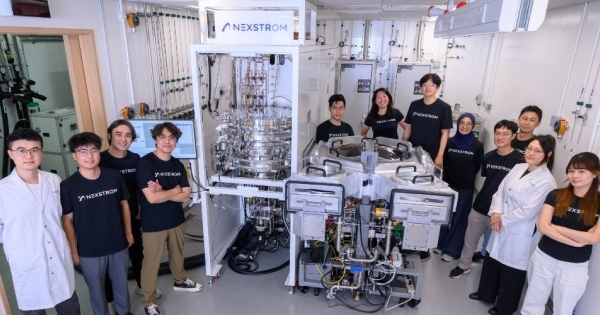
Nexstrom raises US$12 mil seed round to commercialise first 12-Inch Single-Crystal 2D semiconductor platform
Nexstrom, the semiconductor company building the first wafer-scale platform for 2D semiconductor materials,has announced it has raised a US$12 million (RM49 million) seed round led by Xora Innovation, with participation from Foothill Ventures and SEEDS. The round brings Nexstrom’s total capital raised to US$15 million (RM61 million), including US$3 million (RM12 million) in non-dilutive funds.
The funding will accelerate commercialisation of Nexstrom’s wafer-scale 2D semiconductor platform, driving towards the industry's first 12-inch 2D wafer growth on production-ready manufacturing tools. The Singapore-based company is also working closely with prominent industry partners to validate its technology within existing chip manufacturing workflows, positioning Nexstrom to bring next-generation semiconductor materials into large-scale commercial production.
As AI workloads drive demand for faster, more energy-efficient computing, the semiconductor industry is approaching the physical limits of silicon. There is a hard ceiling to how much silicon channels can continue to shrink before electrons begin leaking, causing significant power loss. Nexstrom aims to bypass this bottleneck by developing the industry's first platform for growing 12-inch single-crystal 2D semiconductor materials.
These atomically thin materials support precise electron control, reduce energy loss at the transistor level, and improve efficiency, while remaining compatible with advanced foundry manufacturing. Nexstrom is developing the commercial-scale platform advanced foundries need for next-generation computing.
“Silicon has fueled decades of computing innovation, but the industry now needs a new materials platform to continue scaling performance,” said Dr. Lance Li, co-founder and chief scientist. “For years, the challenge has not been demonstrating the promise of 2D materials, but manufacturing them at the scale and quality advanced foundries require.”
Nexstrom was incubated through Xora's venture-building model to bridge the gap between academic research and commercial semiconductor manufacturing. Through this model, Nexstrom developed a practical path to manufacturing wafer-scale single-crystal 2D semiconductors, allowing chipmakers to move beyond the limitations of conventional materials and build the next generation of AI infrastructure.
Unlike existing methods that yield only small laboratory samples or require changes to existing foundry manufacturing processes, Nexstrom's full-stack platform integrates proprietary chemical vapour deposition (CVD) hardware, process technology and wafer-scale 2D material growth within a foundry’s existing workflow.
By combining advanced equipment, specialised chemistry and manufacturing expertise, Nexstrom’s technology promises continuous, single-crystal 2D material growth across industry-standard 12-inch wafers, providing a clear path to commercial adoption.
Nexstrom’s technical foundation is anchored by Dr. Lance Li, a Clarivate Highly Cited Researcher since 2018, a distinction recognising roughly the top 0.1% of researchers worldwide by research influence. A pioneer in single-crystal MoS2 (molybdenum disulfide) growth since 2012, he later led corporate research at TSMC on post-silicon electronics, bringing decades of expertise across 2D materials, atomic-layer chemistry and semiconductor manufacturing to Nexstrom.
The company is also supported by a board and advisory group that includes semiconductor industry leaders Dr. Sundar Ramamurthy, Dr. Philip Wong, Dr. Aaron Thean and Dr. John Langan.
“The question is no longer whether 2D semiconductors matter. They are already on the technology roadmap of major semiconductor companies. The challenge is making them manufacturable,” said Dr. Philip Wong, board advisor at Nexstrom and Inez Kerr Bell Professor at Stanford University. “The industry needs high-quality, uniform 2D materials on 300 mm substrates, and solving that materials bottleneck is exactly where Nexstrom is focused.”
By enabling wafer-scale 2D semiconductors compatible with advanced manufacturing, Nexstrom is laying the foundation for the post-silicon era of computing.
The new funding will support ongoing platform development, strategic collaborations with semiconductor foundries, and the expansion of Nexstrom's engineering and leadership teams as the company advances high-performance, low-power chips for AI, data centres and future computing applications.
Related Stories
 Technology
Carpenter Technology Corporation (CRS) Stock Price, News, Quote & History
1 hour ago
 Technology
Roda computer and Westek Technology now share the MilDef brand
1 hour ago
 Technology
Gujarat boosts defence, aerospace startups
2 hours ago
 Technology
How 'Buy Canadian' is changing grocery aisles
6 hours ago
 Technology
Durham Joins £5.3M Laser Power Tech Project
6 hours ago
 Technology
AI Leak Detection Tech to Save Millions of Liters
6 hours ago
 Technology
PMET Successfully Completes Phase 2 Caesium Testwork Program with Koch Technology Solutions
6 hours ago
 Technology
From life-saving care to a car pricing app: Top Australian innovators on how they're problem
7 hours ago