
Narendra Modi, the Indian diaspora and the rise of Hindu nationalism
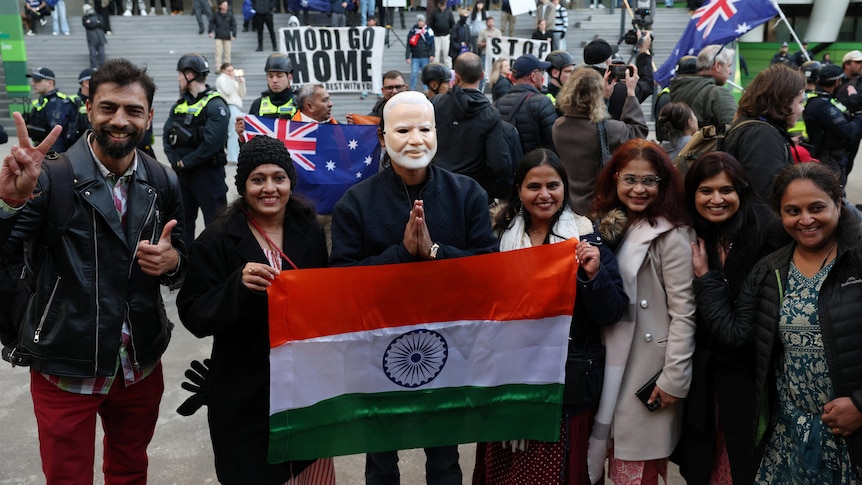
Bhavika and Dr Trishul Darji think India's prime minister Narendra Modi is a modern-day messiah.
Earlier this month, the couple flew with their three children from Sydney to Melbourne to join thousands who gathered at a football stadium to give Mr Modi, 75, the kind of welcome usually reserved for Taylor Swift or Justin Bieber.
As one member of the diaspora told the ABC outside the arena: "I never got to see Modi when I lived in India, so it's a dream come true."
Another said: "He's bringing everyone together to build the nation.''
"Somewhere inside of me, I really believe that he is a descendant of God… he's a very special character, a very special human being," Mrs Darji told the ABC's Compass program.
It's an image the prime minister himself is at pains to push in speeches and across social media. "God has made me an instrument to represent all the people of India," he said on X.
Who wouldn't want to see their messiah in person?
By midday on July 9, the streets around Docklands Stadium had transformed into a sea of saffron scarves, Indian and Australian flags, drummers, dancers, and ecstatic faces.
Families had driven overnight from regional towns, office workers had taken the day off sick, and the heavy security presence was impossible to ignore.
At the edges of the euphoria were the dissenters, those who haven't bought into the Modi mystique — Sikhs seeking a separate state, Muslims feeling increasingly targeted, and human rights groups who say Mr Modi has turned a secular India into a Hindu-first nation where hundreds of millions following other faiths are marginalised.
"The face of Hinduism has changed, and it has become increasingly polarised into people wearing religiosity on their sleeves," said Devleena Ghosh, Honorary Professor at the University of Technology.
"There is an alarming rise of ethnonationalism," said Nandini Sen Mehra, from Hindus for Human Rights.
"To say that the way to be a good Indian is to be a good Hindu and the way to be a good Hindu is to be a north Indian following certain kind of Hinduism… So, if your practices are different, if, for instance, your political leanings are different, if you want to live life in a different way, you're anti-national, or you're anti-Hindu, or you're outside."
So is Mr Modi the architect of a stronger, prouder India or a leader whose politics are driving deeper division in India and among the diaspora?
Hindutva and the Indian diaspora
According to the Australian Bureau of Statistics, in 2025 India overtook the United Kingdom to become the largest overseas-born population in Australia for the first time. Nearly one million Australians were born in India. With the increase in migration, Hinduism is now the fastest-growing religion in Australia.
"India's got 1.5 billion people. So, we're talking a lot of people and a lot of migration outside of India," Trishul Darji said.
"They carry Hinduism to the different countries. But we can't ignore the fact that Hindutva exists and is arguably growing, and very prominent people all over the world are involved in it."
The Hindutva movement is a nationalistic brand of Hinduism. It espouses that India should be a Hindu-first state which allows little tolerance for dissent and subjugates minorities to the will of the majority.
It has been blamed by human rights groups for empowering vigilantes to target religious minorities, sometimes ending in death. The violence which followed the destruction of the Babri mosque in Ayodhya by Hindu nationalists in 1992 is the most infamous example. At least 2,000 were killed in religious violence at the time.
Journalist Aarti Bertigeri has worked extensively with the Indian diaspora and is not surprised that Hindutva ideology has filtered into Australian society.
"It's just the way that diaspora groups operate," she said.
"The larger the group, the more chance you have to only socialise within that same group. That means that you're only going to talk about the things that connect you — whether that is being South Asian, whether it's cricket, whether it is having this ideology of Hindutva. I hope that in the second generation it will die out."
Dr Ghosh says the diaspora is basically traditionalist and conservative … "quite monolithically Hindu in a particular way without acknowledging the various traditions that exist in Hinduism''.
"There have been increasing attempts to consolidate a Hindu identity or at least attempt to define a Hindu identity."
Do closer ties come at a cost?
Nandani Sen Mehra says while Mr Modi's recent visit represents closer ties between India and Australia, it has overshadowed serious concerns that are being quietly swept under the carpet.
"There are certain jobs that will not hire Muslims. Every day you see someone say that 'I'm a proud Hindu and my delivery person, his name was Muhammad, and I'm very happy to say that I cancelled my order'," she said.
"This is not the India that I think is healthy. And we live in Australia, which is so multicultural.
"It's interesting that the same people who will not stand for racism in Australia will turn a blind eye to what's happening in India and say, 'Well, but Hindus also need their place in the sun'."
Dr Ghosh says Mr Modi's religious politics has emboldened division in Australia.
"He allows us to feel comfortable about prejudices. Say you were brought up in secular India where you were supposed to be accepting of everybody, including Muslims, Christians, Dalits, etc., but you've always had an anti-Muslim bias…. Now you can say it."
Mr Modi has been credited with positioning India as an emerging superpower, and that's easier with a "strongman" approach, Nandini Sen Mehra said.
"When you're trying to find an identity, it's very easy to come around this image of a strong man. This image of, oh, India is now finally being respected."
India is certainly being respected and seemingly highly valued by Australian politicians.
Ms Betigeri says that Australia is eager to strengthen ties — not only for economic and strategic reasons, but also to appeal to its large Indian diaspora and its growing electoral influence.
"I think all politicians who know how to harness the Indian diaspora will be successful in their relevant electorates," she said.
Australian prime minister Anthony Albanese is aware of this. In the stadium speech, he sent subtle messages to Indian Australians, who've now become an influential major voting bloc.
He praised Indian Australians as a "living bridge" between the two countries. "You belong here" and "your community's contribution matters". The messages resonated with the audience who erupted into cheers.
Former Australian politicians too have courted the diaspora. Tony Abbott referred to Mr Modi "as more than a kindred spirit — as almost a brother". Scott Morrison wore scarves carrying the logo of Hindu nationalist groups.
Critics like Dr Ghosh want Australian politicians to learn about Hinduism and "not take the easy way out of one particular group who may be a bit noisier than the others".
"Listen, talk to other people, get more views. And that's the problem with the lack of education. They don't try to find out more."
India has become one of Australia's most important geopolitical allies, meaning it is willing to overlook criticisms against the Modi administration, according to some experts.
"India really has been the one holding all the strings. Australia has been knocking on India's door for decades. India has only ever opened it up a crack. We will return your phone calls, we will come to the table, we will decide to bestow the honour of our friendship onto you.
"So, Australia is very protective of that, and I don't think it's going to do or say anything to disrupt that, unfortunately."
And Australia did exactly that. It rolled out the red carpet for the most influential and controversial leader of modern India.
For diaspora such as the Darjis, Mr Modi deserves the respect, and plenty of credit.
"I mean, we can't ignore what Modi's achieved," Trishul said.
"He's brought divided people together, you know, so he's done a lot of good work.
"And I was really pleased to see that the country that I'm living in welcomes him with open arms, you know, that they respect the good work that he's done, the commitment that he has always shown to Hinduism and to India.''
Compass: Faith, Power and Modi will screen on ABC Australia on Sunday, August 2. Check the program guide here. In Australia, watch now on ABC iview.
Related Stories
 India
India
Centre forms panel to finalise 'permanent political solution' to Gorkha issue
2 hours ago
 India
India
India news: Gandhi's notes sold for $1.7 million at auction
7 hours ago
 India
India
Inside BJP’s 10-point Vande Mataram resolution: ‘No vote bank' politics, cites Mahatma Gandhi’s ‘anti
10 hours ago
 India
India
'Against communal pressure, appeasement and vote-bank politics': BJP's Vande Mataram salvo at Congress over two
12 hours ago
 India
India
The Cost of Cash Transfers: India’s Welfare Dilemma
13 hours ago
 India
India
Gen Z: India's BJP mastered WhatsApp and X. Now it is trying to crack Instagram
13 hours ago
 India
India
How BJP and Congress are chasing Gen Z: Inside the battle for India’s youngest voters ahead of 2029
14 hours ago
 India
India
Charanjit Singh Channi’s academic pursuit: A new model in indian politics
17 hours ago