
Manitoba won't approve massive AI data centre proposed for south of Winnipeg: Kinew

Manitoba won't approve massive AI data centre proposed for south of Winnipeg: Kinew
Big AI centres offer little economic benefit while impacting people, environment, premier says
A large AI data centre pitched for a 141-hectare tract of farmland south of Winnipeg will not go ahead, Manitoba Premier Wab Kinew says.
"We've taken a look at this project. We've taken a look at AI more broadly — what's happening across North America — and these hyperscale data centres don't appear to be in the best interests of Manitobans," he told CBC Manitoba Information Radio host Marcy Markusa on Thursday.
"So we're going to say no to this data centre."
Las Vegas-based Jet.AI and Vancouver-based Consensus Core planned to build a data centre powered by natural gas turbines just north of Ile des Chênes in the rural municipality of Ritchot.
CBC has reached out to Jet.ai and Consensus Core but has not yet received a response.
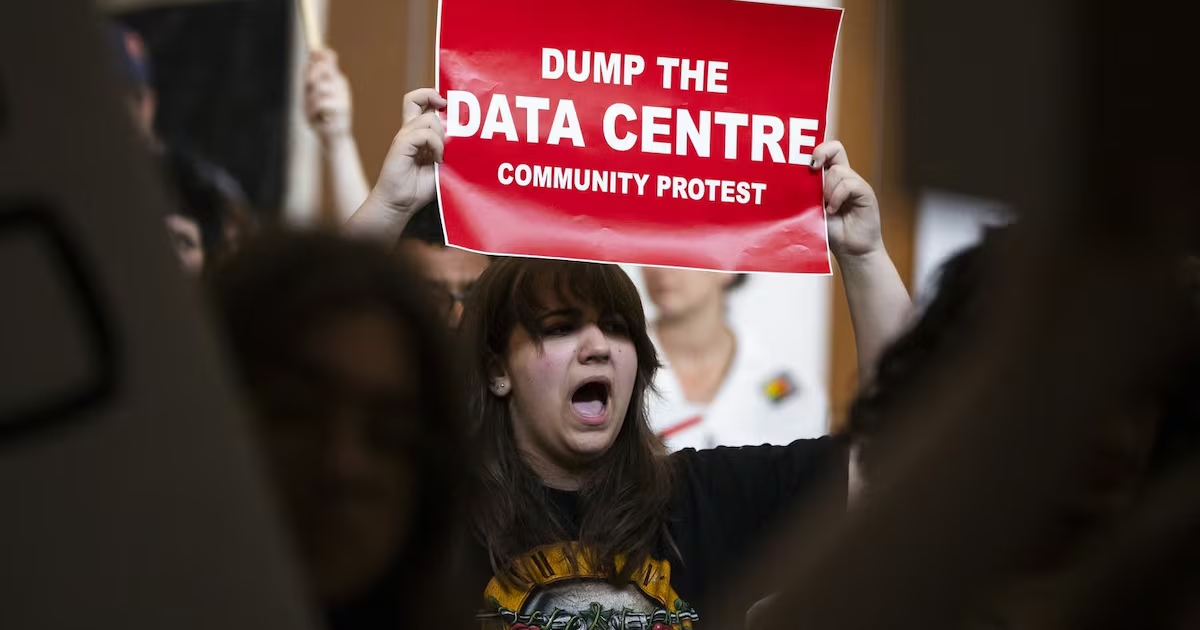
An online petition against the project, citing negative impacts of noise, light and air pollution, has gathered more than 13,500 signatures to date.
Climate Action Team Manitoba, a coalition of environmental and community non-profit organizations, issued a "position statement" in March on such huge AI facilities, saying they "would threaten Manitoba’s clean energy future."
Kinew said he is concerned about the impact on both the environment and the rural community.
"We got to be mindful of the unique way of life and the benefits that rural Manitobans want to keep," he said.
And while there would be a buzz of economic activity during the construction phase of the project, once built, it offers little benefit to the province, Kinew said.
"In fact, most of the economic benefit probably leaves the province."
Ile des Chênes resident Christie Little, who started the petition against the centre, said Thursday's news put her "completely over the moon."
"I'm so happy to hear that the provincial government is listening to us and the things that we have to say, and they're actually looking into how this can affect our lives … our province and our environment," she said.
Kinew said the decision doesn't mean there won’t be data centres built in the province.
There are already nine in Winnipeg and one in Winkler, but none so large. The government stores a lot of data, such as health information for Manitobans, in smaller centres.
Wab Kinew says no to AI data centre proposal south of Winnipeg
In order to safeguard information, rather than put it on a cloud system operated by a large company, the province bought a rack of GPUs (graphics processing units) and beefed up MERLIN (Manitoba Education, Research and Learning Information Networks).
"That's the scale of data centre that we're going to do," Kinew said.
"We use about one to 1.5 megawatts of compute as the entire government … so the idea of building, like, a 500-megawatt facility, it doesn't really make sense."
Kinew's decision comes as other provinces are diving into the big data centres — and on the same day that Prime Minister Mark Carney unveiled Canada's AI strategy.
But Kinew compares the surge to embrace those centres to another scramble in the 1800s.
"When we look at the gold rush and the potential bubble that's happening with these hyperscale data centres, I don't think that's something that our provincial economy should place a huge bet on right now," he said, adding the technology is rapidly changing.
Highly capable AI is now available on consumer laptops, so people can store their information privately, rather than relying on cloud-based services, Kinew noted.
"I have the feeling that maybe these $30-billion hyperscale data centres are going to be albatrosses in the future, when people can run the AI that's necessary for their day-to-day use on their local MacBook," he said.
Darren Bernhardt has been with CBC Manitoba since 2009 and specializes in offbeat and local history stories. He is the author of two bestselling books: The Lesser Known: A History of Oddities from the Heart of the Continent, and Prairie Oddities: Punkinhead, Peculiar Gravity and More Lesser Known Histories.
With files from Marjorie Dowhos
Related Stories
 AI News
Bill Gross bets AI can help mass
6 days ago
 AI News
Nigeria records 93% rise in AI micro
6 days ago
 AI News
The Italian gelato maker using AI to invent new flavours
6 days ago
 AI News
Closing the Gap Between Agentic CX Pilots and Production
6 days ago
 AI News
New Brunswick data centre debate highlights cross
6 days ago
 AI News
How to Structure an AI Agent Referral Fee Agreement Between Startups
6 days ago
 AI News
No, AI didn’t delete a Swedish reality TV series
6 days ago
 AI News
There is no AI in Armageddon. Artificial intelligence is a tool, not an apocalypse
6 days ago