
Future of AI content depends on intelligence of machines
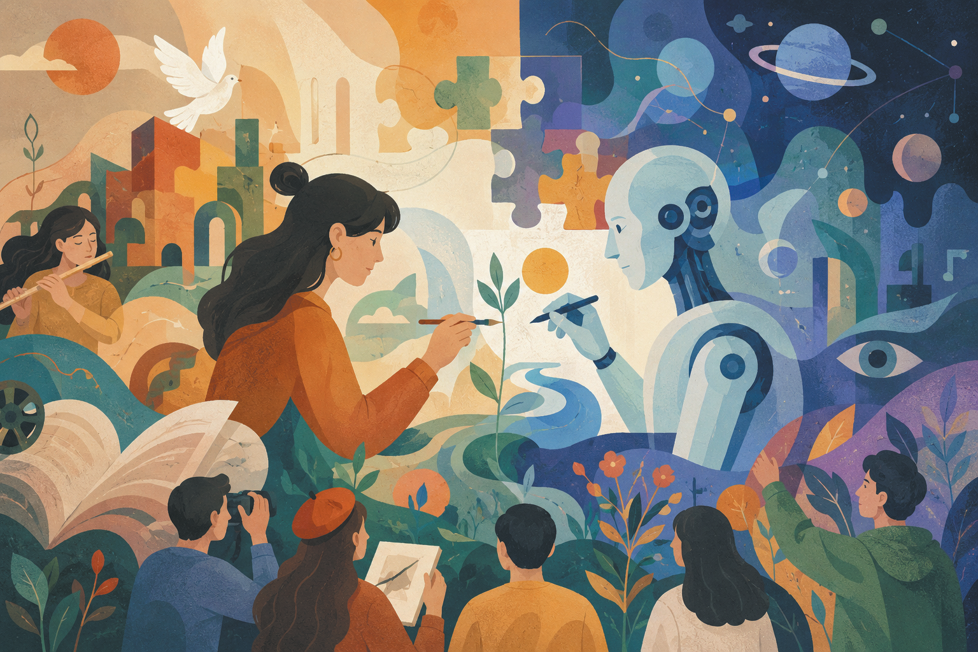
Artificial intelligence has already entered the creative industries. It writes scripts, generates images, edits footage and is beginning to produce feature-length movies. Elsewhere, a debate still rages on: Should AI be part of the creative process?
The real question is what happens when AI begins making culture, not simply content.
The public can already sense the difference. Millions of people happily watch AI-generated pets, imaginary creatures or absurd comedy clips on social networking sites. Yet many of those same viewers become uneasy when AI is used to make movies or replace actors. The technology has not changed. People's expectations have.
We do not ask the same things of every form of content.
Short videos reward speed. AI excels at it, generating endless streams of novel, visually engaging content at minimal cost. Platforms built on attention have every reason to embrace it.
But cinema asks for something else. A movie does more than entertain. It invites audiences into imagined worlds and leaves them carrying emotions long after the credits have rolled.
That is why AI's arrival in the culture industry poses a deeper question than its arrival in technology: Can a machine reproduce the human experience without ever having lived one?
This is what unsettles people. AI is no longer competing on efficiency alone. It is entering domains long considered uniquely human: imagination, empathy and artistic expression.
None of this is an argument for keeping AI out of the creative industries. Like every transformative technology before it, AI will change how culture is made, automating routine work, enabling new forms of collaboration and, in some cases, generating content almost entirely on its own.
But changing creative production is not the same as replacing human creativity.
AI learns from what already exists. It recombines patterns, styles and structures found in enormous collections of human work.
This makes it exceptionally good at producing content, but not necessarily at generating original ideas.
History's most influential novels, movies and paintings rarely succeeded because they represented the most statistically likely choice. They mattered because someone was willing to defy convention and imagine the world anew. Innovation begins where precedent ends. But that is not how AI learns.
The value of human creativity also lies beyond the finished product. Audiences respond not only to what a work says but to the knowledge that someone devoted years of thought, observation and persistence to making it. Creative labor leaves traces that are impossible to measure, yet easy to recognize. A novel carries the weight of lived experience. A movie reflects countless artistic decisions that no algorithm can fully explain.
As AI dramatically reduces the time and effort required to produce content, something else may quietly become more valuable: evidence of genuine human commitment. In an age when almost anything can be generated instantly, works shaped through patience, uncertainty and personal experience may become increasingly rare — and therefore increasingly meaningful.
There is another reason the debate matters.
The economics of AI creates new tensions within the content industry. Much of AI's extraordinary productivity depends on learning from existing human works while replacing parts of human labor.
If creators cannot protect their intellectual property or receive fair recognition for their contributions, technological progress risks becoming economically unbalanced.
Recent copyright disputes involving film studios, publishers and online writers illustrate that these concerns are no longer theoretical. They are already reshaping creative industries around the world.
Quantity presents another challenge. More content does not automatically produce better culture. Audiences still have only 24 hours in a day. When AI makes it possible to generate almost unlimited volumes of stories, videos and images, attention — not production — becomes the scarcest resource.
Under such conditions, originality can easily be buried beneath an avalanche of formulaic material, making effective platform governance more important than ever.
For that reason, the future of AI should not be judged simply by lower production costs or faster creative workflows. A healthier measure of progress would ask different questions. Does AI give creators more room to imagine, or less? Does it respect authorship or dilute it? Does it strengthen human responsibility, or encourage people to surrender creative judgment to algorithms? And are audiences told clearly that what they are watching was shaped by AI?
These questions point toward a broader principle. AI should expand human creativity, not displace it. It should reward original work rather than exploiting it. It should remain transparent rather than invisible. Above all, it should leave human beings firmly in charge of cultural decisions.
As Si Xiao, vice-president of Tencent and president of Tencent Research Institute, has observed, people must remain the "helmsmen" of technology.
That responsibility does not belong only to technology companies or governments. It belongs equally to creators, platforms, publishers and audiences, all of whom shape the cultural environment in which AI develops.
AI will almost certainly become a permanent part of cultural production. The real question is whether it will make culture more human or merely more efficient.
Technology can generate content at unprecedented speed. Only people can decide what is worth creating in the first place. That is why the future of AI ultimately depends not on the intelligence of machines, but on the judgment of those who choose how to use them.
The author is a senior research fellow at the Digital Content Research Center, Tencent Research Institute.
The views don't necessarily reflect those of China Daily.
If you have a specific expertise, or would like to share your thought about our stories, then send us your writings at opinion@chinadaily.com.cn, and comment@chinadaily.com.cn.
Related Stories
 AI News
Chinese internet giants set to reap AI profits in 2 to 3 years, UBS says
40 minutes ago
 AI News
Faster homework, poor exam results: What AI is doing to students’ learning
40 minutes ago
 AI News
ITU and AWS expand cooperation on AI and cloud technologies
1 hour ago
 AI News
Army’s TITAN platform moving into production phase with $192M delivery award for Palantir, Anduril
1 hour ago
 AI News
Dell Buoys AI Trade Amid Looming Chip Shortages
1 hour ago
 AI News
Rethinking cybersecurity operations in the age of artificial intelligence
1 hour ago
 AI News
AI Child Porn Is Still Porn
1 hour ago
 AI News
Cities turn to artificial intelligence to speed housing permitting
1 hour ago