
Maine Democrat Graham Platner halting U.S. Senate run amid sexual assault allegation
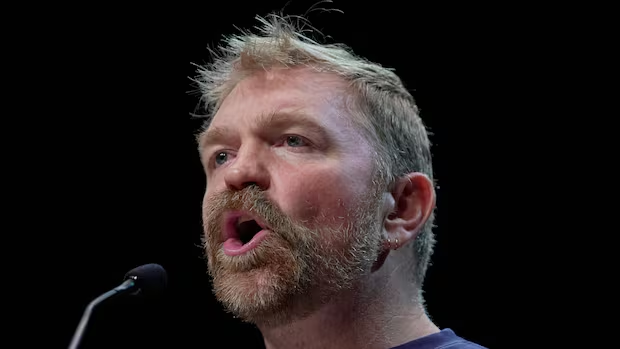
Maine Democrat Graham Platner halting U.S. Senate run amid sexual assault allegation
Candidate says decision to shutter campaign that withstood months of controversy is not an admission of guilt
Graham Platner announces exit from U.S. Senate race
Graham Platner said Wednesday that he plans to withdraw from the U.S. Senate race in Maine after recently facing an allegation of sexual assault.
The move shuttered a campaign that had withstood months of controversy only to implode and imperil Democrats' attempt to regain power in Washington.
Platner's exit will most likely force a reckoning within the party, which has been divided between its moderate and progressive factions, as it struggles to unify during this year's midterm elections.
Maine is considered a key state for control of the narrowly divided Senate, and Democrats were desperate for a candidate capable of defeating Republican Sen. Susan Collins while President Donald Trump is broadly unpopular.
His controversies include a Nazi tattoo. Why Democrats are still standing by Senate candidate Graham Platner
Trump's scandal-plagued pick wins Texas Senate primary run-off — and Democrats see an opening
In an 11-minute video posted to social media, Platner said the process to replace him needs to be "open, transparent and democratic" and to reflect the will and values of people who supported him. He also lashed out at Democratic leaders in Washington, D.C.
"People in D.C. need to stay in D.C.," he said. "Decisions should not be made by people in places of political power."
At times scratching his beard and looking off camera as he spoke, Platner seemed to become emotional as he announced his plans, seated on what appeared to be a wooden deck as the noise of nearby traffic whizzed by.
He also stressed that his decision to step aside was not an admission of guilt.
Although Platner had never before held elected office, progressive leaders promoted him over Gov. Janet Mills, who was favoured by the Democratic establishment.
Mills dropped out of the race in late April as Platner, a military veteran and oyster farmer, consolidated support from primary voters who were eager for a more combative candidate and were willing to overlook his checkered past, which included a tattoo recognized as a Nazi symbol and online posts in which he was dismissive of sexual assault.
Shortly before Platner clinched the Democratic nomination in the June 9 primary, there were reports that he had exchanged sexually explicit messages with other women while married and that he had become physical with a previous girlfriend during an argument.
But Platner's support didn't crater until Monday, when Politico reported that a woman said he had drunkenly forced her to have sex after she told him to stop.
Democrats' autopsy of 2024 U.S. election blames Harris and 'identity politics' for loss
Eric Swalwell resigns from U.S. House, suspends California governor campaign amid sex assault allegation
Jenny Racicot, who lives in Maine, told Politico she had been in an on-and-off relationship with Platner but cut off contact with him after that night in 2021 and told him the encounter wasn't consensual. In a CNN interview, she said she had been raped "by definition."
After the story was published, Platner released a video on social media where he denied the allegation as "categorically false." He then said he would be "taking the time to reflect on the best path forward" for his campaign.
High-level backers pulled their support, including Vermont Sen. Bernie Sanders, who said on Tuesday that he spoke with Platner and that "in light of these very serious allegations, I have recommended that he step aside."
Replacement must be named by July 27
State law includes a provision for Democrats to replace Platner before the general election. The state Democratic Party held an emergency meeting Wednesday, where more than 100 state committee members signed off on holding a nominating convention in the event of Platner's withdrawal.
Platner announced he would do just that less than an hour later.
According to the statute, party officials may select a new nominee if a candidate who won the primary withdraws by 5 p.m. on July 13. The replacement candidate must be named by July 27.
Democrats must net four Senate seats to gain control of the 100-member chamber, and party leaders viewed Maine as a critical piece of the puzzle, along with Alaska, Ohio and North Carolina.
Related Stories
 AI News
One revolver, six bullets: Turkish president’s ‘unusual’ gift to NATO leaders
5 seconds ago
 AI News
The World Cup quarterfinals teams explained as Taylor Swift eras
10 seconds ago
 AI News
The Latest: After weeks on hold, deal between Israel and Lebanon is progressing, says US official
11 seconds ago
 AI News
Wickenheiser, Leafs part ways after eight seasons
19 seconds ago
 AI News
Barnaby Joyce's scathing two
35 seconds ago
 AI News
News of the day: Canadian savings deteriorate, charitable estate donations, breaking the credit cycle, catastrophic insurance losses and more
55 seconds ago
 AI News
Plans for more pipelines to export Canadian oil — and emissions
57 seconds ago
 AI News
Saskatoon sees downed power lines, broken trees after extreme wind and thunderstorm
1 minute ago