
Law on Enterprise Uzbekistan International Digital Technology Center signed. Details
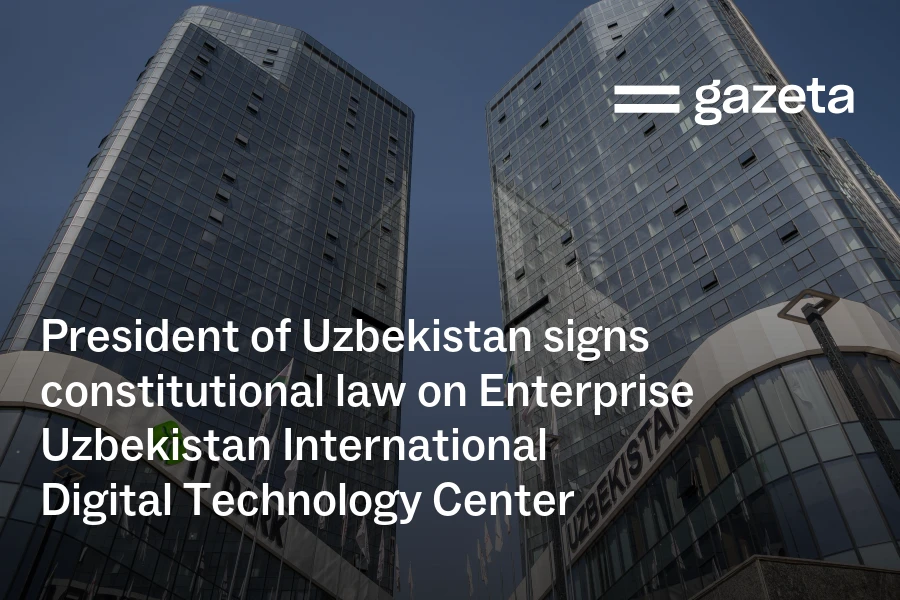
President Shavkat Mirziyoyev signed the constitutional law On the International Digital Technology Center (Enterprise Uzbekistan, website). The law will enter into force in six months, on 21 January 2027.
The law aims to create a special jurisdiction for attracting investment in digital technologies, facilitate the development and commercialization of innovations and promote the export of services.
The special legal framework will remain in effect until the end of 2100. The president will determine the boundaries of the center.
The special legal framework may cover:
the development, implementation and commercialization of digital technologies, services and products;
investment activities and the export of services;
experimental testing of digital technologies;
civil and economic proceedings;
financial and banking activities;
intellectual property protection.
In certain cases, the framework may also apply to projects carried out by center participants outside its main territory.
The center will have a special framework for applying legislation. It will include the Constitution, the constitutional law itself, decisions of the president and the Supervisory Board and, where necessary, English and Welsh common law and principles of equity.
According to Enterprise Uzbekistan, the center is a technology jurisdiction for global big tech companies and will be located within IT Park in Tashkent. Enterprise Uzbekistan emphasized that the center was not primarily about tax incentives, but about the special legal framework as a whole, which would allow major technology companies to operate directly from Uzbekistan.
The president of Uzbekistan will approve the composition of the center’s Supervisory Board and serve as its chair.
The board will set the center’s strategic development priorities and approve key rules governing its special legal framework.
English will be the center’s official working language. All decisions of the Supervisory Board and the center’s administration will be published in English.
The center’s participants will include residents and investors. The law defines four categories of investors: institutional, infrastructure, startup and resident investors.
Different requirements, operating conditions and support measures may be established for each category.
Investors will have the right to independently determine the amount, types, forms and areas of their investments and freely dispose of income generated from investment activities within the special legal framework.
The assets, investments and property of center participants will be protected from confiscation, nationalization, expropriation and seizure. Exceptions include final decisions of the Tashkent International Commercial Court, as well as measures related to combating money laundering, terrorist financing and sanctions-related restrictions.
The center’s authorities, participants and their employees will be exempt from taxes and fees established by Uzbekistan’s tax legislation, except for VAT, corporate income tax and personal income tax.
The center’s authorities and participants will also be exempt from VAT and customs duties when importing equipment, components, software, materials and samples used for the production of digital technologies, activities within the regulatory sandbox and the operation of the center.
A regulatory sandbox will be introduced to test innovative technologies, products and services. It will operate for up to 12 months, unless the board sets a different period.
Participants may be temporarily exempted from certain legal requirements and licensing and permitting procedures while working within the sandbox. They will also have access to the center’s infrastructure, including research laboratories.
Center participants will be able to obtain banking, investment, venture capital, insurance, payment and other financial services through accredited partners. With the Central Bank’s approval, branches of foreign banks may also operate within the center.
The center may establish special rules for accessing and protecting personal data.
The law also contains provisions on cloud technologies. The center may set rules for storing and reusing information using cloud technologies.
At the same time, measures must be taken to protect data from unauthorized access, alteration, destruction or dissemination. Requirements for storing information must also take international security standards into account.
The law separately regulates the protection of intellectual property rights.
Employment relations within the center will be governed by the constitutional law, Uzbekistan’s labor legislation and decisions of the center. Special rules for organizing work may also be introduced.
Foreign workers will be subject to a separate procedure. Within established quotas, they may be exempt from the requirement to obtain confirmation of their right to work in Uzbekistan. Entry, visa and registration procedures for foreign specialists will also be subject to the special legal framework.
The constitutional law also establishes rules for activities involving artificial intelligence.
Center participants will be able to develop and test AI technologies. When developing or testing solutions that could directly or indirectly affect human rights and freedoms, they must take measures to protect those rights and legitimate interests.
The law also requires participants to assess risks, prevent discrimination and comply with Uzbekistan’s international obligations.
Educational institutions will be able to implement programs in line with the center’s requirements. The use of educational programs and standards from foreign countries and international organizations will also be permitted.
The law establishes a separate framework for resolving disputes arising under the special legal framework.
The Tashkent International Commercial Court will have jurisdiction over economic, civil, corporate and labor disputes related to the activities of center participants, among other matters.
The court will also hear disputes concerning decisions by the center’s authorities, property relations, liquidation, reorganization, insolvency and bankruptcy of participants, as well as other cases provided for by law.
For violations of the center’s rules, its administration may issue written warnings, impose financial sanctions, temporarily restrict activities, suspend benefits or ultimately terminate a participant’s status.
Related Stories
 Technology
Fortifi Companies to Show Groundbreaking Technology at PACK EXPO 2026
29 minutes ago
 Technology
Branding for Startups in Ahmedabad: Social Sherpa Builds Brands Ready to Scale
2 hours ago
 Technology
ZAWYA: Central Bank of Bahrain to triple technology investments
2 hours ago
 Technology
Hinduja Tech Appoints Faiz Ahmad As CEO, Effective 1 November
2 hours ago
 Technology
Fusion firm Xcimer announces fresh DOE milestones award
3 hours ago
 Technology
Sub-Rs 20,000 smartphone market may be heading to a 'collapse' and reason is the 'most
3 hours ago
 Technology
Qatar, Italy Eye Expanded Digital, Technology Cooperation - Fana News -
3 hours ago
 Technology
Qatar, Italy Eye Expanded Digital, Technology Cooperation
4 hours ago