
India’s UPI payment developer eyes diaspora for growth

“Is it possible to get 15-20 markets in the next 10 years’ time? I think that’s a top-level kind of go-to-market approach,” said Dilip Asbe, CEO of the National Payments Corporation of India (NPCI), which developed the Unified Payments Interface, or UPI.
“The way India is self-sufficient on domestic payments, we would like to be as much self-sufficient on cross-border payments as well,” he said.
“NPCI is in talks with Japan, Malaysia and Bahrain among others,” Asbe said, adding their governments and central banks will have the final say due to geopolitical and regulatory implications.
“NPCI is also exploring agentic AI to enable payments through platforms such as OpenAI’s ChatGPT and Alphabet Inc’s Gemini,” Asbe said.
UPI is the world’s largest real-time payment system by transaction volume, according to the International Monetary Fund.
It has transformed everyday payments in India by allowing users to transfer money instantly between bank accounts using a mobile phone, bypassing card networks for many transactions.
NPCI now wants to replicate that success overseas by linking UPI with foreign payment systems, initially focusing on countries with large Indian communities that account for the world’s biggest remittance flows.
Apps such as Google Pay and PhonePe use UPI to process payments in India, while Apple Pay has yet to launch for domestic payments.
NPCI’s strategy is aimed at India’s 35 million-strong diaspora, which sent home over US$155 billion in remittances in the fiscal year ended March, the largest inflow globally.
Overseas Indians have also helped shore up the country’s foreign-exchange reserves during periods of market stress through special deposit schemes.
“The diaspora is going to increase, travel is going to increase, the trade is going to increase,” Asbe said.
The overseas expansion comes as UPI’s business model is evolving at home.
India’s lower house of Parliament on Thursday approved legislation allowing banks and other payment providers to levy charges on UPI transactions.
Finance minister Nirmala Sitharaman said in a post on X that NPCI is yet to decide on any charges.
An NPCI spokesman declined to comment.
“The expansion will build on UPI’s presence in nine countries, including Singapore, France and the UAE,” Asbe added.
UPI currently allows person-to-person remittances for Singapore and Nepal, while inward remittances are enabled from Greece.
Established by the Reserve Bank of India and banks, NPCI operates the country’s retail payments infrastructure.
Besides UPI, it also runs the RuPay card network, a domestic alternative to Visa Inc and Mastercard Inc.
NPCI is also offering the technology, as a public good, to developing nations such as Namibia, Peru and Trinidad and Tobago to help build and operate a similar system.
The push comes as countries seek greater control over their payment systems after Western sanctions cut Russia off from the SWIFT financial messaging system and froze much of its foreign-exchange reserves.
“No government would want over-dependence for critical functions like payment systems,” Asbe said.
“The weaponisation of the payment system has been exercised,” he said.
Related Stories
 India
India
'Fighting for retaining democracy': Congress leaders hit back at FIR over INDIA bloc protest
8 minutes ago
 India
India
World Juniors: UAE Stun India to Enter Quarterfinals
2 hours ago
 India
India
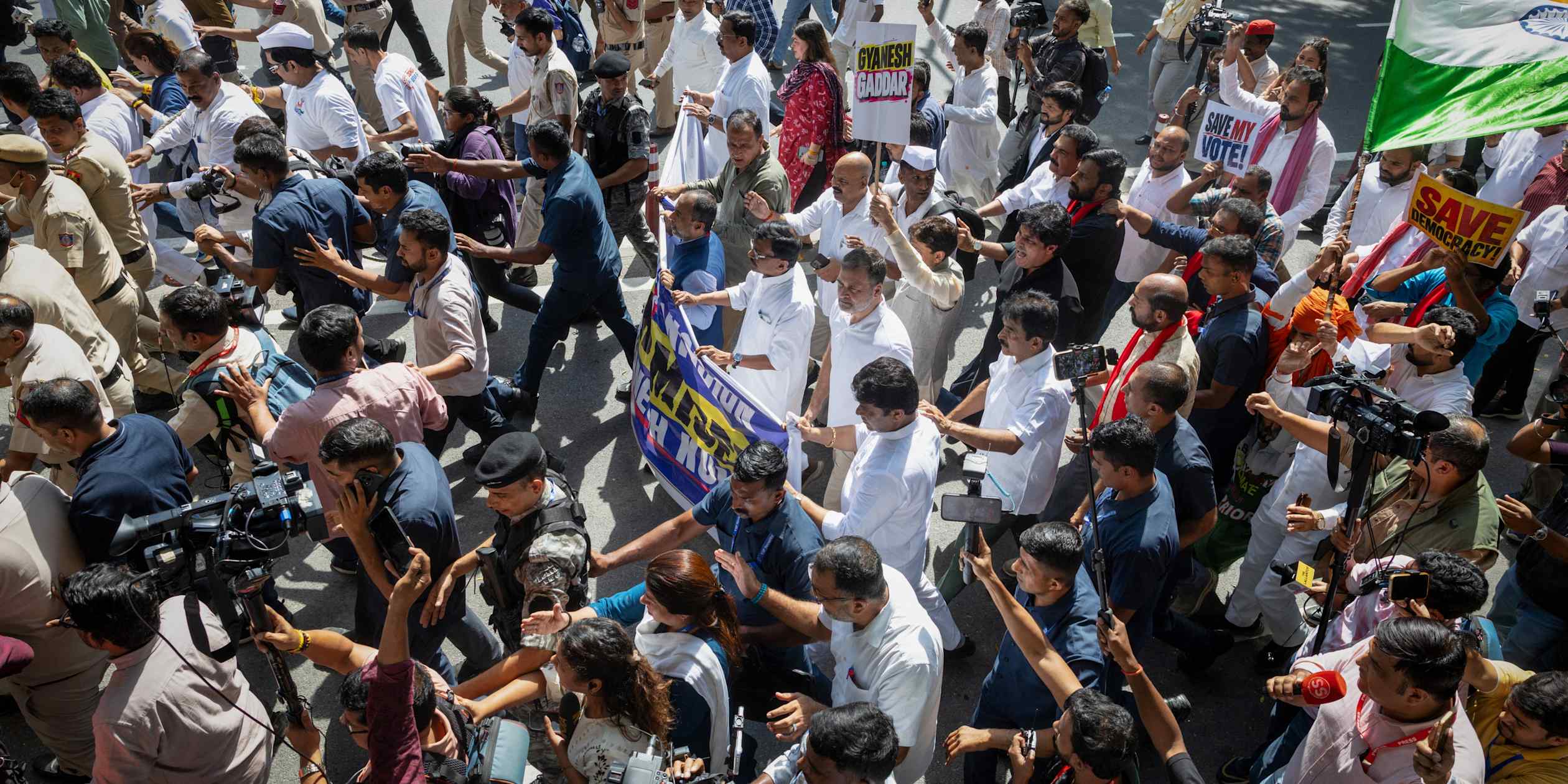
India's opposition protests pile pressure on Modi government
4 hours ago
 India
India
THE BOND BEYOND BORDERS MODI AND THE INDIAN DIASPORA
4 hours ago
 India
India
From Gujarat to Centre: NDA allies highlight PM Modi’s continuity, coalition politics | India News
6 hours ago
 India
India
World Juniors: UAE Stun India
8 hours ago
 India
India
From maker to breaker: Decoding Mamata Banerjee’s journey of TMC, losing its symbol and political future
9 hours ago
 India
India
INDIA bloc march: EC says no party requested meeting till 4 pm
16 hours ago