
How Epicenter is driving $110M investment in Memphis, supports job growth
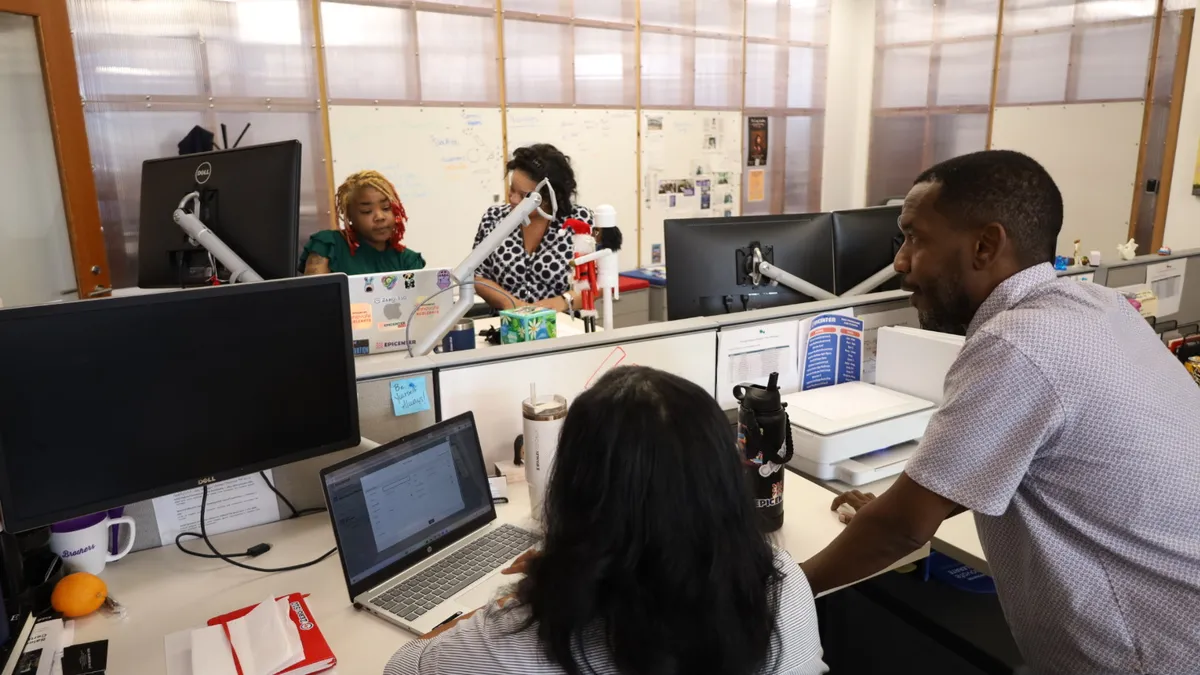
How Epicenter is driving $110M investment in Memphis, supports job growth
Medical devices. Package tracking. Ride services. These are just a few innovations born out of Epicenter Memphis. Hear directly from the CEOs who turned these ideas into reality.
Over a decade after its founding, one downtown-based nonprofit is driving job growth in Memphis through the hundreds of startups it has helped get off the ground.
Epicenter, founded in 2015, operates as educators, early investors and a support system for rising entrepreneurs in the Memphis area.
“I think a lot of consulting firms, more profit-oriented organizations … are willing to just say no because their job isn't to help the entrepreneur, their job is to make money,” said Nate Smith, director of programs.
“Our job is to help the entrepreneur.”
Epicenter’s multiple classroom-style programs cover everything from growing an idea into a marketable product, to how to pitch that product to investors and land contracts.
More one-on-one consultation helps with pitching practice, diagnosing issues or finding new directions to take the business.
Smith said the job growth potential for Memphis, and the resources they can bring to the city is the "most exciting" part of his work.
“New job creation comes from companies that are less than 10 years old,” Smith said. “Entrepreneurs that we work with when they're hiring people — this is a new job that's created in Memphis. They’re higher-paying, creative, exciting. These are the exact type of jobs Memphis needs more of, and these companies are great vehicles for attracting resources to Memphis."
A decade of growth: $110M generated
While 342 companies have gone through Epicenter programs since 2023, one of the best showcases of Epicenter’s success has been its medical technology (med-tech) centric ZeroTo510 program. These courses provide investment and expert guidance on everything from networking to product development and marketing.
Of nearly 40 companies that have gone through ZeroTo510 programs since 2015, more than 25 are still active, and ZeroTo510 alumni companies have raised more than $110 million.
Half of businesses launched are women-owned
Epicenter’s programs have also been successful in assisting women-owned businesses.
According to Founders Forum Group, only 2.3% of nationwide venture capital funding in 2024 went to women-founded businesses. Since Epicenter’s 2023 pivot to programming that exclusively supports “innovative entrepreneurs and startups”, 55% of startups supported have been women-led, and they have accrued $4.5 million or 39% of funds raised since. About 40% of female founders, who went through ZeroTo510 Accelerator have raised more than $500,000, which is 8 times the national average for female founders.
Goal to generate permanent investment in Memphis
Smith hopes by the time Epicenter finishes its next decade, they will have doubled the number of entrepreneurs, and by extension increase permanent investor presence in Memphis in a similar way Nashville has achieved.
In the present day though, many innovative businesses that work with the nonprofit are receiving large investments and generating revenue, from businesses nearly 10 years old to just 10 months. Here’s a closer look at three startups made possible by Epicenter whose products could revolutionize their respective fields.
Corami Biotech’s goal is to transform how heart disease, the number one cause of death for Americans, is treated.
“When you take a pill or when you give injection, drugs just don't have a good way of finding the heart and being effective, and when you increase the dose, you end up hurting other tissue, like the liver, lungs, the brain,” Esra Roan, Ph.D. said. “So we're changing how we deliver drugs for the heart by going straight to the heart.”
In short, medication is instead delivered onto the surface of the heart through a sophisticated delivery system that places a soft material on the heart, which is loaded with the necessary therapeutics, Roan explained. Generating revenue comes later — right now she's focused on solving the big technical questions that will get her product into hospitals and saving lives.
“The questions we're asking are, can this be put on the heart? What happens when you put this on the heart? It's not so much about revenue, downstream questions.”
While it is one of the few biotech companies in the entire state, Roan, a former professor of biomedical engineering at the University of Memphis, said because of the strong medical device manufacturing capabilities in Memphis, she is better able to “make what’s in my head.”
Her “philosophical” reason for operating in Memphis equally important. Roan is set on fundamentally changing how the heart is treated, and finding "democratized" solutions that make it accessible not just to those who can afford to visit the top cancer treatment centers in the country, but to the average patient in Memphis as well.
“The heart disease problem is for real here, these are real elevated problems that [local hospitals] need solving,” she said. “If you’re a researcher in the Silicon Valley region … you’re not able to see the real problems. My surgeons tell me, day in and out in Memphis, that they see more advanced, more mortal cancers, patients don’t go get their early checkups, so our problems are bigger here, and we solve more real problems that impact patients."
Wes Montague’s freight quality software platform Ship It Pro is strategically placed at no better a location than Memphis, one of the top shipping and logistics hubs in the world. Shippers, manufacturers and carriers can utilize Ship It Pro’s universal system for tracking cargo damage and freight claims to better mitigate risk and address shipping quality issues.
“Today, the industry can't tell you what happened to that freight when an incident happened,” Montague said. “From the moment the freight's handed off from the shipping dock to that carrier … all the way to the retail outlet, we're creating a single source record so when there is an incident, everybody's working from the same source of truth.”
Ship It Pro began as an LLC in 2020, but it was only last October that it became a C Corp. Since then, over $250,000 in investment has been generated, with a $150,000 deal in the works, Montague said.
A Memphis native, Montague said with all the tech money moving to Nashville in recent years, he "almost" regretted opening the company in Memphis, but his heart is in his hometown. And now, promoting Memphis as a place for similar startups is now part of his mission.
“There's more of a small-town feel here in Memphis, so it's almost like, hey, I've got a big fish idea, maybe there's a little more tension on this idea if I'm doing it in the backyard where logistics lives,” he said. “I knew I had connections here, I knew people are more friendly, more [accessible]… I probably wouldn't have been able to have those doors opened up in a bigger city like Nashville.
“I've now looked beyond just making Ship It Pro successful, but this is about my city. This is about bringing attention to Memphis. We've got a lot of cool stuff going on here, and we've always been kind of overlooked. Open your doors Memphis, support what's being built right here in your backyard.”
MedHaul founder Erica Plybeah originally had no interest in entrepreneurship, associating it with the stress her father felt running his small business. And she didn’t have wealthy friends or family that could give her tens of thousands in loans like many entrepreneurs. But as she heard encouragement from Epicenter and came to understand the nitty gritty details of founding a startup, she began to believe that it was possible for her.
Founded in 2017, MedHaul is a digital health company that helps health organizations find and schedule medical transportation for patients to get to important appointments. The company has grown to operate in 15 states.
“We work with health systems, health plans, providing our software platform to book rides that are typically more complex medical transport, but non-emergency," she said.
For adults who don’t have a car, the company is helping to lessen the impact of missed appointments, with ride booking that takes around 90 seconds, opposed to hours. It's a critical logistical advancement — according to MedHaul's website, adults without reliable transit access miss important medical care one in five times.
Plybeah said her experience operating in Memphis helped her find that early support she needed.
“It is evident that there is not a lot of early support or it’s just very difficult to find because those places [like New York, San Francisco] are so saturated,” she said. “Memphis has this kind of way of wrapping their arms around you once they see you are motivated and driven … making sure you have that early support you need, so that you can go out and attract that support from other places.”
Plybeah said she is also one of a very small number of solo Black women founders in the country that have raised over $1 million in venture capital, with only six in the southeast. She’s certain it wouldn’t have been possible without Epicenter’s support.
The experience of building a business from scratch is a challenging one, but less because of monetary restraints or workload, but because of how lonely the experience can become.
In their entrepreneurial journeys, each quickly realized support from their peers is a comfort that cannot be replaced.
“Building a company is just a very isolating experience, especially when it’s your first and you’re under 40,” Plybeah said. “You’re thrust into this role as a CEO … you’re not welcome into traditional CEO communities, and then you’re not really welcome into your own career communities because you’re no longer their peer.”
She said the support she’s received from Epicenter has made the "impossible possible."
“Epicenter is passionate about what the entrepreneur needs holistically, they are really good at not abandoning you. It sounds simple, but it’s tough for many organizations, and Epicenter has been one of the most consistent in providing the support that the entrepreneur as a human needs, and as a business needs."
She has also learned founders should also prioritize their personal lives throughout the process.
"We as founders need to prioritize the things we care about outside of the company, so build the company without losing yourself. It’s not the money that we should be prioritizing,” she said.
It’s a similar story for Montague. Initially, he held his patent tightly to his chest, and found it difficult to talk about his idea. Epicenter was the communal outlet he needed to build the confidence to market Ship It Pro, and come full circle in giving advice to entrepreneurs just starting their journey.
“I think it's a mental health thing too,” he said. “I turned a lot to faith during it, but for me to be able to come here in an open, friendly environment … and get the feedback and hear it out loud, let me voice what I'm trying to get at, and people helping critique it, it's boosted my self-esteem, my confidence, that I'm on the right track.”
Roan knows what it’s like to get in the weeds of a project. In the midst of taking a sizable monetary risk and sometimes hearing from critical people, having deeply human interaction is key to getting off the ground.
“You have to eat uncertainty and risk every morning as a cereal. Every morning you wake up, you check a box that you're resolving,” Roan said. “All the while, you might have kids; you don't have insurance; you don't have salary; your salary could go next month; you're really in this milieu."
She said having Epicenter as a type of sounding board has brough her "peace" in the uncertain midst of entrepreneurship.
"To be seen and understood is a great peace, and that allows you to open up and talk about your problems where you can solve them and leads to actual positive constructive ways that our startups improve.”
Jacob Wilt is a reporter for The Commercial Appeal covering Dining, Retail and Real Estate in the Memphis area. You can reach him at jacob.wilt@commercialappeal.com.
Related Stories
 Startups
Build What Everyone Else Will Want Tomorrow: Anand Lunia’s Playbook for the Next Generation of Fintech...
3 hours ago
 Startups
VC Platform: Dariusz Zuk's Plan to Globalise Polish Startups
6 hours ago
 Startups
Airwallex tips $1 million into 10 AI startups
8 hours ago
 Startups
ASX courts VC
16 hours ago
 Startups
Venture capitalist Oren Zeev's sharp warning: why Israeli startups must incorporate in the US
19 hours ago
 Startups
Bitroot Ventures Launches Early
1 day ago
 Startups
Airwallex invests $1 million in 10 AI startups, spanning roads to robots
3 days ago
 Startups
Stripe Acquires Clerky to Offer Legal Infrastructure for Startups
3 days ago