
“From ‘The Old Man and the Sea’ to ‘Ocean and Entrepreneurship’”… Son Ju
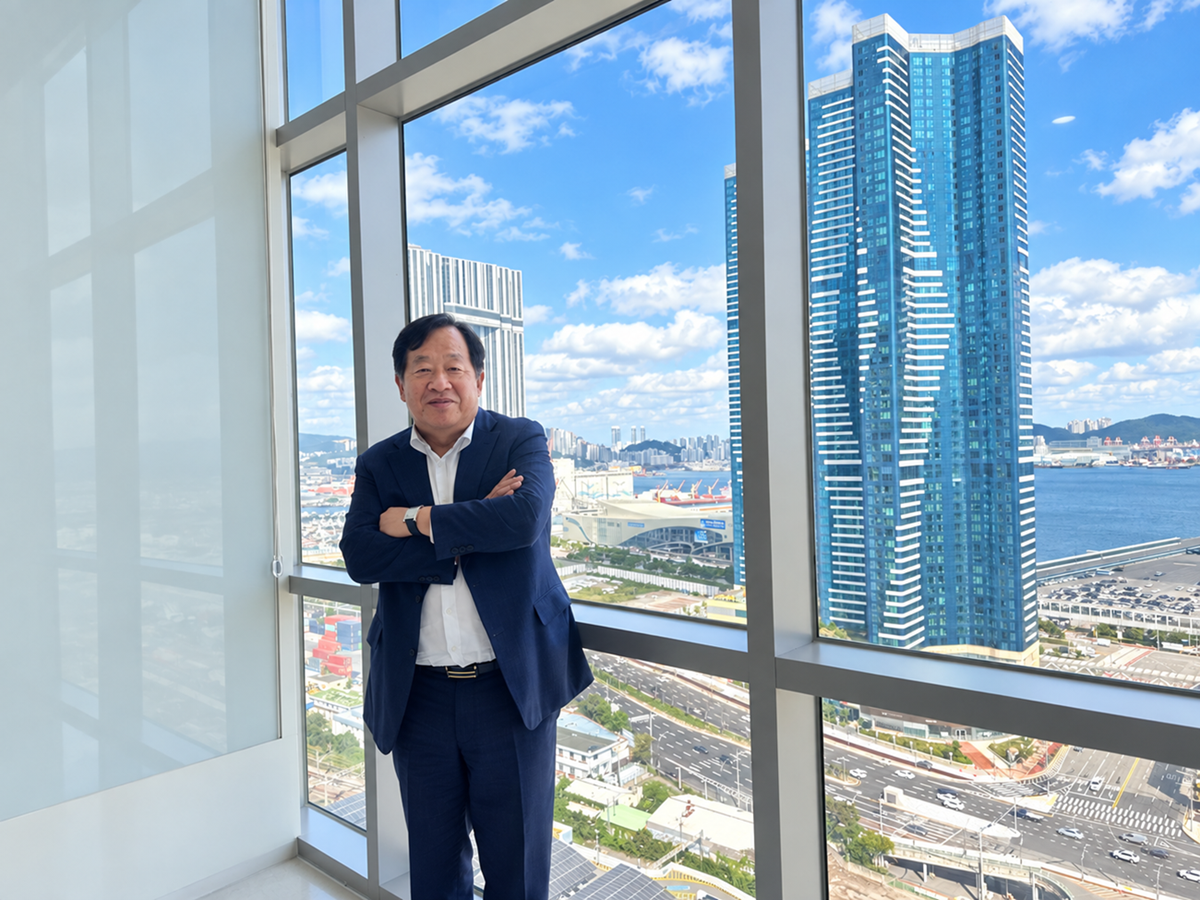
Can a startup ecosystem be created simply by hosting a large-scale startup event in Busan? Son Ju-eun, Chairman of Megastudy Education, states that a complete ecosystem is formed only when startups and investors actually meet, investments are made, and time accumulates for the companies discovered in this way to grow and attract the next generation of entrepreneurs.
Chairman Son, who serves as the chairman of the organizing committee for 'FLY ASIA 2026'—now in its fifth year—emphasizes 'tangible results' the most. He calls for tracking not just how many business agreements were signed or how many large institutions were attracted at the previous event, but also what kind of relationships the startups and investors met at FLY ASIA have built since then and how much the companies have grown.
FLY ASIA is an Asian global startup expo held in Busan that serves as a startup platform connecting promising Asian startups with domestic and international investors, large and mid-sized companies, and global innovation institutions. This year's event will take place from October 7 to 8 at BEXCO Exhibition Center 1 in Busan under the slogan "Connect Asia, Fly to the World." Under the theme "Blue Ocean Connect," the event will feature a special ocean pavilion and track, as well as conferences on ocean, physical AI, global, investor, and financial innovation; 1:1 meetups; startup IR; LP and VC forums; large conglomerate open innovation; a global pavilion; a pre-event gathering; and networking.
Last year, more than 40 countries participated, hosting over 52 programs and 170 exhibitions, recording 1,271 one-on-one meetups and attracting approximately 200 billion won in investment. The number of visitors reached about 20,000. This year, a dedicated matching app will also be introduced to allow users to find partners and hold meetings based on their areas of interest and investment stage.
Chairman Son emphasized that FLY ASIA, now in its fifth year, must move beyond the stage of simply expanding its scale and evolve into a platform that fosters startups that actually grow in Busan. He believes it should serve as an opportunity for local middle and high school students, university students, and young adults to consider entrepreneurship as a future career option.
“If the significance so far has been in creating an atmosphere that Busan is striving for entrepreneurship, now we need to see a continuous stream of startups actually growing based in Busan. FLY ASIA should also become an event where middle and high school students, university students, and local young people gain new inspiration, thinking, ‘I can start a business too.’”
The example Chairman Son cited while discussing the future of FLY ASIA was the Japanese startup conference IVS (Infinity Ventures Summit). Invited to the event through his daughter's network, he participated in the IVS Youth Program held in Kyoto to experience the scene firsthand.
IVS is Japan's leading startup conference, which began in 2007 and is celebrating its 20th anniversary this year. The 2026 event was held in Kyoto from July 1 to 3. This year marks the 33rd edition in total and is hosted by the IVS KYOTO Executive Committee, composed of Headline Japan, Kyoto Prefecture, and Kyoto City. In addition to the standard IVS, which involves startups, investors, and corporations, the 2026 event also featured a separate invitation-only program called 'IVS CORE,' targeting decision-makers such as startup executives, institutional investors, senior executives of large corporations, and policymakers.
What Chairman Son focused on at this event was not the splendor of its scale, but the structure in which startups, investors, and companies gathered in one place to find partners they needed and create business opportunities. The time spent fostering the startup ecosystem together with the private sector and the local community over the 20 years the event has been held was also impressive.
FLY ASIA also emphasized that startups must go a step further than one-sided pitching where they simply introduce themselves to investors. The idea is that investors should present the type of company they are looking for, and startups should be able to find investors who can play a necessary role in their growth process, not just for funding. In fact, this year's program includes Open Investment (OI) reverse pitching and meetups, startup IR pitching, OI meetups with domestic and international VCs, ACs, and large corporations, and 1:1 meetup matching.
“Investors should be able to say, ‘We are looking for this kind of company,’ and startups should be able to ask, ‘We intend to do this kind of work; which VC can do more than just investment?’ If enough startups and VCs gather, actual matching can take place within that space.”
It takes time to verify results. Just as it takes several years for early-stage startups to receive investment, grow, and achieve an IPO or a large-scale exit, Chairman Son stated that FLY ASIA should also be carried out with a timeframe of about 10 years. Therefore, for this year marking the 5th edition, he proposed a plan to re-examine the companies that participated in the 1st through 4th editions to verify their subsequent investments, growth, and re-establishment after failure, and to introduce these results within the event.
“We need to revisit the companies that have participated so far. There are likely companies that have continued to grow and establish themselves after winning, as well as founders who failed once but succeeded in other businesses. Only when such results are visible can people say, ‘FLY ASIA was not just an event that spent money, but one that actually produced something.’”
The two words Chairman Son particularly focuses on in Busan are "maritime" and "startup." His philosophy is to combine Busan’s assets—such as its maritime industry, ports, and logistics—with entrepreneurship to create an environment where local youth can launch and grow businesses within the city. He emphasized that it is more important for companies to emerge and grow within Busan itself than to simply increase the number of Busan-born entrepreneurs operating in the capital area.
FLY ASIA’s adoption of the theme 'Blue Ocean Connect' this year aligns with this direction. The event will feature a special marine pavilion showcasing marine innovation, technology, and investment, with the participation of over 30 marine-related organizations and companies. Exhibitions on open innovation by large and mid-sized enterprises, as well as the Smart Ocean Startup Support Association (OSA), will also be held.
However, Chairman Son emphasized that it is difficult to build a regional startup ecosystem solely through annual events. He argued that a hub is needed where entrepreneurs can regularly gather to prepare and grow their businesses, and that a structure must be established where companies discovered there can meet domestic and international investors and firms at FLY ASIA.
“You cannot produce results with just two days of FLY ASIA. To revitalize Busan, we need a forward base where entrepreneurs can gather. We must continuously nurture promising entrepreneurs there and organically connect them with events like FLY ASIA. To transform Busan from a city of ‘The Old Man and the Sea’ into a city of ‘Ocean and Entrepreneurship,’ we must build the foundation of the startup ecosystem from the ground up.”
Chairman Son’s criteria for evaluating entrepreneurs have been refined more specifically over the past decade. The Yoonmin Foundation for Creative Investment, which celebrates its 10th anniversary this year, has been discovering early-stage startup teams every year through its "Good Starter" program. Candidates are shortlisted from the teams applied for in the first and second halves of the year through document screening, followed by on-site inspections, and finally, companies selected for support are chosen through presentation evaluations. Through this process, he has personally listened to presentations from hundreds of teams over the past decade. While business models, market size, and past performance are important, what he closely scrutinizes when meeting founders is the energy of the CEO and key personnel.
It’s not like you can know everything about someone after seeing them for five minutes. Still, I get a sense of it to some extent. Whether or not they have energy is quite important.
In the early stages, rapid growth is possible by hiring personnel and expanding marketing based on investment funds. The moment a founder's true strength is revealed is when the growth slows and unexpected problems arise. When a business hits a limit, it requires the inner strength and patience to persevere and find a way again, as well as the energy to pour everything one has into the endeavor. In particular, founders must guard against the moment they think they have succeeded too early.
“I don’t think I’ve ever popped the champagne. Life hasn’t changed much, whether I was lecturing or now. It is dangerous to get drunk too quickly on the thought that you have succeeded. Starting a business requires enduring a rough process until you cross the valley of death and establish yourself to some extent.”
Another principle I often tell founders is to minimize the risk of failure as much as you strive for great success. This is because choosing excessive investment and expansion to grow rapidly can cause the entire company to be shaken by a single poor decision.
There is an experience that Chairman Son never fails to mention when discussing the relationship between investors and founders. It was in 2001, when Megastudy first received external investment.
Megastudy, incorporated in July 2000, launched its online services in September of that year and began offering video lectures the following summer. Although it was a time when the potential of the online lecture market had not even been fully verified, venture capital analysts began visiting the company not long after the video services were launched.
One investment manager who approached first came in person despite being told that he had to meet at 3 a.m. due to Chairman Son's lecture schedule, and they met several times afterward to discuss the business. Shortly after, Ahn Geon-young, an investment manager at another VC firm, also visited Megastudy. Although Ahn had proposed a higher valuation, Chairman Son maintained his relationship with the investor who had approached him first and examined the business for a long time, and adjusted the terms to allow both investors to participate.
The relationship with the two investors continued even after Megastudy grew. In particular, the connection with the investment analyst who first visited Megastudy eventually led to the establishment and management of Mega Investment. Sharing this experience with young founders, Chairman Son cites who one will go with as a more important criterion in investment than immediate valuation.
“You shouldn’t choose investors based solely on how many times your investment you receive or how much more money you get. Difficult moments will arise in business, and at those times, an investor’s experience and coaching are also crucial. I gained both back then. Ultimately, gaining people was the greater benefit.”
Chairman Son's story ultimately returns to life rather than business. Having risen from a star lecturer to the founder of Megastudy, and then to an investor and director of a startup foundation, he brings up "how to live" before "how to succeed" when explaining his choices. There is an "inequality" he has frequently discussed in his lectures: the order is life first, work second, and success third. This means that one must first determine what kind of life one wants to live, choose work that aligns with those values, and then accept success as the result.
The founding of Megastudy also stemmed from the same concerns. While working as a star instructor, he pondered ways to reduce the regional disparity in private education and chose the new approach of online education before internet lectures became commonplace. After starting the business, there was much to learn regarding investment and corporate management, but the problem he wanted to solve and the direction of the business were clear.
“You shouldn’t make success your primary goal. How you live comes first, work second, and success third. You realize the life you want to live through your work, and the result can be either success or failure. I want to tell young entrepreneurs not to get too consumed by success.”
The change Chairman Son desires at FLY ASIA is to create a foundation where entrepreneurs can launch businesses in Busan, meet investors, and grow. A virtuous cycle must be established where companies that grow in Busan attract junior entrepreneurs, and the region's young generation accepts entrepreneurship as a viable option.
Chairman Son, who has been watching the growth of FLY ASIA and took on the role of organizing committee chairman for this year's 5th event, now looks forward to seeing its achievements translate into actual corporate growth. Taking this year as an opportunity, he envisions FLY ASIA continuing to see the success of startups that participated in previous events, and to see companies starting in Busan continue to expand into the global market.
“Now that we are marking our fifth anniversary, what happens from now on is even more important. I hope that through FLY ASIA, talented entrepreneurs will be discovered, meet investors, and grow, so that in a few years, we can see many companies emerge that we can say, ‘This company started in Busan, went through FLY ASIA, and has grown like this.’ I hope FLY ASIA plays a role in making Busan a city of ‘the ocean and entrepreneurship,’ rather than a city of ‘The Old Man and the Sea.’”
Related Stories
 Business
Unhinged Business Co. Receives Best Scaling Start Ups Advisory in Australia of 2026 Recognition for Commercial Strategy and Founder Focused Growth
5 hours ago
 Business
Uber invests $10M in Indian fleet operator Carrum at $168M valuation
15 hours ago
 Business
Startup Teragen Energy bets on fuel cells for data centers
16 hours ago
 Business
This startup is building a single platform to manage operations and suppliers
17 hours ago
 Business
The Legacy Question: What Happens When A Startup Founder Passes Away?
19 hours ago
 Business
Ukraine has been trying to bring the war to Russia. More Russians are beginning to feel it
20 hours ago
 Business
Mirzapur: The Movie Becomes Producer Farhan Akhtar's Biggest Hit Beating Don 2, Gully Boy
20 hours ago
 Business
Palo Alto Networks founder Nir Zuk raises $245 million for new cybersecurity startup
20 hours ago