
Ukraine has been trying to bring the war to Russia. More Russians are beginning to feel it
Ukraine has been trying to bring the war to Russia. More Russians are beginning to feel it
Summer was marked by fuel shortages and drone attacks on warehouses
As Kyiv reeled Tuesday from another night of deadly strikes by ballistic missiles and jet-powered drones, Russia's state-controlled media didn't report on the damaged highrise buildings or the cars that were set ablaze.
Instead, Russian broadcasters reported that several military facilities in Ukraine had been successfully targeted, while at home, the country's air defences had intercepted more than 380 Ukrainian drones.
But Russia's own vulnerability has become harder to conceal.
Local officials reported that two civilians were killed in Russia during the overnight strikes. And there are reports in the country's media that Moscow plans to allow postal workers to arm themselves with anti-drone weapons.
The measures are another sign of how Ukraine's expanding drone campaign is bringing the war deeper into Russian territory — and increasingly into the lives of ordinary Russians.
Massive Ukrainian drone strike batters targets deep inside Russia
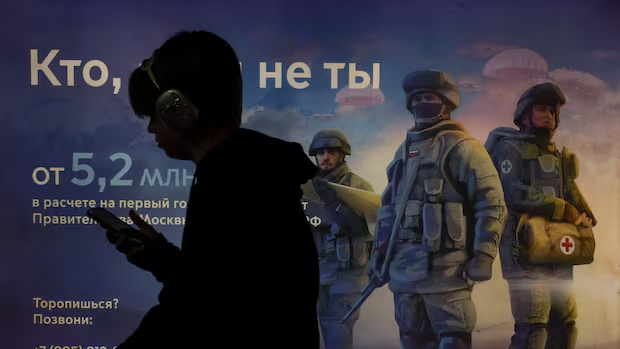
For nearly five years, the Kremlin has tried to shield much of the population from the realities of its full-scale war against Ukraine, as well as its economic consequences.
But Ukrainian drone strikes on refineries, energy facilities and e-commerce warehouses this summer have been a blunt reminder that Russia is not impenetrable.
"After the active drone raids on Russia — on Moscow and the Moscow region in particular — anxiety has increased greatly," said Tatiana, 66, who wanted to be identified only by her first name. "We were driving to the dacha with the children and saw a huge column of smoke. Naturally, that also causes fear."
Russia reports large-scale Ukrainian drone attack across 12 regions
Ukraine hits Moscow oil refinery again, part of massive drone wave inside Russia
Tatiana, like others CBC News spoke with for this story, communicated through voice memos sent on a messaging app. No one wanted to give their last names for fear of being punished for speaking to foreign media about the war.
She said she sometimes lies to her grandchildren when they wake up at night because of the noise, telling them it is construction work because she does not want them to be afraid.
At her dacha, a country home, she said people talk about the fear caused by the buzzing of drones overhead.
Ukrainian attacks on refineries and energy facilities have contributed to a fuel shortage in Russia, leading to long lines at gas stations, fuel rationing and public frustration. Videos posted on social media showed fights and arguments breaking out at some stations.
The government has taken steps to stabilize supplies, including importing fuel from countries such as India. It's a significant move given that Russia is one of the world's largest oil exporters.
The shortage has also helped fuel the popularity of GdeBENZ (Where is the Benzine), an app that directs motorists to gas stations with available fuel.
Denis Volkov, director of the Moscow-based research and polling organization Levada Center, said as the fuel crisis intensified earlier in the summer, surveys showed rising anxiety and a decline in approval of the Russian government.
But he said the mood has softened somewhat as fuel supplies have improved.
Levada’s August survey, published on Thursday, was conducted through video calls with 1,600 people across Russia. About one-quarter said they were experiencing tension and fear, while nearly 60 per cent described themselves as being in a normal mood.
About two-thirds said they had experienced problems with mobile internet access, messaging apps or fuel. One-third said the fuel shortage had seriously affected their lives.
"The main concerns are, of course, economic, but also the overall continuation of hostilities," Volkov said in a phone interview with CBC News from Moscow.
Ksenia, 41, a single mother who works in the civil service in the Russian capital, said the drones do not frighten her terribly. But she is struggling with rising prices.
"It feels as though no salary or freelance work is enough to cover expenses anymore," she said in a message to CBC News.
"Is there any light at the end of the tunnel? Who knows."
The Russian economy is expected to grow by just 0.4 per cent this year, while many non-military sectors are stagnating or shrinking. If Ukraine continues striking Russian targets, including its oil and grain export infrastructure, the country's economic growth could be pushed down further.
Last month, Andrei Klepach, chief economist at Russia’s state development bank, lost his job after giving a public speech about the economic problems created by the war.
Last week, the Kremlin envoy for international development, Boris Titov, was quoted as saying the Russian economy could go "berserk" if the country continues on a steadfast war footing.
In August, Russian President Vladimir Putin signed a decree allowing the government to take control of infrastructure deemed critical if it is considered inadequately protected from drone attacks.
Sanctioned but standing: Russians see their prices rise as Trump and Putin head to Alaska
Wildberries is the Amazon of Russia. Ukraine is trying to destroy it
"The country is spiralling into a terrifying abyss. Especially when you look at the economic results of the last five years, it makes you want to cry," said Vitaliy, 40, a businessman from Noginsk, about 40 kilometres east of Moscow.
Vitaliy runs a business supplying spare parts to chemical plants. He said Western sanctions have made it difficult to obtain foreign-made parts, forcing the supply chain to shift toward what he described as the buying of "domestic crap."
"The business is going under. I am not down to my last piece of bread, but I am deeply worried about the future of myself, my family and my loved ones."
Vitaliy said he was also saddened by the attacks on e-commerce warehouses because of the losses they represent for other business owners.
The one thing that gives him some solace, he said, is that his ID card says he is fit for military service "with restrictions." He hopes that will be enough to keep him from being swept up if the government launches another mobilization.
In recent weeks, rumours have circulated that Russia is preparing for another mobilization. Ukrainian President Volodymyr Zelenskyy has also speculated that it could happen after Russia's parliamentary elections scheduled for Sept. 18 to 20.
The Kremlin has denied that it is about to start another large-scale draft, but fear persists, and the New York Times recently spoke with men who are making plans to leave the country just in case.
Briar Stewart is a CBC correspondent, based in London. During her nearly two decades with CBC, she has reported across Canada and internationally. She can be reached at briar.stewart@cbc.ca or on X @briarstewart.
Related Stories
 Business
Mirzapur: The Movie Becomes Producer Farhan Akhtar's Biggest Hit Beating Don 2, Gully Boy
48 minutes ago
 Business
Palo Alto Networks founder Nir Zuk raises $245 million for new cybersecurity startup
50 minutes ago
 Business
Honda invests in rare-earth
51 minutes ago
 Business
French cardiac monitoring startup Implicity reports 26% lower mortality as it raises €35 million
1 hour ago
 Business
Secretive defense startup Covenant emerges from stealth with $250 million at over $1 billion valuation
1 hour ago
 Business
This Startup Raised $10 Million to Bring AI to Old Factories
1 hour ago
 Business
Munich-based FRYTE Mobility raises €3.5 million to connect eTruck fleets with charging infrastructure across Europe
2 hours ago
 Business
A lofty goal and new leader: How 43North Foundation intends to make $5B impact
2 hours ago