
Canada's oil windfall may yet wipe out its losses from tariffs
Canada's oil windfall may yet wipe out its losses from tariffs
Even as Trump tries to squeeze Canada, Iran war's oil industry impact sends billions to this country's coffers
Canadians are well aware of the damage U.S. President Donald Trump has inflicted on this country by signing off on tariffs targeting about $27.6 billion in Canadian products.
But thanks to his unsuccessful management of the Iran war, Trump's other hand is effectively writing cheques to the Canadian economy, drawing on funds paid by U.S. consumers at the gas pump.
In fact, the extra money now flowing into Canadian coffers — for context, Canada supplied the U.S. with more than 60 per cent of its crude oil imports last year — will go a long way to making up tariff losses, and could end up more than compensating for them.
Earlier this summer, as the missile exchanges in the Gulf died down and Trump signalled that peace was on the way, the price of oil began to fall from the $100-plus US range it hit in response to the initial U.S.-Israeli attack on Iran, and Iran's closure of the Strait of Hormuz. By the end of July, a barrel of Brent crude had dipped to $72 US.
But the resumption of hostilities has been followed by new successes for Iran's regional allies, and oil has returned to where it was at the height of the Hormuz crisis. Brent crude hit nearly $110 US when trading opened on Friday morning.
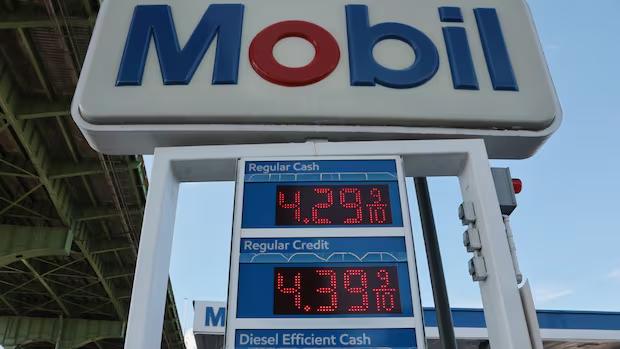
While Canadians are also feeling the impact of fluctuating oil prices — both at the pump and as it gets absorbed into shipping costs — the windfall from those profits could boost the overall economy enough to offset the cost of Trump's tariffs, with some provincial governments even projecting a turnaround on their deficits.
From deficit to surplus? How oil prices could soon reverse Alberta's fortunes
On Wednesday, the Houthis, Iran's Yemeni rebel allies, seized the port city of Mokha on the Red Sea Coast from Yemeni government control. The strategic Perim Island (also known as Mayun) fell to the Houthi army on Thursday. The losses potentially close one of the few safe maritime routes left for Saudi oil to reach the world.
The island sits across the Bab al-Mandab, the "Gate of Grief" that connects the Red Sea with the Indian Ocean. (Its name comes from its perils for mariners — now magnified by Houthi missiles.) Saudi jets pounded the Houthis' new positions as the week closed, but they had already consolidated their hold.
Houthis seize strategic island, Saudis close pipeline as fighting escalates
Saudi and Yemeni officials expressed shock at their enemies' rapid gains. On Thursday, the Trump administration had refused urgent Saudi requests for direct U.S. strikes to slow the Houthis.
Saudi oil is concentrated in its Eastern Province, bordering the Persian Gulf. But since the outbreak of war, that eastern coast and its sea outlet at the Strait of Hormuz are vulnerable to attack by Iranian drones and missiles. The Saudis have responded by diverting oil from Persian Gulf ports some 1,200 kilometres across the country through the Petroline pipeline to Yanbu, on the country's western Red Sea coast, and loading it onto tankers there.
From Yanbu, tankers could head south through the Bab al-Mandab into the Indian Ocean, which is what they did through much of the summer, carrying around three million barrels of oil a day.
But in August, Houthi missile attacks caused that traffic to slow dramatically. Instead of heading south from Yanbu, tankers started going north through the Suez Canal into the Mediterranean. That added time and expense, because the Suez Canal isn't deep enough to handle a modern fully-laden oil tanker. But at least the oil could move — as long as the Petroline kept bringing oil to Yanbu.
"The big thing for oil markets is that you have that relief valve of the Suez Canal," said Calgary-based Joe Calnan, vice-president of energy at the Canadian Global Affairs Institute. "If the pipeline is destroyed and disrupted for a long period of time, then you're not going to have that relief valve at all."
Who are the Houthis? How they could send oil prices surging even further
On Thursday, Iran's allies — possibly Iraqi militias — scored direct drone hits on the Petroline, creating a plume of black smoke visible from space.
"That just bottles up seven million barrels per day,” Calnan told CBC News. Now, no oil is reaching the Red Sea.
Regardless of how long it takes to restart the pipeline, or whether the Houthis can truly close the strait, Iran's coalition is now in an even stronger position to threaten world oil supply than it was on Monday.
Saudi Arabia's misfortune is Canada's windfall
When oil first shot past the $100 US per barrel mark in the spring, the Canadian oil industry experienced a bonanza.
Economist Jim Stanford, director of the Centre for Future Work in Vancouver, estimates that the second quarter after-tax profits of the whole industry, upstream and downstream, doubled those of its first quarter, to come in at about $23 billion. (Of course, while Americans paid for most of that windfall, Canadian consumers also had to pay more at the pump.)
Oil is now back in the same price range, and should stay there for some time, according to Calnan. "We're well above $100 per barrel for Brent continuous contract crude."
Unexpected oil windfall expected to take a big bite out of N.L.'s deficit
That means more money for the industry, but also for governments and for Canada's overall gross domestic product.
Alberta has already ridden the Iran war's oil bonanza to a complete reversal of its financial fortunes, moving from a projected $9.4-billion deficit to a $2-billion surplus.
Newfoundland and Labrador was projecting a $668-million deficit this year. This week, Finance Minister Craig Pardy told CBC News "we're looking at $500 million plus to our coffers as a result of the upswing in oil," bringing the province much closer to balance. Prices now look set to remain well above the province's budget estimate of $79 US per barrel for some time.
Skyrocketing oil price brings in $500M to N.L, says finance minister, helping fight deficit
The federal government stands to benefit, too, mostly through corporate and personal income taxes. Tyler Meredith, former economic advisor to the Trudeau government, told CBC News that every $10 increase in the price of a barrel of oil translates into about $2 billion of additional revenue for the federal government — "a pretty substantial benefit."
That money could help to offset the cost of tariff relief programs for other industries.
Could it cancel out the tariffs?
A $20 increase in the price of crude would likely add about $12 billion to $24 billion to the Canadian economy.
U.S. tariffs affect about $28 billion worth of goods, so at first glance the oil windfall appears inadequate to compensate for tariff losses. But some tariffed goods will continue to trade, because U.S. buyers need them and lack alternatives. Other goods will find different markets, either in Canada or abroad.
Most analysts estimate the cost to Canada’s GDP of all tariffs to be somewhere between 0.3 per cent and 0.6 per cent, or $10 billion to $20 billion per year.
But having oil at $100 US per barrel, rather than $80, is generally estimated to add about 0.5 per cent to one per cent to overall Canadian GDP, or $16 billion to $32 billion per year.
Can Canada actually win a trade war with the U.S.? | About That
The oil-price spike may also have secondary positive effects for Canada that can prove lasting, said Calnan, since there's little reason to believe Saudi Arabia will be able to defang the Houthi rebels any time soon.
"They've tried for years and they've been unsuccessful," he said, explaining how eight months into the war, countries historically dependent on Gulf oil are starting to look for new providers. "I know for sure that countries in East Asia are seriously looking at Canada for that energy security and diversification. That is unlocking long-term investment."
Iraq scrambles to address fallout from alleged militia attack on Saudi oil pipeline
Offshore oil production in Newfoundland and Labrador is already up about 25 per cent this year.
"We see now an emerging interest in our exploration plays and that hasn't been the case for the last three or four years,” said OilCo CEO Jim Keating, who heads up the Crown corporation that leads oil and gas activities on behalf of the Newfoundland and Labrador government.
Already, U.S. tariffs fall much more heavily on manufacturing provinces such as Ontario, Quebec and British Columbia than they do on Alberta and Saskatchewan.
Higher prices will put even more pressure on industries that consume a lot of energy, such as manufacturing and transportation. High energy prices also tend to spill over into inflation in food and consumer goods, at a time when many Canadian families are already feeling stretched to make ends meet.
But high oil prices should also relieve downward pressure on the Canadian dollar, allowing for cheaper imports, which can partly counteract inflationary pressure on the cost of living.
And Calnan says industries beyond oil potentially stand to benefit in the future.
"If we're talking about big new investments happening in Alberta, that will help boost manufacturing and other industries elsewhere in Canada, because there'll be an enormous amount of steel, and skilled trades workers needed to complete these huge facilities."
Carney releases video saying U.S. wanted 'dependency' in too many areas
On his way to the Republican convention in Dallas, Trump on Wednesday assured voters that "right after the election, oil prices are going to be tumbling downward." But there are few signs the markets are buying it. Oil futures contracts remain at the $100 level to the end of 2026.
Your guide to the U.S. midterms, and why they're crucial for Donald Trump
In both of the world's current major wars involving superpowers — the U.S.-Israeli war on Iran and the Russian war on Ukraine — oil infrastructure has become a major target.
Both the Russians, who famously anticipated a swift collapse followed by a victory parade in Kyiv, and the Trump administration, which has declared victory over Iran more than once, now appear mired in conflicts with no clear exit, said Calnan.
"Wars have a problematic tendency to just keep going and be very difficult to bring to a clean finish," he said. "I'm not sure why people keep thinking that wars they start are going to end in a month."
Evan Dyer has been a journalist with CBC for 25 years, after an early career as a freelancer in Argentina. He works in the Parliamentary Bureau and can be reached at evan.dyer@cbc.ca.
Related Stories
 Canada
Provinces are turning to U.S. health
6 minutes ago
 Canada
Skyrocketing diesel prices could turn into high grocery prices soon, as shipping costs go up
6 minutes ago
 Canada
Residents and officials meet on dredging concerns
6 minutes ago
 Canada
World’s best wheelchair basketball players take centre stage in Ottawa
56 minutes ago
 Canada
Arrest after boy, 15, stabbed in park
59 minutes ago
 Canada
Byelection wins, personal relationships influence Ford cabinet shuffle, insiders say
59 minutes ago
 Canada
Teenage boy badly hurt in unknown substance attack
2 hours ago
 Canada
Metro Vancouver bus drivers reach tentative contract deal: company
4 hours ago