
Calgary uses AI to determine the 50 highest
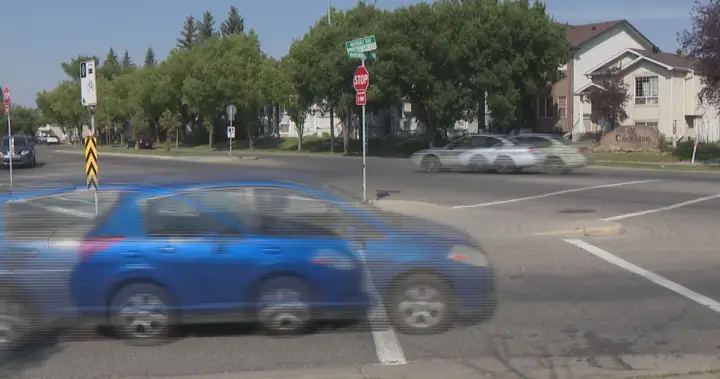
The City of Calgary has used artificial intelligence to determine the 50 riskiest intersections for pedestrians across the city, but it’s unclear what will be done to address the issue as just half are recommended for upgrades.
According to a report set to be presented at the city’s Community Development Committee meeting Tuesday, administration used the city’s AI platform to assess and assign a risk score to more than 17,000 intersections across Calgary.
Many of the locations don’t meet “conventional warrant” thresholds for upgrades like traffic signals, overhead flashers, or curb-bump outs, the report said, as that set of criteria is based on factors such as traffic volumes, pedestrian volumes, roadway geometry, and speed limits.
City administration compiled a list of the top 50 highest-risk pedestrian intersections identified by the AI platform that do not have existing traffic signals like rectangular rapid flashing beacons with risk scores ranging from 93.55 to 99.02.
The intersection of Martindale Boulevard and Martindale Gate N.E. topped the list, followed by Falshire Drive and Falton Drive N.E. with a score of 98.54.
Ward 5 Coun. Raj Dhaliwal told Global News he was surprised with the intersections that scored the highest risk ratings, with four of the intersections in the top 10 in his area.
“I was asking myself is there something missing from my assessment,” Dhaliwal said of the intersection in Martindale. “Every time I drive by there, I see less pedestrian traffic.”
Just 26 of the locations are recommended for pedestrian safety improvements which are estimated to cost approximately $6 million, the report said.
According to the report, administration could “proactively advance improvements” with additional funding rather than “waiting” for future traffic counts, collision history or studies to “justify intervention under traditional processes.”
Some on council have questions about how AI was used to determine those findings, including modelling, inputs and prompts.
“I’m all for data-driven decision making. This is empirical evidence that is telling me that these things need to be upgraded,” Dhaliwal said.
“But at the same time, I want to know why, how and what.”
The report notes there “may be public scrutiny” around the city’s use of AI, but adds all the recommended improvements were reviewed and validated through professional engineering judgment and technical assessment.
The city’s use of AI is “innovative,” said Alex Gaio, an associate principal at Leading Mobility, with the sheer amount of data administration would need to comb through.
“We have a lot of data, the city updates its hotspot map every 10 minutes,” he said. “So the volume that we get is overwhelming for people to deal with, and we’re racing against risk.”
Last year, 15 people were killed on city streets and so far this year six people have died; another 283 incidents involving pedestrians resulted in injuries.
“If we really care about the safety of our residents, pedestrian safety, motor vehicle safety… then let’s put our money where our mouth is,” Dhaliwal said.
Although committee is not being asked to make a financial commitment Tuesday, city administration said it could incorporate the pedestrian safety upgrades into the next four-year budget.
If city council was to approve additional funding during budget talks in November, the report said design work could begin in 2027, with shovels in the ground in 2028.
Related Stories
 AI News
Globus Medical Acquires Higgs Boson Health To Add AI
58 minutes ago
 AI News
IITM Pravartak Announces Batch 03 of Advanced Certificate in Applied Artificial Intelligence & Deep Learning
58 minutes ago
 AI News
Google rolls out Gemini AI feature to help readers analyse their e
1 hour ago
 AI News
How AI and Smart Manufacturing Are Transforming China's Optical Fiber Giant
2 hours ago
 AI News
Sunny Hostin of ‘The View’ bets on AI clones as Hollywood fights over its soul
2 hours ago
 AI News
130,000 faces scanned in a week: The technology changing Australian policing
3 hours ago
 AI News
Mom Who Travels For Work Builds AI Clone of Herself to Keep Her Teenage Son Company
3 hours ago
 AI News
ChatGPT said you’d lose your jobs right now
3 hours ago