
Big banks exploring Canadian dollar
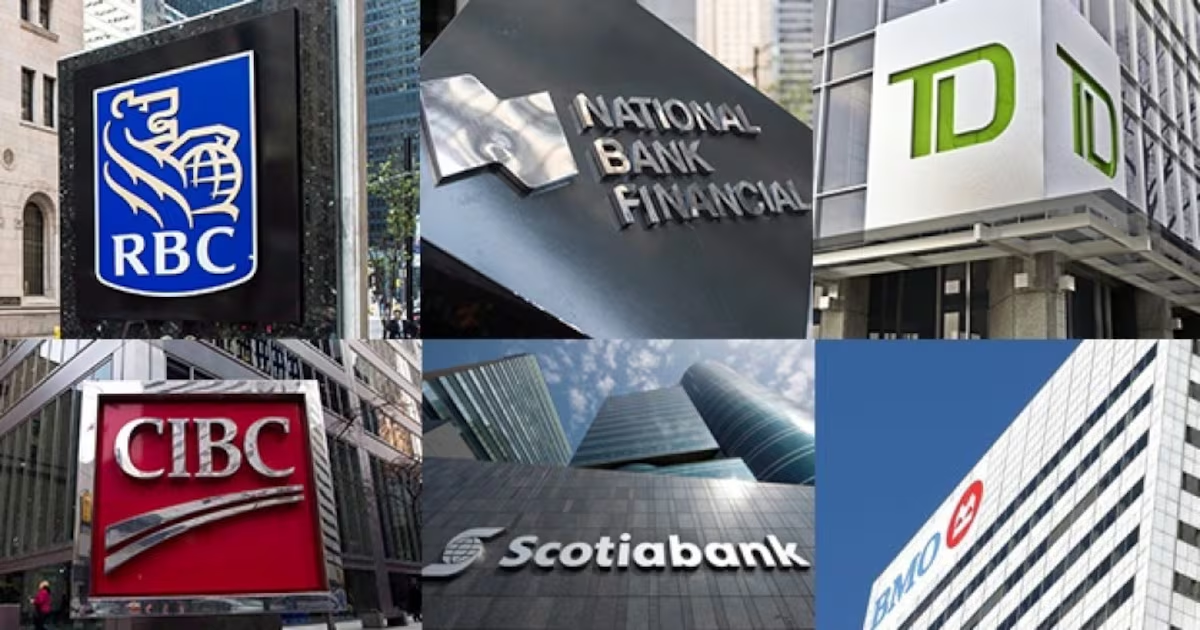
TORONTO — Canada’s big banks are exploring the development of Canadian dollar-based digital money, starting with a tokenized deposits initiative.
Tokenized deposits are traditional bank deposits recorded on a decentralized database or distributed ledger, such as a blockchain. The plan seeks to deliver faster, more efficient and programmable payments to Canadian customers while preserving safety, stability and effective regulatory oversight.
It means Canadian dollars could be converted into tokens on blockchain for easier transfers, said Claire Célérier, Canada Research Chair in household finance at the University of Toronto’s Rotman School of Management.
“My understanding is that the six banks will share the same blockchain, and so it implies that transactions can be made instantaneously across wallets with tokens,” she said.
Bank of Montreal, CIBC, National Bank, Royal Bank, Scotiabank and TD Bank are taking a collaborative approach to the project.
The tokens would be issued by commercial banks and from a legal perspective, depositors can treat them the same as traditional bank deposits.
The banks say the first phase aims to move tokenized deposits between Canadian financial institutions.
“It’s really exploratory now. I think what they’re saying is that they’re willing to work together to develop the technology,” Célérier said.
She said the potential capabilities would be of particular benefit to large companies or institutional investors, allowing them to complete “more sophisticated transactions.”
“What I expect is that these tokenized dollars will be mostly used by large companies and so on who have accounts across these Canadian banks, and it will be used to move large amounts of money,” she said.
Cristian Bravo, professor and Canada Research Chair in banking and insurance analytics at Western University, said the potential change could allow large producers to settle accounts far faster than their typical 30-day window.
“If you have an instant settlement, you’re closing that gap and closing that inefficiency in the market. And the fact that you have the money when you fulfil the contract, that can help reduce dependency on working capital and mobilize that capital faster,” he said.
But Bravo said that due to the lack of historical examples, it is not clear how much of an effect the move could have on the bottom lines of companies or institutional investors that use it.
Bravo said it is also notable that digital money is not the same as cryptocurrency, but rather a “digital ledger to move deposits in a very quick, instant way.”
In September, the Office of the Superintendent of Financial Institutions released a statement on tokenized and other digitally represented assets. It said that the tokenized deposits were not legally different from traditional deposits.
“The underlying technology of a financial product or service does not determine its legal nature. To be clear, we focus on what the product or service is, not how it is built or delivered,” the statement reads.
The Bank of Canada said on its website in June that it, along with other central banks, was studying tokenized systems to assess use cases.
Daniel Johnson, The Canadian Press
This report by The Canadian Press was first published Sept. 22, 2026.
Related Stories
 Finance
How an amateur found Germany’s biggest hoard of Roman silver coins
7 hours ago
 Finance
How can Winnipeg end homelessness for good?
10 hours ago
 Finance
Can Canada turn its airports into money
19 hours ago
 Finance
Taylor Frankie Paul teases exit from ‘Secret Lives of Mormon Wives’
22 hours ago
 Finance
Chancellor vows to stay on for Germany’s ‘democratic future’ after latest loss to far
1 day ago
 Finance
What to Invest In Right Now, September 2026
1 day ago
 Finance
Why Annamalai's Periyar clarification is a strategic pivot to consolidate his movement in Tamil Nadu...
1 day ago
 Finance
Government plans to introduce economy bill critics say will threaten right to strike
1 day ago