
Africa’s live events boom: The continent is ready for its mega
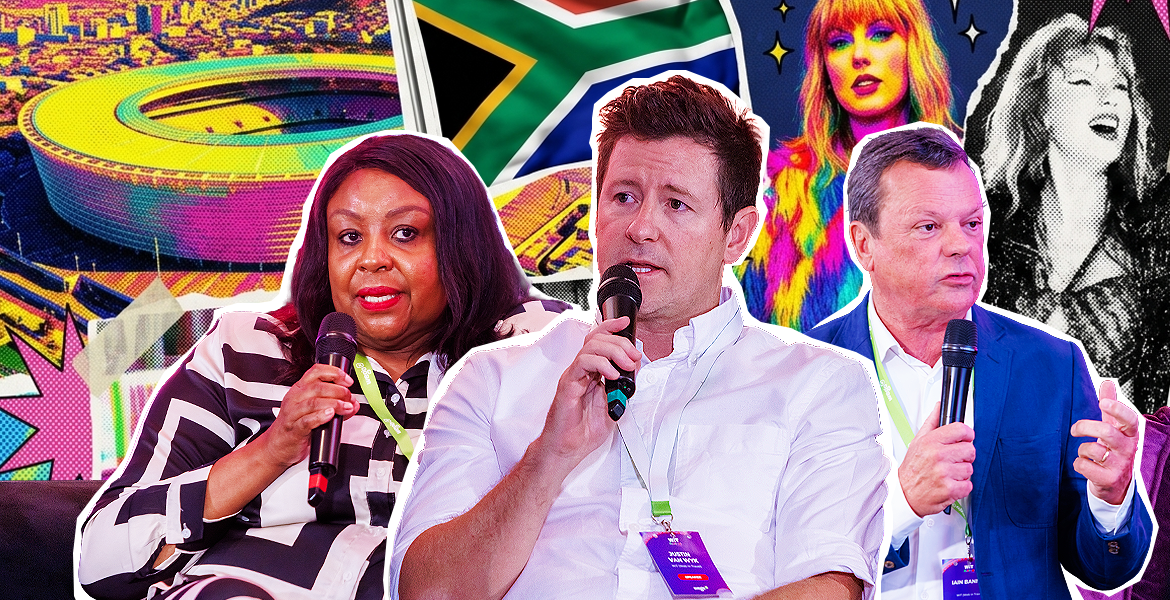
From Springbok sell-outs to Formula E, South Africa is proving it can host world-class live events. But infrastructure gaps, rising costs and a talent drain are holding the continent back from its full potential.
The global live events industry is on a tear. Valued at an estimated US$40 billion in 2024, the market, spanning concerts, conferences, festivals and sport, is forecast to reach US$75 billion by 2035. Festivals alone accounted for US$271 billion in 2026 and are expected to grow at a compound annual rate of 12% through to 2035.
And Africa, according to the panellists speaking about “The Live Events Surge” at WiT Africa, is not just watching from the sidelines.
“We’ve had record growth year after year coming out of COVID,” said Justin van Wyk, CEO of Big Concerts and Managing Director of Ticketmaster South Africa, part of the Live Nation family. “South Africa is no different. We sold over 620 million tickets around the world last year through Ticketmaster. We just had our biggest January in history. Everything is going in one direction.”
No discussion of the live events surge is complete without Taylor Swift and van Wyk had the numbers to make the case. When Swift played three nights in Melbourne, she drew 288,000 fans and generated approximately A$174 million in direct economic impact, supported by an A$8 million government investment from the State of Victoria.
When Swift played three nights in Melbourne, she drew 288,000 fans and generated approximately A$174 million in direct economic impact. Image credit: The New Yorker
For comparison, Melbourne’s Formula One Grand Prix drew a larger crowd of 465,000 but delivered only A$144 million in direct economic impact, despite the Victorian government writing an annual operational grant of around A$102 million for the race.
“When we compare those two, Taylor Swift’s economic impact was much higher,” van Wyk explained. “That’s because of global travel. People are not going to Cape Town and seeing who’s playing. They’re saying Coldplay is in Cape Town, let’s go see Coldplay and do everything around that. The concert is the driver now.”
The multiplier effect for a mega-concert is typically 2.5 to 3.5. Van Wyk’s rule of thumb: 150,000 tickets for a Coldplay show in Cape Town would generate roughly a billion rand in economic impact for the city.
“6 out of 10 people globally are now travelling to concerts — planning their entire trip around the event. The driver has flipped.” — Justin van Wyk, CEO, Big Concerts
Springboks, Formula E and the power of sport
Music is only part of the story. When the All Blacks played South Africa at DHL Stadium in Cape Town, Ticketmaster received 650,000 ticket applications for a venue with roughly 50,000 seats – demand that could have filled the stadium 13 times over.
Moderator Iain Banner, Founder of Go Green Africa and Co-founder, Africa’s Green Economy Summit pointed to Formula E as a model for understanding live event economics.
The Cape Town Formula E race generated R485 million in direct economic impact, with a multiplier of 2.1, producing a total economic contribution of R1.1 billion to the city. Three jumbo jets flew in equipment and teams from around the world. The event worked. Formula One, by contrast, he argued, almost certainly won’t – at least not in Cape Town. The setup cost runs to R1.5 billion, against a realistic maximum local revenue of around R500 million.
“Why is it going to oil countries? They’ve got the money. We’ve got other priorities. It would be great, but it doesn’t make financial sense,” he said.
Iain Banner, Founder of Go Green Africa and Co-founder, Africa’s Green Economy Summit pointed to Formula E as a model for understanding live event economics. The Cape Town Formula E race generated R485 million in direct economic impact, with a multiplier of 2.1, producing a total economic contribution of R1.1 billion to the city.
Tracy Mkhize, Chairperson of Cape Town Tourism, highlighted the outsized impact of the city’s two anchor events – the Cape Town International Jazz Festival and Africa Tech Week. Both have been returning to Cape Town year after year, she noted, building a reliable base of high-spending international visitors.
Africa Tech Week attracted more than 15,000 attendees in its most recent edition. The Jazz Festival drew 12,000 over four days. In 2023, the Jazz Festival alone brought together 4 million engagements and generated over R1 billion in economic impact, according to Nielsen research.
“These are high spenders,” said Mkhize. “The multiplier effect benefits not just the city but the whole of South Africa.”
The Cape Town International Convention Centre, where Mkhize is based, has just recorded its best financial year since opening – evidence, she argued, that the urge to meet in person has come back stronger than ever, not weaker.
“Events have come back bigger and better than before. The desire to meet, connect and share ideas is quite high — we never lost that.” — Tracy Mkhize, Chairperson, Cape Town Tourism
AI, isolation and the human need to gather
Banner raised a broader question that hung over the panel: as artificial intelligence increasingly replaces human interaction in the workplace, does the live events sector become more valuable, not less?
Both panellists answered with a firm yes. Mkhize noted that the same question was asked during COVID, when hybrid events were predicted to replace physical gatherings permanently. “We’ve seen the opposite. People wanted to interact with each other. The desire to connect is quite high.”
Van Wyk agreed: the live experience – music, sport, conferences – may become the primary arena in which humans seek genuine community as digital life intensifies.
When the All Blacks played South Africa at DHL Stadium in Cape Town, Ticketmaster received 650,000 ticket applications for a venue with roughly 50,000 seats – demand that could have filled the stadium 13 times over. Image credit: SA Rugby
Despite the optimism, both speakers were clear-eyed about the constraints holding South Africa back from hosting the truly mega events – a Beyoncé tour, a Taylor Swift residency – that would cement its credentials on the global stage.
Infrastructure: “We need more venues. We need more open spaces – small amphitheatres, mid-size arenas, large arenas, stadiums, big open spaces. A lot of that is missing in Cape Town’s portfolio,” said van Wyk. A key practical issue: DHL Stadium and the CTICC are so close that a major sporting event and a large concert cannot run simultaneously without gridlocking the city’s freeway network.
Transport: Better public transportation is essential. Van Wyk noted that even now, a rugby match at DHL can make access to and from the CTICC area effectively impossible during the event window.
Air Connectivity: New direct routes matter. “Having a direct flight from Cape Town to the United States is huge for us,” van Wyk said. He is still waiting, he added with a smile, for a direct Cape Town to Sydney route — “fly around the South Pole and make it happen.”
Skills and People: Perhaps the most sobering point: COVID drove a generation of skilled event technicians, riggers and production staff to the UAE, Qatar and Bahrain and many have not returned. “It takes seven to 10 years to replace that workforce,” van Wyk said. “We can buy equipment quickly. The human resources, that’s where we feel it the most.”
Mkhize added that South African event professionals are actively recruited across the Middle East, which speaks to world-class capability but represents a real domestic capacity gap.
The Cost Trap: Mkhize raised what she called “the big elephant in the room”: Cape Town is becoming too expensive for some returning event organisers. “We’re getting responses that it’s actually better to go elsewhere because you pay exactly what you want there,” she warned. “We need to watch out for this. Success can attract events, but it can also kill them.”
The Cape Town Formula E race generated R485 million in direct economic impact. Image credit: carmag.co.za
Chris Martin announced on stage to 70,000 people that Coldplay would begin its next tour in southern Africa. Zimbabwe, already generating excitement with a major international act heading there for an election-period show, is emerging as a new frontier. The NBA’s Basketball Africa League is growing. Formula E has proved the model. The Basketball and music pipeline is full.
“South Africa hasn’t had its Beyoncé or Taylor Swift mega-concert yet,” van Wyk said. “Something on that scale – that’s what I’m looking forward to. What it unlocks. What it reinforces about our credentials as a country that can host mega events.”
Related Stories
 World
World
World shares mostly gain and oil prices slip as the US raises pressure on Iran
45 minutes ago
 World
World
Video. Latest news bulletin | August 25th, 2026
45 minutes ago
 World
World
Burnham to take Zelenskyy’s pleas for Patriot missiles to Trump
1 hour ago
 World
World
Suzuki unveils first electric 'kei' passenger car | NHK WORLD
2 hours ago
 World
World
Victor Lai Diary: The Journey Continues…
3 hours ago
“TÜRKIYE PAVILION” AT NORDEEP SUMMIT 2026
3 hours ago
 World
World
Is UK's Storm Shadow missile a game changer for Ukraine?
4 hours ago
 World
World
Malvern athlete to compete in para
4 hours ago