
Artificial intelligence will not allow us to centrally plan the economy | Montreal Economic Institute

Montreal, March 12, 2026 – Rapid advances in artificial intelligence have breathed new life into the notion that it would be possible to plan the economy given the abundance of data available. This vision, however, rests on a misunderstanding of the way the economy actually works, explains economist Peter J. Boettke in a Viewpoint published today by the MEI.
“Contrary to what some believe, the economy is not a system of equations that we can hope to solve with sufficient computing power,” explains Mr. Boettke, professor of economics and philosophy at George Mason University and author of the publication. “Not only is the quantity of information required enormous, but a good deal of this information simply does not exist in a form that can be collected and codified.”
In the late 19th century, Italian economist Vilfredo Pareto concluded that if one tried to centrally coordinate even a modest economy and match resources to uses and preferences, the number of equations would explode.
“While AI can analyze a large quantity of data, it does not solve the issue of the availability of that data,” adds the researcher.
Nobel laureate economist Friedrich Hayek observed that much of this information is decentralized, spread out among billions of sellers and buyers around the world, and tacit, which is to say not explicitly formulated.
Mr. Boettke explains that the way retailers know their customers, for example, or the emergence of a new product dreamed up by an entrepreneur, are not the kinds of information that can be codified.
Even more important is the role of prices in the discovery and the transmission of information.
Prices, he explains, emerge from interactions between buyers and sellers in a context of competition. They are not data points that can simply be collected and fed into an economic model run by AI.
When the price of a resource increases, it reflects the scarcity of this resource and encourages people to adapt, whether by reducing consumption, innovating, or turning to other options.
By the same token, prices are the result of a constantly evolving discovery process among market actors.
“AI is a powerful tool for optimizing certain activities, but it cannot replace market dynamics,” concludes Mr. Boettke. “Needs, preferences, technologies, and scarcity are constantly evolving, which makes any attempt to centrally plan the economy impossible.”
You can read the MEI Viewpoint by clicking here.
The MEI is an independent public policy think tank with offices in Montreal, Ottawa, and Calgary. Through its publications, media appearances, and advisory services to policymakers, the MEI stimulates public policy debate and reforms based on sound economics and entrepreneurship.
Interview requests Florence Plourde Manager, Communications Cell: 418-670-5939
Related Stories
 Business
Robot factories and hypersonic missiles: JPMorgan Chase’s first $5 billion of defense investments
1 week ago
 Business
Police say a car has hit an Australian lawmaker, critically injuring her; the driver was arrested
1 week ago
 Business
Boomi acquires Israeli startup Elementary for $43 million
1 week ago
 Business
Mega chicken farm expansion plan withdrawn
1 week ago
 Business
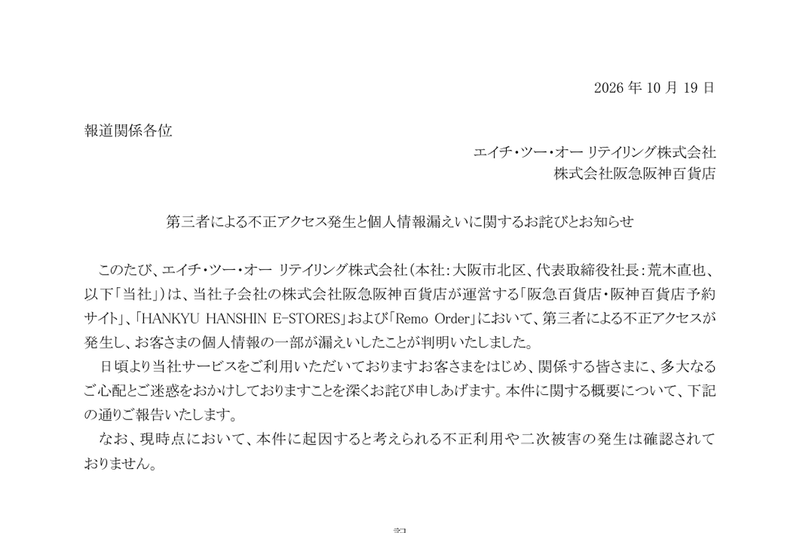
Data Breach at Hankyu Hanshin Department Store Common ID System Affects Nearly All 1.26 Million Members
1 week ago
 Business
Global Startup EXPO and Nippon Startup Awards 2026: METI Showcases Japan's Deep
1 week ago
 Business
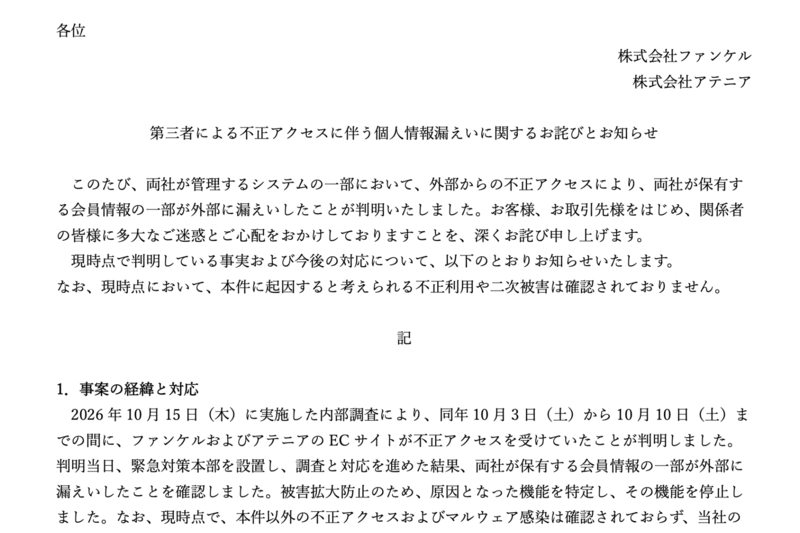
FANCL and Attenir Suffer Data Breach Affecting 780,000 Customers, Exposing Addresses, Names, Phone Numbers
1 week ago
 Business
DeepSeek Quietly Ships V4.1-Flash
1 week ago