
Artificial Intelligence at Cleveland Clinic
Cleveland Clinic is a nonprofit academic medical center headquartered in Cleveland, Ohio, with operations in Florida, Las Vegas, Toronto, London, and Abu Dhabi. The health system employs 83,000 caregivers and operates 23 hospitals and 300 outpatient facilities.
In 2025, Cleveland Clinic reported $18.3 billion in operating revenue and recorded 15.9 million patient encounters, including 14.4 million outpatient encounters.
Leadership has formalized AI as an enterprise priority. The organization appointed its first Chief AI Officer in 2024 to lead enterprise AI strategy, safety, and governance. In its 2026 State of the Clinic address, CEO Dr. Tom Mihaljevic named staffing, scheduling, supply chain, clinical risk prediction, and paperwork automation as areas where AI would support caregivers.
Cleveland Clinic has not disclosed a total AI investment figure, but its commitment is visible through three named, dated partnerships: a Virtual Command Center for hospital operations, developed with Palantir Technologies and announced in 2023; an enterprise ambient documentation platform, rolled out in 2025; and an AI sepsis detection platform, expanded in 2025.
This article examines two internal AI use cases that show how Cleveland Clinic applies AI to clinical work:
We begin by examining how Cleveland Clinic applies ambient AI to address the documentation burden on its clinicians.
Ambient AI Documentation for Clinicians
Documentation is one of the most persistent drivers of clinician strain in U.S. healthcare. In the American Medical Association’s 2025 survey of nearly 19,000 physicians, 41.9% reported at least one symptom of burnout, with ineffective EHR (Electronic Health Record) systems and excessive administrative tasks among the leading stressors. The AMA’s 2024 data found that 22.5% of physicians spent more than eight hours a week on the EHR outside normal working hours.
For an organization that recorded 14.4 million outpatient encounters in 2025, even small per-visit documentation costs compound into a significant capacity and retention problem.
Cleveland Clinic focused on ambient AI — technology that listens to a patient visit in the background and automatically drafts the clinical note — as a way to reduce the documentation burden. The tool Cleveland Clinic adopted uses a phone-based app that records the patient-clinician conversation with consent and generates a structured note inside Epic, Cleveland Clinic’s EHR system. According to Cleveland Clinic, the system also provides clinical documentation integrity support, point-of-care coding, and customized after-visit summaries.
Cleveland Clinic’s broader AI philosophy shaped how it approached the problem. Chief Digital Officer Rohit Chandra summarizes the strategy as partnering where possible and building only when necessary, and describes AI vendor selection generally as closer to buying into a company than buying a finished product, since AI as a whole is still early enough that few vendors have a truly finished offering. His team favors pilots with clearly defined outcomes over traditional RFPs, and Chandra identifies change management, rather than the technology, as the harder challenge.
Rather than choose a vendor on paper, Cleveland Clinic ran its own head-to-head evaluation, testing five ambient AI scribe products throughout 2024 and scoring each on documentation quality, product features, provider satisfaction, ease of implementation, and return on investment.
Video: Cleveland Clinic’s AI Scribe Bake-Off: How Ambience Healthcare Came Out on Top (Source: Healthcare IT Today)
Published accounts describe the evaluation somewhat differently. The AHA reports that Cleveland Clinic involved 25 to 35 clinicians with each of the five vendors, in pilots lasting three to five months. Cleveland Clinic’s own Consult QD describes approximately 250 physicians across more than 80 specialties and subspecialties participating in the evaluation, while Fierce Healthcare reports more than 300 clinicians over a six-month evaluation period. The sources differ on the size and structure of the evaluation, though all agree Cleveland Clinic tested five vendors before selecting a partner.
Ambience Healthcare was selected and awarded a five-year exclusive partnership. Fierce Healthcare separately reports that Cleveland Clinic providers subsequently logged 25,000 encounters using Ambience across 20 specialty areas. Neither Cleveland Clinic nor Ambience has published details of the underlying language model.
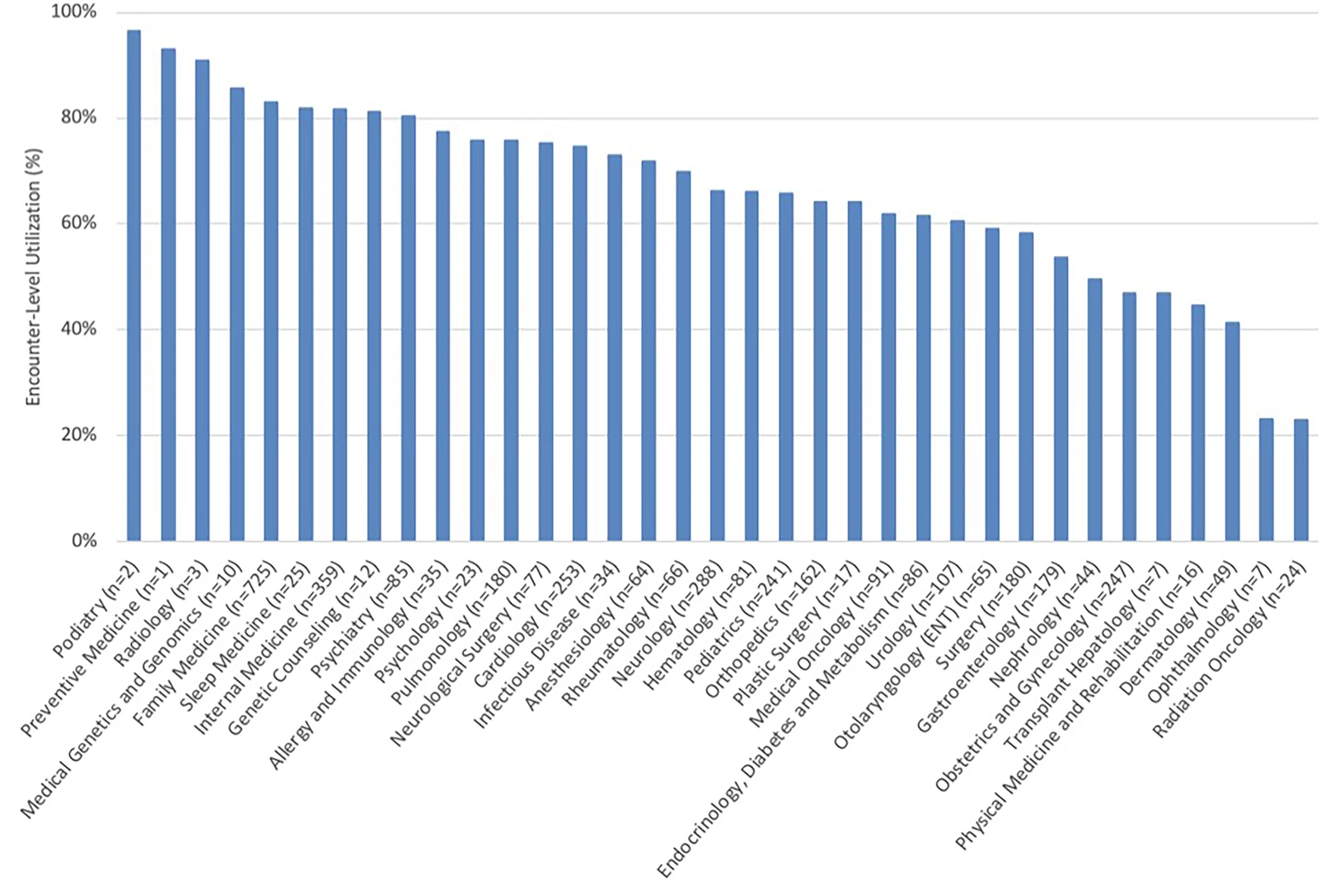
Fierce Healthcare’s account of the pilot also shows why specialty-level results matter. During the evaluation, Ambience reached 80% adoption among the clinicians who piloted it — a figure Cleveland Clinic’s Beth Meese described as two to three times higher than the other four vendors tested, based on anecdotal comparisons rather than published data (Cleveland Clinic released Ambience’s pilot results but not the other four vendors’). Adoption also varied widely by specialty:
Enterprise averages can mask specialties where a generative AI tool is not yet a good fit. Beth Meese, Cleveland Clinic’s executive director of digital health, cited Ambience’s responsive engineering support and documentation quality among the reasons it was selected.
The rollout itself was sequenced by complexity. A peer-reviewed account in npj Health Systems describes four deployment waves:
The same paper notes mandatory training before access, live virtual sessions three times a day, and physician super-users present at training.
For clinicians, the visit workflow now looks different at each stage:
The specialty-level breakdown above matters because an enterprise-wide adoption number can obscure specialties where the tool isn’t yet a good fit. Beth Meese, Cleveland Clinic’s executive director of digital health, said Ambience was particularly responsive to the clinic’s feedback during the pilot and had local team members who helped providers implement and understand the tool — factors she cited among the reasons it was selected.
This use case is widely deployed. Enterprise rollout began on March 10, 2025, and reached more than 4,000 clinicians in about four months. The npj Health Systems paper reports the following results roughly a year after deployment:
Two caveats apply. Half of the paper’s authors are Ambience employees who disclosed equity in the company, and the retention figure measures stated intent, not observed turnover.
Screenshot: AI Scribe 12-month encounter-level utilization by specialty at Cleveland Clinic (Source: npj Health Systems)
Cleveland Clinic’s own figures add time savings. Consult QD reports roughly two minutes saved per appointment and 14 minutes per clinician per day, with active users relying on the tool for 76% of scheduled visits. Fierce Healthcare reported pilot-stage results including a 49.6% drop in after-hours documentation time, a 25% reduction in note creation time, a 32% increase in patient face time, and 67% of clinicians reporting reduced cognitive burden. These figures are self-reported and have not been independently audited, and Cleveland Clinic has not published a financial return for the program.
Sepsis is among the costliest conditions U.S. hospitals manage, accounting for about $62 billion a year in hospitalizations and skilled nursing care, according to the Association of American Medical Colleges. Each year, about 1.7 million U.S. adults develop sepsis, and at least 350,000 die during hospitalization or are discharged to hospice, according to the CDC.
Speed is central to outcomes. The AAMC ranks sepsis as the third leading cause of death in U.S. hospitals and notes that each hour of treatment delay raises the risk of death by 4% to 9%.
Existing prediction tools have struggled with both accuracy and noise. A 2021 JAMA Internal Medicine validation of a widely implemented proprietary sepsis model at Michigan Medicine found that it missed 67% of sepsis patients while generating alerts for 18% of all hospitalized patients.
Cleveland Clinic has not named the legacy tool it replaced, but its pilot comparison shows that its legacy sepsis tools generated roughly ten times as many false alerts as the AI platform it adopted, each one requiring clinician time to investigate.
The health system has formalized governance around the problem. James Morrison, MD, chairs Cleveland Clinic’s Enterprise Sepsis Steering Committee, which oversees how detection tools are integrated into clinical care.
Bayesian Health’s platform analyzes electronic medical record data, including laboratory tests, vital signs, and clinical notes, in real time to assess each patient’s sepsis risk. Bayesian describes the system as reading the full patient record continuously, rather than relying on episodic, rules-based screening.
The approach builds on the Targeted Real-time Early Warning System (TREWS), a machine learning model studied across five hospitals and 590,736 monitored patients in a 2022 Nature Medicine paper. The study found that when clinicians confirmed an alert within three hours, in-hospital mortality fell by 3.3 percentage points, an 18.7% relative reduction. Among higher-risk patients, the absolute reduction reached 4.5 percentage points. The paper’s lead author, Suchi Saria, is affiliated with Bayesian Health, so the evidence is peer-reviewed but not independent of the vendor.
Bayesian’s platform received FDA 510(k) clearance in May 2026. In that announcement, Bayesian also cited 82% sensitivity, 89% provider adoption, and detection 5.7 hours earlier than standard care, which are vendor-reported figures from its research program, not results from Cleveland Clinic’s deployment.
Video: Cleveland Clinic expands use of AI technology designed to help doctors identify sepsis earlier (Source: WKYC)
According to Cleveland Clinic, the platform embeds sepsis insights into existing clinical workflows, so care teams can prioritize at-risk patients. Based on the organization’s published pilot results, the clinical team’s experience changes in several ways:
Screenshot: Annotated TREWS sepsis evaluation interface (research version) showing nurse assessment, provider sepsis evaluation, and septic shock monitoring panels (Source: npj Digital Medicine)
Cleveland Clinic has not published a detailed description of who receives alerts, how they are confirmed, or how alerts route between nurses and physicians. That detail matters to any organization evaluating similar tools, because the TREWS study tied its mortality benefit to clinicians confirming alerts within three hours.
For leaders evaluating clinical alerting tools, the practical lesson is to track false-alert rates and time from alert to clinician action alongside sensitivity. A model that finds more cases but floods care teams with alerts may deliver less value in practice than its validation metrics suggest.
The pilot at Cleveland Clinic Fairview Hospital covered more than 3,330 patients in 2024 and 2025. Compared with legacy tools, Cleveland Clinic reported the following results:
These are self-reported results from a single-hospital pilot and have not been published in a peer-reviewed journal. Cleveland Clinic has not disclosed mortality, length-of-stay, or cost outcomes from its own deployment. MedCity News’ 2026 coverage of Bayesian’s outcomes lists Cleveland Clinic among its customers, but the mortality and adoption figures in that report come from MemorialCare, a separate health system.
Maturity signals point to a scaling program rather than an experiment. Cleveland Clinic reports the platform in place at 13 hospitals, with expansion planned across Ohio and Florida. Sources describe that status differently, with HealthLeaders characterizing the 13 hospitals as testing the technology. The two organizations also plan to co-develop AI modules for other critical conditions, which would extend the partnership beyond sepsis.
This article highlights several strategic insights from Cleveland Clinic’s AI initiatives:
Related Stories
 AI News
Mediaocean launches AI venture arm for ad startups
44 minutes ago
 AI News
Cal Thomas: AI: A substitute for real intelligence
45 minutes ago
 AI News
New learning space opening to deepen understanding, problem
45 minutes ago
 AI News
U.S. proposes exchanging AI safety alerts with China, Bessent says
1 hour ago
 AI News
Inside Kazakhstan’s push to become a regional AI centre
1 hour ago
 AI News
MerkaLan VII: Job and AI Fair in Bilbao
1 hour ago
 AI News
Obama says the government should ‘act fast’ and regulate AI
1 hour ago
 AI News
The startups fixing Europe’s AI power problem
2 hours ago