
What could a 'super' El Niño mean for the Prairies?
What could a 'super' El Niño mean for the Prairies?
Developing El Niño could be one of the strongest ever recorded
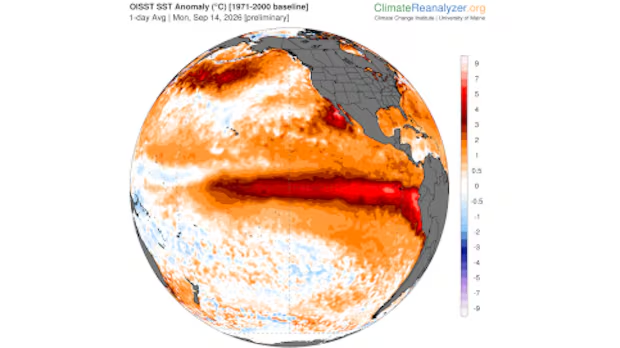
The much-talked-about El Niño continues to heat up in the Pacific Ocean.
"Every indicator has shown that this [El Niño-Southern Oscillation] is continuing to strengthen," said Lindsey Long, a meteorologist with the ENSO team at the Climate Prediction Center (CPC) in the U.S.
"We're getting [sea surface temperature] anomalies of up to 11 C, so those are extremely warm waters that are helping to fuel this."
El Niño is part of the El Niño-Southern Oscillation (ENSO) , which is a fluctuation between warmer sea surface temperature anomalies — El Niño — and colder anomalies — La Niña — in the equatorial region of the Pacific Ocean.
These fluctuations happen in periods of two to seven years.
During normal conditions, west-blowing trade winds push warm sea surface temperatures from South America toward Asia. However, those winds can break down or reverse direction, allowing that warm water to instead pool near South America.
What does this mean for the Prairies?
This disrupts weather patterns around the world, including a stronger Pacific jet stream and an amplified polar jet stream over western Canada.
As of Sept. 14, a very strong El Niño was being observed in what's called the El Niño 3.4 region in the eastern equatorial Pacific, where average sea surface temperatures were 2 C warmer than normal.
Experts predict the current El Niño to peak during the late fall and winter months.
The last El Niño classified as very strong occurred during the 2015-16 winter. The Prairies also experienced a moderate El Niño during the 2023-24 season. Both brought warmer than normal temperatures to the Prairies.
What does a super El Niño mean for the Prairies?
Research scientist Bill Merryfield with Environment and Climate Change Canada says that could also be the case this winter.
"The odds are certainly tilted in that direction of having a relatively mild winter, possibly by a large margin," he said.
"Some of those temperature differences from normal during past very strong El Niños have been in the range of 5 or 6 degrees averaged over the winter, which is quite substantial.”
Both Long and Merryfield say that El Niño events typically lead to less snowfall in the Rocky Mountains, and that warmer temperatures could mean less snow in the Prairies, but that trends for precipitation are not as strong as with temperature.
Research aims to correlate ENSO, precipitation
With a correlation between precipitation and ENSO on the Prairies unclear, researchers are diving deeper into it.
David Sauchyn, director of the Prairie Adaptation Research Collaborative at the University of Regina, says a proxy of soil data across the Prairies has been collected to see years where soil and trees received more or less moisture in a given year.
The research is looking into whether drier or wetter periods might correlate with El Niño or La Niña events.
"We can't say exactly if a dry year was an El Niño year, but we get this cycle — this cycle of every two to eight years it's either quite wet or quite dry," he said.
"It's not the direct measurement of sea surface temperature, but we have a proxy record of soil moisture on the Prairies going back 1,000 years."
Cold snaps, snowstorms still likely this winter
The current projection from the CPC has the El Niño continuing into next spring with a 55 per cent chance of a return to neutral conditions in the April-May-June timeframe.
Merryfield is concerned that less snow than normal or a reduced snowpack could create problems with streamflow, drought and wildfires next spring.
"We might expect vegetation to be drier than usual, which could be conducive to drought and wildfire risk if there's not a good amount of rainfall in late spring and summer to offset that," he said.
But Long notes that a warmer or drier winter does not mean classic Prairie cold snaps and blizzards won't appear at all this season.
"Just because overall you might be warmer, you can still have big snow events, big cold snaps, things like that," she said.
Allister Aalders is a meteorologist and weather reporter for CBC News in Saskatchewan. You can reach out to him at: allister.aalders@cbc.ca
Related Stories
 Canada
Kamala Harris launches into the 2026 midterms as her 2028 decision looms
39 seconds ago
 Canada
Macklem says U.S. trade unpredictability could set back recent economic progress
1 minute ago
 Canada
Bank of Canada governor warns new tariffs could cut fourth
1 minute ago
 Canada
Trump says he wants potash from Belarus for ‘subtantially less’ than Canada
1 minute ago
 Canada
'Deeper ties' with allies like Norway make Canada stronger, Carney says
1 hour ago
 Canada
Health Canada says this counterfeit device may pose health risks
1 hour ago
 Canada
Trump working on deal to buy potash from Belarus for lower price than Canada
1 hour ago
 Canada
3 U.S. media outlets say they plan to sue after Trump denied them White House access
2 hours ago