
New learning space opening to deepen understanding, problem
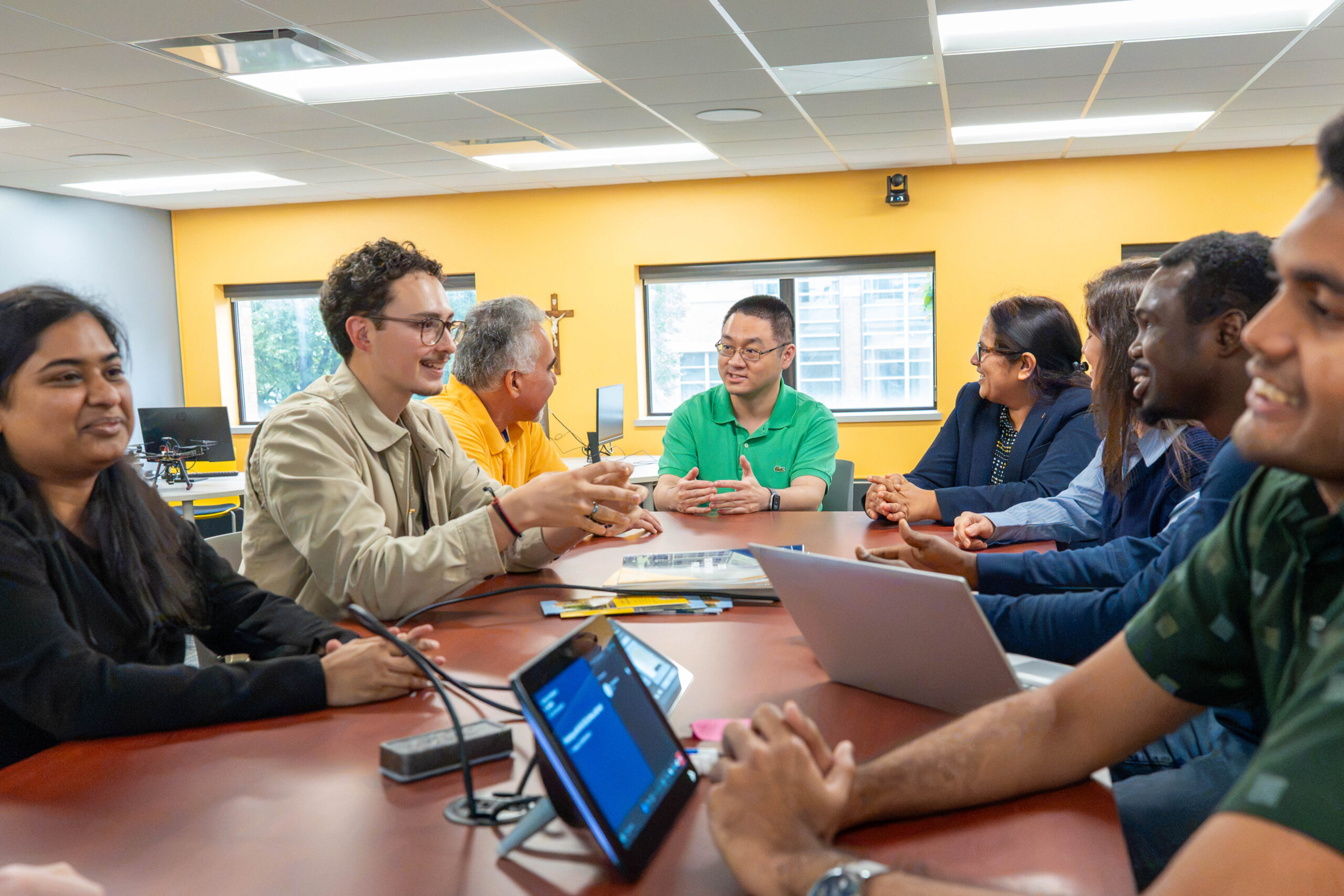
Marquette University is announcing a new space focused on the use of cutting-edge artificial intelligence in learning and research. The AI Discovery Hub, organized by the Opus College of Engineering and situated in Haggerty Hall room 268, offers hands-on experiences for students and employees to develop skills and build confidence in AI tools and decision-making.
The AI Discovery Hub will open for visitors and events on Monday, Sept. 28.
The hub connects human curiosity and problem-solving to emerging technologies in artificial intelligence and machine learning, exploring topics that include assessing AI bias and reliability, analyzing vast and unstructured MRI data, enhancing environmental monitoring and more. Through open exploration, course-integrated visits and hands‑on demos, the AI Discovery Hub combines guided and self-directed learning experiences across AI subfields.
As the global expansion of artificial intelligence technology surfaces new solutions and emerging problems for our communities, Marquette is called to develop skilled, ethical leaders who will help shape the future. Marquette’s AI Discovery Hub aims to empower visitors with a greater understanding of artificial intelligence to inform their future work across communities and industries.
“Our students, faculty and staff are building skills, discovering new knowledge and shaping their personal approach to AI every day in classrooms, laboratories, industry sites and even hallway discussions,” says Dr. Kris Ropella, Opus Dean of Marquette’s Opus College of Engineering. “This space is designed to serve as a physical hub for human-centered exploration of how we will lead the future of AI for positive outcomes on communities. There are countless questions around AI, and we need reflective people gathering and collaborating to discover meaningful answers together.”
Faculty experts and student collaborators have created four workstations within the space to focus on specific technologies that can be applied to human-centered problem-solving across industry and community needs. Workstations and sample projects will rotate over time as new areas of interest emerge.
Workstation 1: Assessing computer vision confidence and healthcare applications
Explore object detection and visual data processing in two sample projects related to measuring reliability of computer vision and how it can be used to support clinical care.
Project 1: Exploring image detection technology and the efforts to assess trust, confidence and data bias in image detection systems.
Project 2: Exploring how AI image detection and analysis can be applied to diabetic retinopathy screenings to support and scale human-centered clinical reviews.
Workstation 2: Spectral & hyperspectral imaging to extend beyond human vision
Investigate how a hyperspectral camera measures light wavelengths that go undetected by normal cameras and human vision, revealing additional information and differences between compared objects. As hyperspectral images capture hundreds of measurements at every pixel, AI is used to process vast datasets, recognize patterns and provide insights in distinguishing materials. This technology supports applications in food quality, agriculture, medical diagnostics, manufacturing and environmental monitoring.
Workstation 3: Investigating Large Language Model (LLM) bias and reliability: healthcare and legal domains
Explore how LLM systems currently used in healthcare and legal contexts can be assessed for reliability and accuracy, as well as biases in their data collection and output.
Project 1: Compare real judicial opinions with AI-generated summaries to identify where LLM outputs differ from human analysis and when error occurs. This project explores the capabilities and limitations of LLMs.
Project 2: Dive into the ongoing analysis of LLM systems currently used in healthcare to understand how and why bias is measured. This project explores the broader push for ethical AI in healthcare and the research needed to determine how LLMs may be trusted in a healthcare context.
Workstation 4: AI and vast datasets in healthcare: aphasia care and brain/spinal cord MRIs
Explore how AI can be a solution for healthcare problems that depend on vast dataset analysis.
Project 1: Explore how LLMs, speech information and brain signal data can be used to support communication challenges related to aphasia and support future assistive tools for patients and caregivers.
Project 2: Explore how AI systems can help analyze and detect patterns from vast, messy datasets produced by brain and spinal cord MRIs. This project investigates where AI can accelerate insights from medical imaging that produces data too unstructured for human analysis.
Marquette community members interested in the AI Discovery Hub can learn more online.
Drop-in visits are welcome from 10 a.m. to 5 p.m. on weekdays during the academic year. Visitors can take guided tours of the workstations and engage in discussions on sample projects and applications. Additional trainings and demos will occur monthly for visitors interested in deeper engagement. Topical events will also be hosted in the space throughout the year. Please see the AI Discovery Hub webpage for event postings.
The AI Discovery Hub is made possible by the generosity of the GHR Foundation, a long-time supporter of engineering education innovation at Marquette.
Related Stories
 AI News
New Brunswick is weaving AI into its K-12 curriculum, drawing praise
50 minutes ago
 AI News
Artificial Intelligence as a Tool to Reduce Racial Bias in Medicine: Challenges and Opportunities
51 minutes ago
 AI News
Claude Code now also accepts instructions in OpenAI’s Agents.md format
51 minutes ago
 AI News
Pope Leo XIV: AI must serve human dignity and strengthen peace
51 minutes ago
 AI News
Gates Foundation launches coalition to build more representative language data sets for AI
51 minutes ago
 AI News
Mediaocean launches AI venture arm for ad startups
1 hour ago
 AI News
Cal Thomas: AI: A substitute for real intelligence
1 hour ago
 AI News
U.S. proposes exchanging AI safety alerts with China, Bessent says
2 hours ago