
Ancient Roman shipwreck discovered off Italian coast
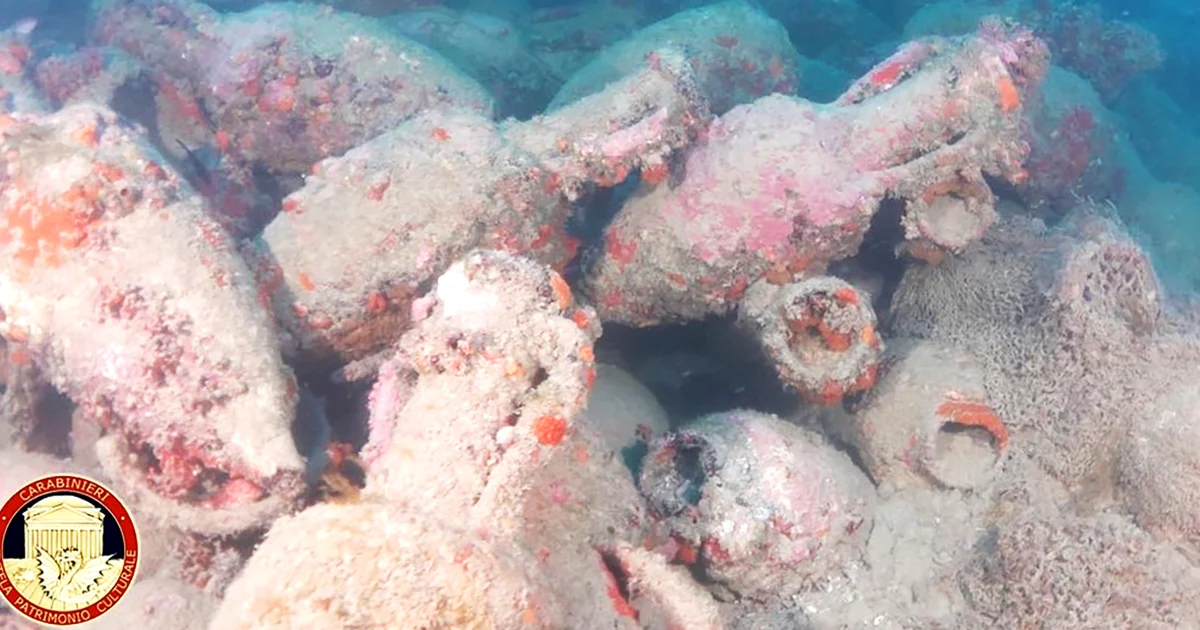
Divers have uncovered a Roman-era shipwreck that had remained untouched on the seabed off the coast of Sicily for more than 2,000 years, police on the Mediterranean island said.
Italian Culture Minister Alessandro Giuli described it on social media as “one of the most significant underwater archaeological discoveries of recent years,” with experts dating the vessel back to the first or second century B.C.
“The sea continues to reveal precious evidence of our history,” Giuli said. “This shipwreck tells the story of the people, trade routes, and exchanges that made the Mediterranean a crossroads of civilizations.”
After a tipoff from residents, the ship was discovered by divers around 3 miles off Sicily’s western coast and about 150 feet below the surface, Italian authorities said in a statement.
“It’s hard to explain what it feels like to think that we’re among the first humans, after nearly 20 centuries, to see that place again,” Giacomo de Mola, a member of the team that found the ship, said in a video post on Facebook.
Hundreds of clay jars known as amphorae were discovered inside the shipwreck, alongside lead anchor stocks and other artifacts, police said.
In a separate Facebook post, De Mola said they could have come from all over the ancient world and the artifacts could be “likely North African amphorae, and a Neo-Punic amphora.”
The discovery could play a key role in helping experts form “a reconstruction of trading routes and also an ancient risk map of the Mediterranean,” according to Simon Stoddart, a professor of archeology at Britain’s University of Cambridge.
Experts will examine the shipwreck alongside previous discoveries throughout the Mediterranean to help paint a picture of the ancient maritime world, Stoddart, who was not part of the team that made the discovery, told NBC News in an email Monday.
The depth of this shipwreck also makes this discovery both remarkable and relatively rare, he added.
However, he cautioned, recording and retrieving “where ethically appropriate” material from the vessel would be a challenge “since this requires specialist equipment and short visits to this depth.”
As it is impossible to always be present at an underwater site, he said, “the location will need to be kept secret until a decision is made as to whether excavation is practical and whether it can be properly resourced.”
Police said they would further document the site to understand the “appropriate protective measures” that need to be implemented and the goal is “safeguarding the historical artifacts preserved on the seabed and returning them to the public.”
For de Mola, the personal impact of the discovery, was enormous. “This time, we didn’t just find a shipwreck. We found a piece of our history.”
Related Stories
 World
Manchester United weigh up stunning move for Real Betis and ex-Tottenham forward Troy Parrott
3 days ago
 World
Israeli police arrest 10 following weekend attacks by settlers on journalist and diplomats
3 days ago
 World
Trump says suspension of Russia sanctions is to keep peace negotiations going
3 days ago
 World
Ukrainian drones strike St. Petersburg oil facilities | NHK WORLD
3 days ago
 World
Victoria Falls stadium in Zimbabwe nears completion for CWC27
3 days ago
 World
‘The world will be amazed:’ Iran’s commanders prepare for further war
3 days ago
 World
Festival opens with musket salute in Sakai, Osaka
3 days ago
 World
Trump's new pitch for Republican candidates — they're really good
3 days ago