
AI pioneer sees Korea's role in developing world model
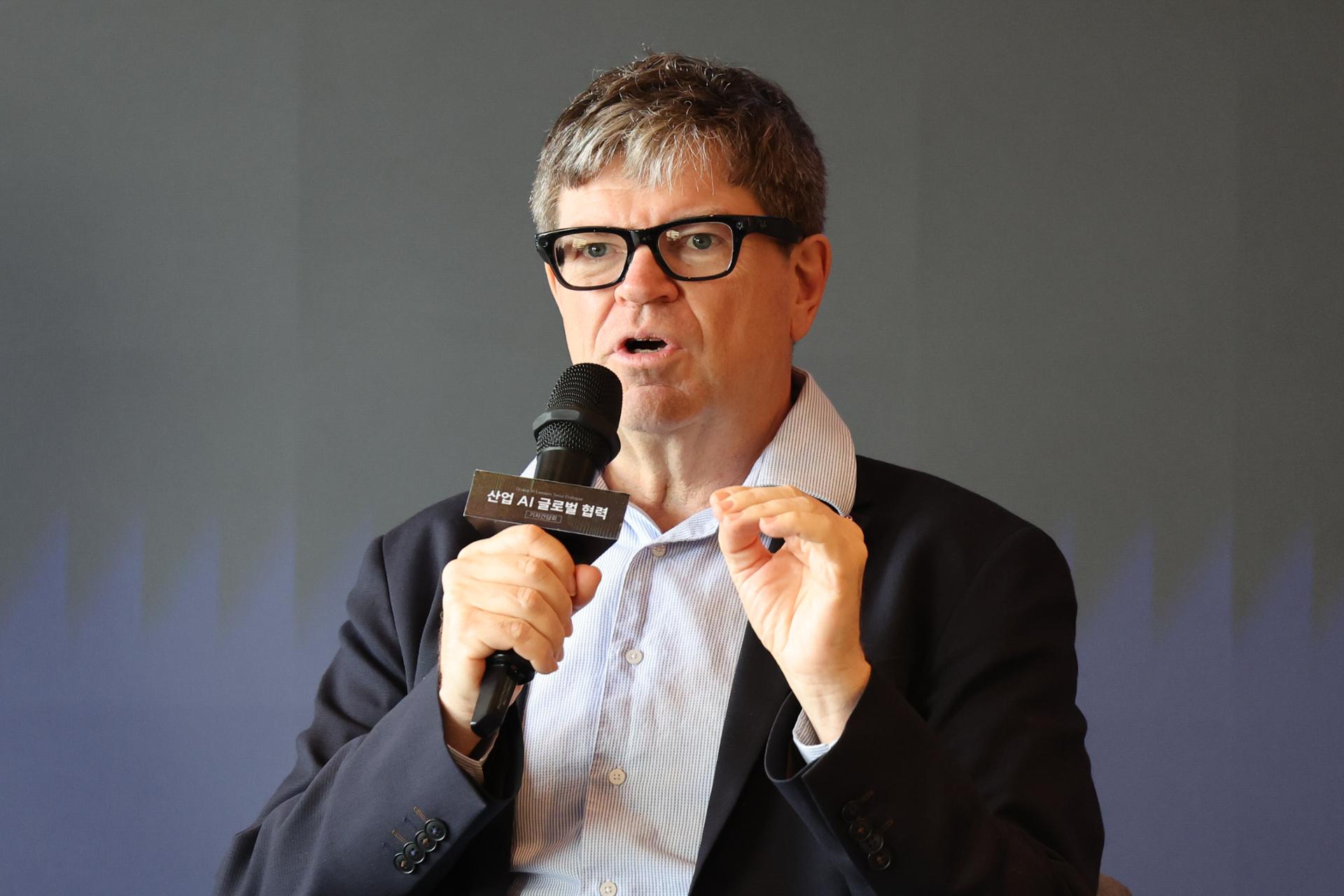
Yann LeCun, chairman of AMI Labs, speaks on industrial artificial intelligence (AI) during the Global AI Leaders Seoul Dialogue at the Westin Josun Seoul hotel in Jung District, Seoul, Monday. Yonhap
Developing industrial artificial intelligence (AI) requires "world AI" capable of understanding the physical world, and Korea has an increasingly important role to play in this field, according to Yann LeCun, widely regarded as one of the four leading figures in the global AI academia.
LeCun and a number of other leading experts shared their views during the Global AI Leaders Seoul Dialogue, an event organized ahead of the fifth International Industrial AI Conference, scheduled for Tuesday in Tokyo.
LeCun is a leading AI scientist, a recipient of the 2018 Turing Award, founder of AMI Labs and former chief AI scientist and vice president at Meta. He is known for pioneering convolutional neural networks, which revolutionized image recognition.
He also serves as chief science adviser to Project Tapestry, an AI Alliance-led initiative to develop a large-scale AI model through federated learning, which allows AI models to learn from data stored across different countries or companies without requiring the data to be transferred to a central server.
Yann LeCun, chairman of AMI Labs, left, speaks on industrial artificial intelligence (AI) during the Global AI Leaders Seoul Dialogue at the Westin Josun Seoul hotel in Jung District, Seoul, Monday. From left are LeCun, Aitomatic CEO Christopher Nguyen, AI Alliance co-founder Anthony Annunziata and ASI Foundry Chairman Jimmy Rhee. Yonhap
Christopher Nguyen, CEO of Aitomatic and chief architect of Project Tapestry, participated in the event. Anthony Annunziata, co-founder of the AI Alliance and director of AI Open Innovation at IBM, and ASI Foundry Chairman Jimmy Rhee were also in attendance.
Ha Jung-woo, standing vice chairman of the Presidential Council on National Artificial Intelligence Strategy, also attended the event and exchanged views with the AI experts.
During the dialogue, LeCun stressed that large language models (LLMs), which power the generative AI chatbots used in everyday life, have limitations in understanding the real world.
“We still don't have robots that can accomplish what a 10-year-old can accomplish, even without any training,” LeCun said. “We do not have fully autonomous level five self-driving cars, a task that any teenager can learn in a few hours of practice. That tells you there's a huge gap to fill between systems that understand language, which turns out to be easy, and systems that understand the real world, which turns out not to be easy.”
LLMs generate text by predicting which word is most likely to come next based on patterns learned from vast amounts of training data. LeCun said this approach excels at tasks involving predictable sequences, such as coding and mathematics, but most information in the real world is far less predictable than language.
He therefore advocated developing world models that can learn the physical laws and causal relationships governing the real world, allowing AI systems to predict the consequences of actions and interact with their surroundings.
“If you want a system that acts in the real world or the digital world, the system has to have the ability to predict the consequences of its own actions. Because without this ability, how can you make sure that the system will act in ways that are proper or safe or will accomplish the task? … Given the state of the world and an action that the system imagines taking, it can predict the resulting state of the world.”
LeCun said AMI Labs is developing world models based on Joint Embedding Predictive Architecture, adding that Korea could play a significant role in advancing the technology by leveraging its strengths in manufacturing and its pool of talent.
Ha Jung-woo, standing vice chairman of the Presidential Council on National Artificial Intelligence Strategy, delivers his congratulatory remarks during the Global AI Leaders Seoul Dialogue at the Westin Josun Seoul hotel in Jung District, Seoul, Monday. Yonhap
In his congratulatory remarks, Ha said it is virtually impossible for any single company or country to develop all the capabilities needed in the AI era. “What matters is not who can develop everything independently, but how countries and companies can combine their technological capabilities, data and research expertise based on their respective strengths to create new value together.”
ASI Foundry CEO May Hwang, who organized the event, said the expertise and experience accumulated by Korea's manufacturing industry will be an important competitive advantage in the era of industrial AI.
“Korean companies can play a role not only in adopting global industrial AI technologies, but also in helping establish standards for how these technologies operate and are used in real-world industrial settings,” Hwang said.
Related Stories
 AI News
Canadian AI company turns away from U.S. government work amid trade tensions
51 minutes ago
 AI News
The Enterprise World Publishes Four Stories Across Leadership, Healthcare and Artificial Intelligence
1 hour ago
 AI News
Finance Teams Embrace AI but Many Still Struggle to Unlock Working Capital
1 hour ago
Google now allows checking if an image, a video, or an audio has been generated with Artificial Intelligence
1 hour ago
 AI News
AI less regulated than milk, Microsoft president says in warning over safety
1 hour ago
 AI News
IMF Chief: artificial intelligence to affect 40% of jobs worldwide
2 hours ago
 AI News
AI in Oil and Gas 2026: How Artificial Intelligence Is Transforming Finance Strategy: Expert View by Spherical Insights
2 hours ago
 AI News
AI is less regulated than milk, says Microsoft president
3 hours ago