
A slice of home: The NRI love affair with Indian art
Non-Resident Indian (NRI) art lover and buyer based in the United States acquired a contemporary artwork referring to Gandhi’s three monkeys because he wanted his children to grow up with that message.
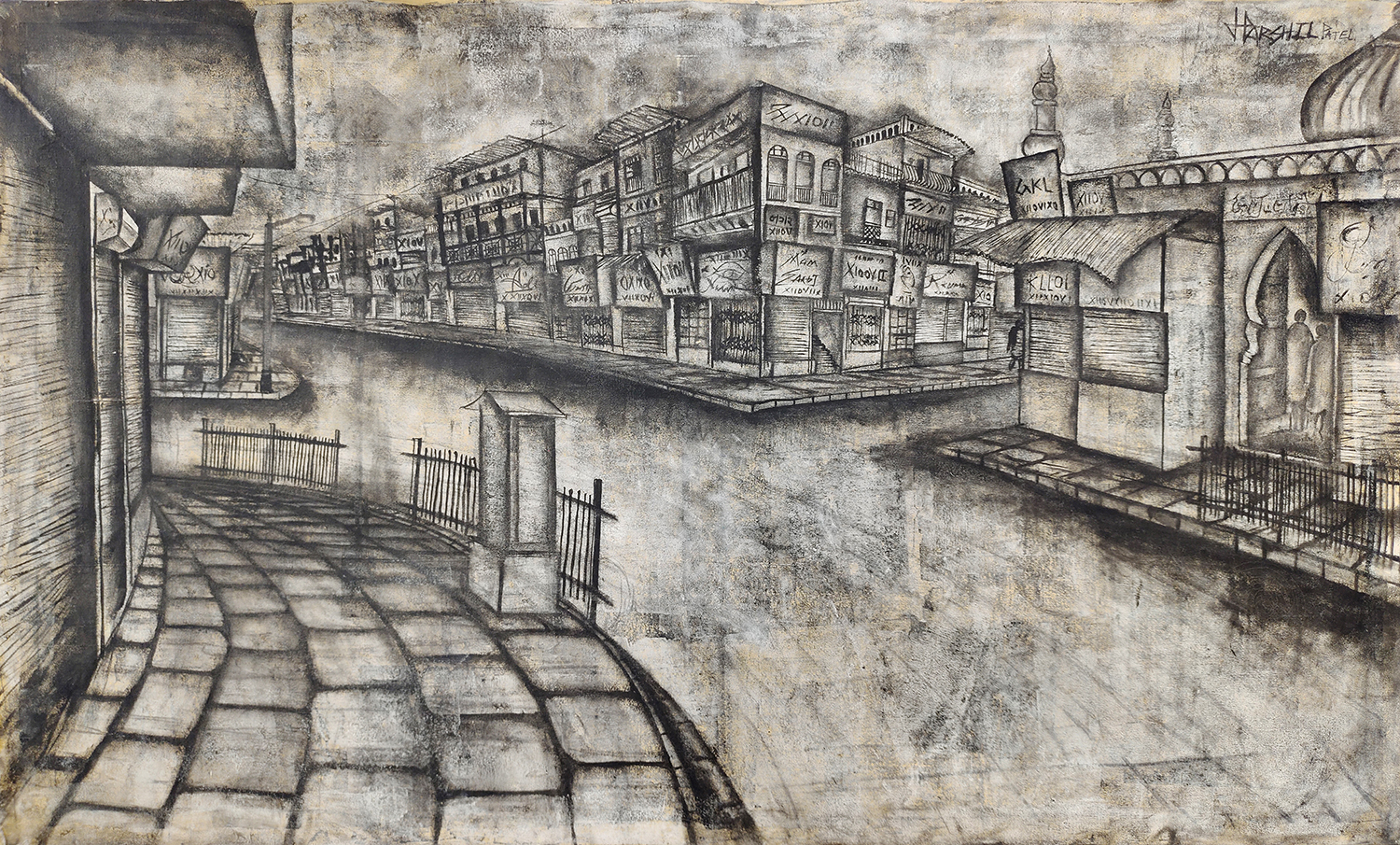
Another NRI art enthusiast acquired a large artwork by Ahmedabad-based artist Harshil Patel, which was all about the architecture, atmosphere and cultural memory of the old city of Ahmedabad, the place where the collector had grown up.
When the family later shifted to a beachfront home, the painting was given an important position. From that space, they could see the beach outside and Harshil Patel’s interpretation of old Ahmedabad inside. It created a beautiful relationship between their present life and the place they had come from. And that painting also became the conversation point with people who visited his house.
For NRIs, art buying has now moved beyond just decorative aesthetic purposes or investment. It is now becoming a way of celebrating one’s own identity and also passing it to the next generation.
According to the Art Basel & UBS Global art market report 2026, the global art market reached an estimated USD 59.6 billion in 2025, marking a 4% year-on-year increase. Auction sales rose by approximately 9% too. Even as the global art scenario is showing positive growth, the Indian art market has also emerged as one of the more dynamic regional ones charting its own success story.
Ask Chaitya Dhanvi Shah, Managing director of Ahmedabad-based DRS Art Company, which has a NRI client base that includes North America, Africa, the Middle East, Europe and Southeast Asia about the changes in the NRI art buying scenario over the years, he says, “We are seeing particular interest among collectors between approximately 30 and 50 years of age. These are people who are professionally settled, raising children outside India and carving a whole new life. They want their children to understand where they come from, and art is becoming an important way of communicating that identity.”
As globalisation makes architecture, interiors and visual environments across cities increasingly similar, Shah feels art can help preserve a distinct cultural identity. “The homes may be contemporary and international, but collectors still want the works on their walls to carry an Indian soul.We have also noticed that collectors consider how an artwork will have its presence within a contemporary international home. Their interiors may be minimal and global, but the artwork gives the space personal history, emotional depth and cultural character. Subjects connected with farming, Indian cities, history, mythology, spiritual geometry, nature, architecture and cultural memory are being appreciated when interpreted in a fresh way.”
Over the years, Shah feels NRI buyers are also veering towards legacy collecting. He explains, “Buyers are thinking about what they can leave for their children, whether the artist and subject will remain relevant, and whether the artwork has proper documentation and long-term collector value.”
The role of digital infrastructure and availability has also added to the growth of the diaspora art buying scenario. The pandemic also changed the way one buys art all thanks to online viewing, virtual exhibitions, collector outreach and systematic digital cataloguing by art galleries. Today, both serious collectors and buyers increasingly discover, research and track artworks online in galleries digital archives before making acquisitions.
Kumar Satish, a young techie, chose to buy a painting during his recent visit to New Delhi for his London home. And he had already done his research before. “Digital space allows you to browse through paintings, catalogues and artist work history. Actually, I quite enjoyed that experience. So, when I was in Delhi for a short break, I just knew what to choose from the gallery. I hope to make my art collection rich in the years ahead.”
Adds Shah from his experience, “Digitalisation has made distance less relevant, but it has made trust even more important.Earlier, an overseas collector had to depend largely on a physical gallery visit, printed catalogue or personal reference. Today, discovery may begin through a gallery website, Instagram, online articles, search engines, AI platforms, digital exhibitions or referrals shared through social media.”
Sachikant Sahoo, a sixth generation Pattachitra artist from Raghurajpur, the heritage craft village in Odisha, has seen many NRI buyers in recent years coming to his village for choosing their art. “Apart from regular NRI visitors coming and buying pattachitra paintings from us directly, we also receive commissioned works. Social media and travel vlogs have also helped in creating awareness about our village.”
Bengaluru-based artist Pankaj Moghe shares his experience of an NRI approaching him for a painting of a temple in Trichy. “At one of the exhibitions in Bengaluru, the NRI couple came across my work and got in touch with me. And then the commissioning of the work happened. In today’s world, if you are an independent artist then you need to have your digital presence so that art enthusiasts can get in touch with you. I am also learning the ropes of social media, especially instagram.”
At the same time, online auctions have also created awareness among buyers. The State of the Indian Art Market Report for FY23, published by Grant Thornton Bharat and Indian Art Investor, recorded 103 online auctions. These online auctions accounted for 75 per cent of the works sold and 45 per cent of the auction turnover, showing how strongly digital access has entered the Indian art ecosystem. A meaningful share of buyers at recent record-setting Indian auctions have been Indian or members of the Indian diaspora, and international auction houses continue to expand dedicated South Asian art sales.
India Art Fair and other fairs and events like Rann Mahotsav have expanded their footprint year on year giving new collectors a wonderful chance to choose their art,
Shah feels that with digitalisation information has become more accessible and that has encouraged many young buyers to explore Indian art. He says, “Collectors can study an artist’s biography, exhibition history, publications and auction records before approaching a gallery.
They can compare different periods, subjects and prices and therefore enter the conversation with greater awareness.”
However, for many artists who are engaged in different traditional art forms, digitalisation has brought about issues of authenticity and that is a matter of great concern. Sahoo says, “Our main challenge is digital prints are being sold as original work. Our work is really time-intensive. And when cheaper digital prints are easily available, it really hurts us badly. And I feel, there must be efforts to preserve our art and craft and create awareness about the original work.”
In spite of certain challenges and issues, the NRI love affair with Indian art is going to be strong in the years ahead.
Related Stories
 Global Indians
Indian diaspora in North Texas celebrates 80th I
2 days ago
 Global Indians
Indian diaspora in North Texas celebrates 80th I
2 days ago
 Global Indians
Independence Day 2026: Rekha hoists tricolour in Melbourne, joins Pankaj Tripathi, diaspora in singing national anthem
3 days ago
 Global Indians
Indian bonds may slip after RBI shortens swap window for diaspora deposits
4 days ago
 Global Indians
'Ghana was the crime scene'
4 days ago
 Global Indians
Indian diaspora in Houston celebrates 80th Independence Day
4 days ago
 Global Indians
Indian diaspora in Houston celebrates 80th Independence Day with patriotic fervour | Hindustan Times
5 days ago
 Global Indians
Can an NRI invest in Indian stocks and mutual funds through an NRE account? Details of the process here
6 days ago