
“A category that doesn’t exist yet”: Experts discuss proposed EU associate status for Canada
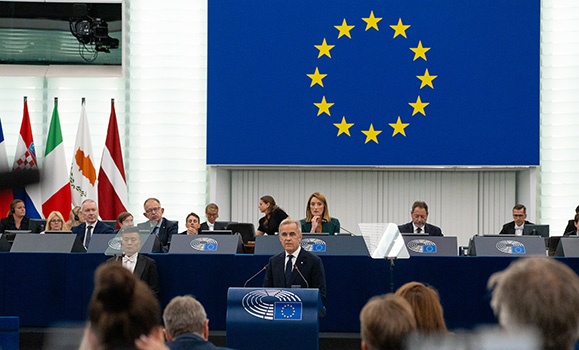
Earlier this month, the European Commission President Ursula von der Leyen made an unprecedented proposal: opening the door for Canada to become the European Union’s first ‘associate member.’
As Canada and the European Union (EU) explore closer ties, questions about what such changes could mean for trade, research and Canadians at home have risen to the surface.
Those concerns and excitements came to Dalhousie on Sept. 22 in a workshop hosted by the Jean Monnet European Union Centre of Excellence (JMEUCE). Panelists examined Canada’s evolving relationship with the EU, including the future of the Comprehensive Economic and Trade Agreement (CETA) as the country’s long-standing alliance with the U.S. gets upended.
As the timely discourse unfolded, one question demanded clarification: what would associate membership actually mean?
If associate membership were enshrined in EU treaties and ratified by all 27 member states — a process that would take considerable time — experts say the benefits could be significant. Such a relationship could expand research opportunities, ease mobility between Canada and Europe, and even bring Canada into Erasmus, the EU’s student-exchange program.
According to Dr. Jan Wouters, Jean Monnet Chair ad personam and professor of international law and international organizations at KU Leuven, the status would qualify as the highest level of partnership.
There is a caveat, says Dr. Ruben Zaiotti: associate membership “is a category that doesn’t exist yet.”
Speakers at last month's workshop. (Submitted photo)
Dr. Zaiotti, JMEUCE director and a professor of political science at Dal, says the commission appears to be proposing a new category short of full membership, though not lacking its own special benefits.
It would offer “something deeper,” he says, giving Canada “access to, among other things, a single market and deepened security cooperation.”
On trade, diversification by expanding ties with the EU may be theoretically attractive. But the existing Canada-EU trade relationship has not yet demonstrated that it can meaningfully reduce Canada's economic dependence on the U.S.
“Europe has not fully ratified CETA,” says Dr. Noah Fry, Killam Postdoctoral Fellow at Dal. “Since CETA’s provisional implementation, Canadian exports to the EU haven’t changed much. Meanwhile, EU imports to Canada have risen substantially.”
He finds this asymmetry worrying.
For Canada Strong – the federal economic and nation-building strategy intended to build a resilient economy amidst the changing global landscape — Dr. Fry argues CETA has severely complicated Buy Canadian Procurement, making it harder for the governments to prioritize Canadian companies when spending public money.
“Not every attempt at trade diversification is helpful,” he says.
Dr. Zaiotti raises concern for another controversial issue to associate membership: a loss of sovereignty over final decision making on a series of policy areas.
“If Canada joins the single market as an associate, Canadian companies could trade with the rest of Europe with no tariffs, Canadian workers could work in Europe, and so on.,” he says. However, “the rules that constitute the single market will be made in Brussels. Canada would not have a say and [would] have to accept whatever policy is decided.”
Behind the proposal sits a larger question: is Canada turning to Europe as its relationship with the U.S. becomes more uncertain?
Dr. Zaiotti says the answer is largely yes. “The push to reach a new level in terms of depth of relationship is definitely tied to what’s happening in the U.S.,” he says. “The trust between Canada and the U.S. has really lowered.”
Dr. Wouter sees opportunity for developing the long-standing partnership between Canda and the EU amidst a period of global turmoil.
“Right now, I think there is the awareness on both sides that it’s maybe a good moment to deepen that, to strengthen it, to consolidate it on so many issues of global challenges that we feel we have similar approaches that we can be complementary to.”
Canada is looking for alternatives, not just on the economic side of things.
Whether ‘associate membership’ transpires into more than a floated idea or not, the proposal shows a growing willingness on both sides of the Atlantic to engage in further discourse as uncertainty grows to the south.
“Canada is looking for alternatives, not just on the economic side of things — looking for other sources for trade, investment, and so on,” Dr. Zaiotti says, “but also politically, in terms of finding new allies that can be trusted.”
Related Stories
 Canada
New York’s governor removes DA in Cornell rape allegations, appoints AG Letitia James to take over
37 minutes ago
 Canada
Police urged vigilance after a high
37 minutes ago
 Canada
Why children in government care face a higher risk of sexual exploitation
37 minutes ago
 Canada
Canadian TV show 'Mayday' cited by passenger who thwarted Flydubai attack
38 minutes ago
 Canada
Indigenous groups given just 2 months to consult on Pacific Link pipeline designation
1 hour ago
 Canada
Toronto hospital to greatly expand permanent housing program that reduces ER visits
2 hours ago
 Canada
Suspected Ebola case at Montreal hospital turns out to be a false alarm
2 hours ago
 Canada
Trump's trade rep sounds pessimistic about deal with Canada, saying issues are 'quite difficult to resolve'
3 hours ago