
Ethiopia concludes UNESCO–Huawei project to advance technology
Ethiopia concludes UNESCO–Huawei project to advance technology-enabled secondary education
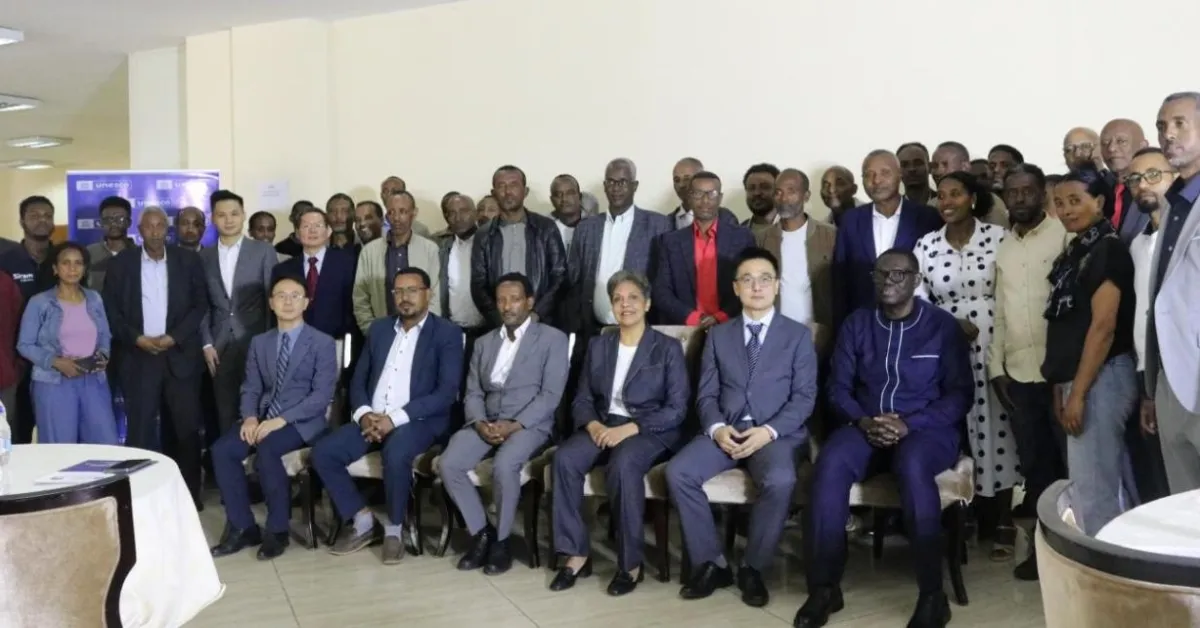
The closing event in Addis Ababa brought together representatives of the Ministry of Education, UNESCO, Huawei, educators, education technology specialists and partners to review achievements, share lessons and discuss opportunities to sustain and scale the results. Implemented by UNESCO and the Ministry of Education, with support from Huawei, the Ethiopia component formed part of Phase I of the global initiative launched in 2020 in Ethiopia, Ghana and Egypt.
The project supported schools to use technology to improve the continuity and quality of education during both normal circumstances and periods of disruption, including the COVID-19 pandemic and climate-related shocks.
Strengthening digital education and meaningful learning
In Ethiopia, the project focused on Grades 9 and 10, particularly science subjects and English, combining digital infrastructure, teacher capacity development, digital pedagogy and curriculum-aligned content. It supported 24 pilot secondary schools, reaching approximately 12,000 students and 250 educators.
In 2023, the schools received 480 tablets, 48 laptops, 48 Wi-Fi routers/access points and 24 smartboards to support technology-enabled teaching and learning. The project also developed an EdTech Training Manual and digital platform for online and offline training, with more than 350 educators trained, alongside a Digital Content Development Manual, ICT Integration/Implementation Guidelines for Secondary Schools and studies generating recommendations for technology-enabled pedagogy. An online Community of Practice enabled educators to exchange experiences and provide peer support.
A major achievement was the development of 150 multimedia-rich digital learning contents for Grades 9 and 10 in science and English, incorporating video, graphics, motion and interactive features. The content was designed to be curriculum-aligned, pedagogically sound, accurate, inclusive and accessible, while supporting scientific reasoning, experimentation and problem-solving.
At the closing event, Dr. Rita Bissoonauth, Director of the UNESCO Liaison Office in Addis Ababa, emphasized the project’s people-centred approach:
Technology should serve education, and education must remain at the centre of technology. Technology must be human-centred, inclusive, and responsive to learners and teachers.
Mr. Hu Xiaodong of Huawei similarly stressed that digital technology should help deliver quality and inclusive education regardless of location, noting that connecting schools is only the foundation for improving learning outcomes and opportunities.
The project generated practical lessons, including challenges related to multimedia expertise, electricity and mobility, that can inform Ethiopia’s continued digital education efforts. Its experience contributes to the ICT and Digital Education Strategy and Implementation Plan (2023–2028) and aligns with Digital Ethiopia 2025, the Education and Training Policy, the Ten-Year Development Plan, Education Sector Development Programme VI, SDG 4 and the African Union ICT and Digital Education Strategy. It also complements initiatives such as e-SHE and contributes to a more integrated digital education ecosystem connecting infrastructure, platforms, content, institutional systems and skills.
The Ministry of Education underscored the importance of building on these foundations through stronger national ownership, sustained collaboration and the expansion of successful approaches to other secondary schools.
With the project phase concluded, attention is turning to testing, refining and scaling its results. The 150 digital learning contents will be piloted with teachers and students, followed by quality assurance and refinement before wider deployment.
The experience will also inform further teacher capacity development, including planned support on AI in education, as Ethiopia explores the responsible use of emerging technologies.
The Ministry is also preparing to revise its Digital Education Strategy and Implementation Plan for 2026/27–2030, with priorities including expanded digital content and interactive textbooks, AI pilots, improved infrastructure and connectivity, and stronger partnerships.
UNESCO reaffirmed its commitment to supporting Ethiopia’s digital transformation while keeping learners, teachers and human development at the centre.
Related Stories
 Education
Indigenous
22 hours ago
 Education
Harvard Business School takes up Northeastern’s case for higher education
1 day ago
 Education
MI5 warns UK universities over ‘theft of tech secrets by Chinese front company’
1 day ago
 Education
MI5 warns UK academics to cut ties with Chinese group over alleged spying
1 day ago
 Education
Former IAS Divya Mittal to enter politics, wants to fix education and jobs
2 days ago
 Education
Observatory on Artificial Intelligence in Education for Latin America
3 days ago
 Education
Where do B.C.'s provincial political parties stand on SOGI in schools?
3 days ago
 Education
An estimated 200 million U.S. adults could benefit from tooth
3 days ago