
63,000 Startup Ideas Narrowed Down to 1,100 Businesses… What Round 2 of 'Startup for All' Showed
63,000 people took on the challenge of starting a business with a single idea. Among them, 5,000 passed the first hurdle, and after two months of incubation and evaluation, 1,100 advanced to the next stage. Although most of the ideas lacked revenue or legal entities, actual business results, such as attracting investment and filing patents, began to emerge during this process. The "Everyone's Startup Project," a large-scale startup experiment launched by the government for the first time this year, has moved beyond idea collection to a stage of verifying commercialization potential.
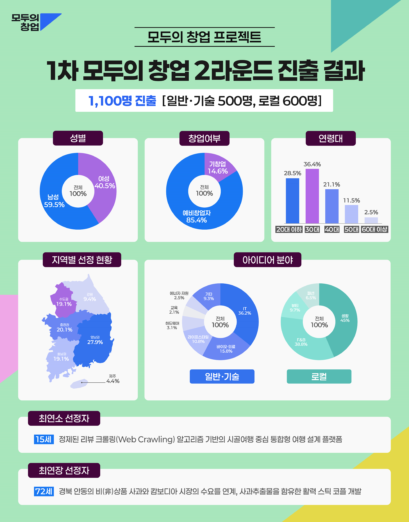
The Ministry of SMEs and Startups selected a total of 1,100 participants for the second round of the first "Startup for All" project, comprising 500 from the general and technology tracks and 600 from the local track, out of the 5,000 selected in the first round. Compared to the initial 63,000 applicants, this means that approximately 1.7% have advanced to the second round. These participants will receive support including initial commercialization funds, mentoring, regulatory screening, advanced GPUs, and cooperative guarantees, and will compete for the final 200 spots this coming December after undergoing regional auditions.
A total of 1,100 participants advanced to Round 2 of the 'Startup Project for All,' including 500 in the general and technology categories and 600 in the local category. 85.4% of the selected participants were prospective entrepreneurs, with ages ranging widely from 15 to 72. Local participants accounted for 80.9% of the total. (Source: Ministry of SMEs and Startups)
Looking at the data of the finalists for Round 2 reveals characteristics that differ from existing startup support programs. First, the age range is wide. While young people aged 39 and under accounted for the largest share at 64.9% of the total, the youngest finalist was 15 and the oldest was 72.
The idea proposed by a 15-year-old contestant is an integrated travel planning platform centered on rural travel utilizing a refined review crawling algorithm. They did not stop at the idea stage but also pursued a patent application. A 72-year-old contestant proposed a vitality stick using apples from Andong, North Gyeongsang Province, that were difficult to sell due to their low marketability, and proceeded to secure intellectual property rights and conduct consumer research. These are examples where entrepreneurship was not limited to young people or technology developers, but rather connected personal problems with local resources to business ideas.
The regional distribution is even more pronounced. 80.9% of all finalists for Round 2 came from regional areas. The Yeongnam region accounted for the largest share at 27.9%, followed by the Chungcheong region at 20.1%, the Honam region at 19.1%, Gangwon at 9.4%, and Jeju at 4.4%. The selection results reflected the nature of the project, which aims to discover a pool of startup candidates on a national scale within a domestic startup ecosystem where capital and talent are concentrated in the Seoul metropolitan area.
The influence of AI is evident in startup ideas. In the general and technology tracks, IT accounted for the largest share at 36.2%, followed by bio/medical at 15.8% and lifestyle at 10.8%. Notably, AI-related keywords were included in 43.2% of all application forms. This indicates that AI is rapidly expanding beyond the realm of some deep tech startups to become a foundational technology that prospective entrepreneurs consider from the very beginning when designing new businesses.
In contrast, in the local track, the lifestyle sector accounted for 45%, F&B 38.8%, and beauty 9.7%. With AI and IT standing out in technology startups, and sectors close to local daily life and consumption, such as lifestyle and food, in the local track, different startup landscapes were formed even within a single program.
What stands out more than the numbers is that some ideas transitioned into actual investment targets during the approximately two-month incubation process. One challenger from Seoul received 200 million won in investment from CNT Tech, an incubation institution, after being recognized for their growth potential in the AI operations management market. Another challenger from Gwangju secured 100 million won from the Gwangju Creative Economy Innovation Center based on coreless motor technology and is also pursuing a partnership with TIPS.
While it is difficult to generalize based on the results of a total of 1,100 participants, it is noteworthy that, unlike startup support that ends with business plan evaluation, incubation institutions participated from the early stages to connect ideas to the business and investment phases. For the "startup that anyone can attempt," which Everyone’s Startup emphasized from the beginning, to grow into an actual company, it ultimately becomes crucial to identify and refine marketability and technological capabilities at this stage.
Incubation institutions also took note of the diversity of the participants. Qnesty, which manages the General and Technology tracks, assessed that while existing startup support tended to discover business items that were already familiar or had proven success potential, "Startups for All" is unearthing new ideas stemming from the founders' experiences and problem-solving perspectives. The Jeonbuk Creative Economy Innovation Center, which manages the Local track, also explained that participants from diverse backgrounds—ranging from young farmers to traditional craftspeople and IT developers—combined their experiences and expertise with business ideas.
Incubators participating in the 'Startup for All Project' evaluated that the program unearthed entrepreneurs from diverse backgrounds and ideas stemming from everyday problems, which were difficult to access through existing startup support. Participants advancing to Round 2 cited the experience of refining their ideas and refining their business plans through mentoring as a major achievement. (Source: Ministry of SMEs and Startups)
In the second round, the support method also changes. The 1,100 selected participants will be provided with initial commercialization funds and mentoring, as well as support necessary for commercialization and investment attraction, such as regulatory screening, advanced GPUs, and agreement guarantees. Nationwide information sessions will begin on September 7, and the final 200 participants will be selected in December following regional auditions.
A particularly notable feature is the regulatory screening service. Before business ideas enter the market, it identifies potential conflicts with relevant laws, licenses, and regulations, and provides support to redesign the business plan itself if necessary. This approach involves first analyzing relevant laws, licenses, and compliance requirements using an AI-based regulatory screening solution, after which expert lawyers provide advice based on this analysis. The plan goes beyond simply resolving issues for individual entrepreneurs; regulations that apply to multiple challengers or significantly impact commercialization will also be utilized as targets for future institutional improvements.
The scope of startup support is also expanding beyond project participants. Starting in September, the Ministry of SMEs and Startups will launch the new "Startup Community for Everyone." It will consist of small clubs where experienced entrepreneurs share their experiences, autonomous groups formed by aspiring entrepreneurs based on their interests, and community events involving members of the local startup ecosystem. Participants are expected to include Jang Min-hong, a partner at Carbon Black and former co-founder of Lunit; Lee Dong-gun, CEO of MyRealTrip; Kim Hyung-san, CEO of The Swing; Park Hyun-ho, CEO of Kmong; Yoon Soo-young, CEO of Trevari; and Kim Do-jin, CEO of Happy Moon Day.
Everyone’s Startup started with an approach different from the method of seeking established startups from the outset. It is a method that builds a large pool of candidates starting from individuals' ideas and problem awareness, rather than their entrepreneurial experience or credentials, and then narrows down the pool to founders with business potential through phased incubation and evaluation. While the initial recruitment scale of 63,000 people demonstrated interest in entrepreneurship, the first compression process, which narrowed the pool from 5,000 to 1,100, can be seen as a stage to verify whether that interest can be converted into an actual business.
Moving forward, the more important statistic is not the number of applicants, but how many of them actually establish companies, launch products into the market, and generate investment, revenue, and employment. From a 15-year-old travel platform to a 72-year-old local produce business, and encompassing AI operations management and coreless motors, 1,100 diverse ventures are now awaiting market validation. The experiment that "anyone can start a business" has entered the next round to determine "whose ideas survive as businesses."
Related Stories
 Business
My startup worked out of 5 different spaces in a year. Here's how we found our dream office.
33 minutes ago
 Business
Vodacom, Bridge for Billions partner to boost startup ecosystem
1 hour ago
 Business
August recap: Top 10 agriculture innovation, startup, business and trend stories
1 hour ago
 Business
Student startup entries target environmental, farm challenges
6 hours ago
 Business
Nepal flooding victims to get £50,000 of support
7 hours ago
Temasek, London
8 hours ago
 Business
Council to 'better explain' vertical drinking term
9 hours ago
 Business
Ulrich Siegmund: From CDU member to AfD lead candidate
9 hours ago